Brand demand for Spanish-language UGC is climbing. The steps, the status for invoicing, rates and secure payment.
Why Spain is a good UGC market right now
Seven reasons rooted in the market itself.
Demand for Spanish-language content goes far beyond the Spanish market, which widens the client base.
Many local brands have moved to video advertising without bringing production in house.
Online commerce is growing fast, and every product page needs videos.
Production costs stay reasonable, which allows brands to order in series.
Marketplaces are heavily used, and their sellers buy content continuously.
The country is culturally close to several neighbouring markets, which makes content reusable.
And competition between creators remains lower than in English-language content.
The five steps to get started
1. Learn the format
Watch thirty adverts in your category, note their hook and their objection. The format is learned by observing what brands already run, not by reading general advice.
2. Build a portfolio of three videos
Three videos filmed on the same day, with products you own, each handling a different objection. The portfolio does not prove your talent, it proves your consistency.
3. Define your packages
One video, a batch of three, a batch of three with advertising rights. Three lines are enough, and they avoid the price question in every exchange.
4. Find your first brands
Start with those whose products you already use, then with marketplace sellers, whose decision cycle is the shortest.
5. Get paid safely
Invoice before handing over rights, deposit or secure platform, and written confirmation of what was agreed. This step is settled before the first assignment, never during it.
How to invoice legally in Spain
Seven points to check with the competent administration and with an accountant, since the details change.
The regime applicable to independent activity and the timing of registration, dealt with above.
Social contributions, their basis and their frequency.
The mandatory mentions on an invoice, including continuous numbering.
The treatment of value added tax according to the type of client.
The periodic declaration obligations, distinct from the payments.
The particular case of clients established outside the country, which follows other rules.
And the retention of supporting documents, whose duration is checked.
What to prepare before the first invoice
Six things to gather now.
Your tax identification and full professional details.
A numbered invoice template, ready to use.
A bank account separate from your personal one, which simplifies everything afterwards.
A simple document listing your prices and timescales.
An accounting contact, even for a one-off question.
And a supplier file ready to send, which structured brands request before the first payment.
What rates to charge in Spain
Seven markers for building a scale without underselling.
Systematically separating the production price and the rights price.
Invoicing the batch rather than the isolated video, which matches real demand.
Counting writing time, often longer than the shoot.
Invoicing the second version of the same video separately.
Pricing exclusivity, never granting it free.
Planning a renewal price stated from the first assignment.
And raising prices in steps after ten delivered assignments, rather than case by case.
Where Spanish brands look for creators
Seven channels, from the most direct to the slowest.
Matching platforms, where briefs are already formulated.
Searches by city and category on social networks.
Recommendations between brands, the most effective and least visible channel.
Agencies, which regularly subcontract.
Marketplace sellers, who order continuously.
Sector professional groups.
And unsolicited applications, which work well here if they contain an example visible immediately.
How to get paid without unpaid invoices
Six simple rules.
Writing down what was agreed, even after a verbal agreement.
Asking for a deposit on any first assignment with a new client.
Delivering a watermarked version before rights are paid, when the amount justifies it.
Setting a payment date and repeating it on delivery.
Using a platform that secures the payment when the client is unknown.
And stopping work at the first unpaid invoice, rather than accepting a second assignment.
The four weeks before the first order
| Week | What you do | The deliverable |
|---|---|---|
| The first | Find your shooting corner, fix the sound | A ready set |
| The second | Film three products you own | Three videos |
| The third | Write the profile, the rates, the lead time | A complete profile |
| The fourth | Answer five listings | A first order |
What blocks people most at the start
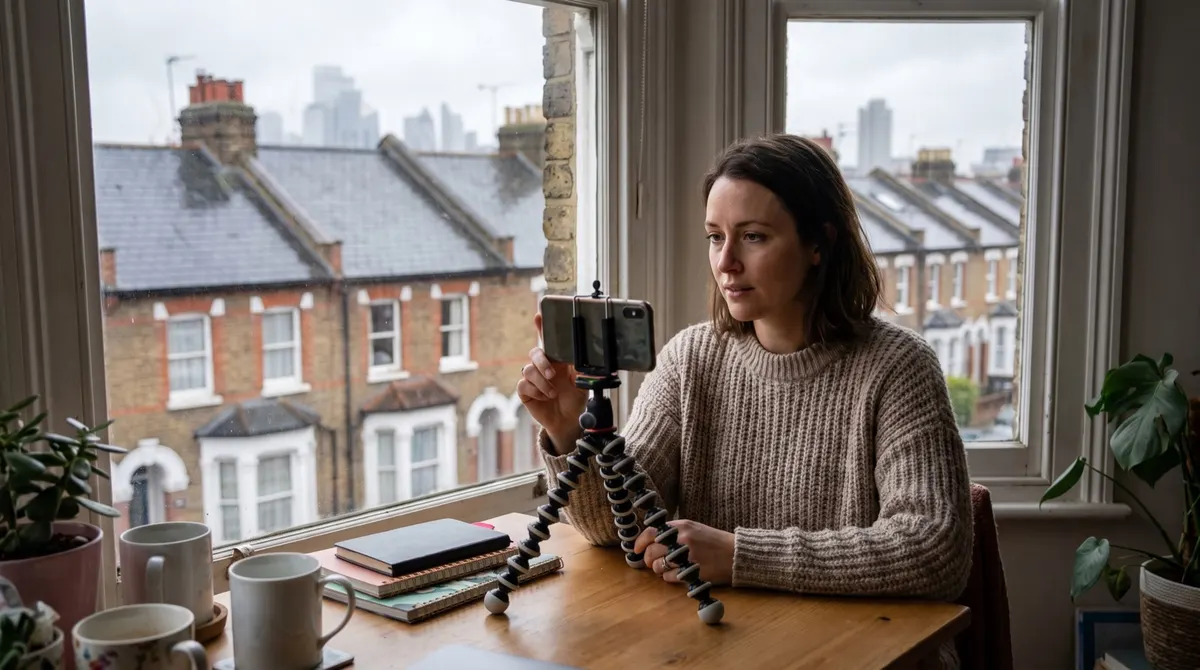
Wanting to buy gear before delivering anything. A recent phone, a window and an entry-level mic are more than enough for the first twenty orders.
What is put in order from the first income
The filing framework and the invoicing. The applicable regime, the contributions and the invoice format are confirmed with an accountant before you collect regularly.
The mistakes of the first six months
Six mistakes that cost most at the start.
Waiting to have equipment before starting, when a phone is enough.
Accepting the first assignment without writing down the rights.
Setting a low price to obtain a reference, then being unable to raise it.
Delivering without checking the requested format, which causes a redo.
Neglecting the administrative file, which blocks payment at the worst moment.
And working without a calendar, which produces full weeks followed by empty ones.
One last marker: in Spain, what distinguishes a creator who makes a living from this is neither the gear nor the talent, it is the order in which they handle things. Status, prices, portfolio, prospecting: in that order everything follows on; in any other, each step blocks the next.
Sources
- Agencia Tributaria, Spanish tax authority
- Spanish Social Security, self-employed registration (RETA)
- Ministry of Finance, Costa Rica
Checked on 26 August 2026. Thresholds and rates change: where this guide and the official source disagree, the official source is right.