Belgium has a large base of industrial manufacturers selling equipment to other businesses: packaging lines, food processing, handling, cutting, textile machinery, laboratory and process equipment. The purchase is technical, expensive and slow, and it involves several people who are not all in the same room.
That last part is the whole point, and it is what most machinery videos get wrong. The person your sales engineer met at a fair is rarely the person who decides. They are the person who forwards a link.
The video does not sell, it gets forwarded
A capital purchase moves through an organisation. Someone finds you, someone else evaluates you, a technical lead has an opinion, a finance person asks what it costs to run, and at some point a director sees fifteen seconds of something and says yes or asks a question.
Who actually watches it
Almost never the person you talked to. The real audience is the colleague who was not at the meeting, opening a link on a Tuesday with no context, no salesperson beside them and no patience.
That audience needs three things in the first thirty seconds: what the machine does, what it looks like running, and roughly what scale of operation it belongs to. A film that opens with a logo animation and a drone shot of a car park loses them before any of that arrives.
What a technical buyer is verifying
They are not being persuaded. They are checking a list, and video is unusually good at answering some of it and useless for the rest.
| What they want to know | Can video answer it | What the shot has to contain |
|---|---|---|
| Does it do the job on my product | Yes, and it is the main reason to film | The machine running on real material, not a demo dummy |
| How fast is it really | Yes | An uncut sequence long enough to count cycles |
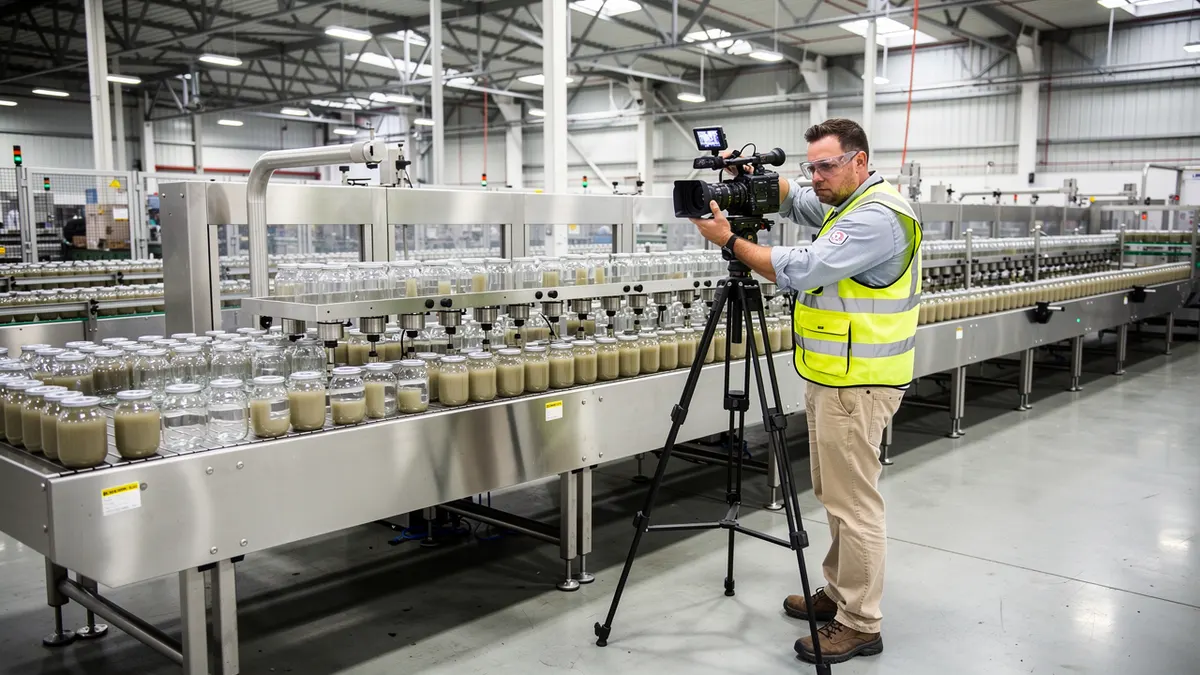
| How much space does it need | Yes | A person standing next to it, and a wide shot |
| How noisy and how clean is it | Yes, if you keep the real sound | Location audio, not a music bed |
| How do I clean and change it over | Yes, and almost nobody films it | Hands, tools, panels open, in real time |
| What does it cost to own | No | A conversation, not a film |
The fifth row is where a modest budget buys the most advantage. Changeover and cleaning are what an operations manager worries about at two in the morning, and a company that shows them is signalling that it has nothing to hide.
The demonstration is the highest-return format
One machine, one real material, one uninterrupted run. It is the least fashionable thing you can film and the most forwarded.
What ruins a demonstration
Cutting. A sequence assembled from eight angles with music over it proves nothing, because any of those cuts could be hiding a stop. A single continuous take of ninety seconds proves the machine ran for ninety seconds, and a technical viewer knows the difference immediately.
The other failure is the fake product. Running a line on cardboard blanks when the buyer packs glass jars answers the wrong question, and the buyer notices.
The sound matters more than you think
Keep it. A machine has a rhythm, and an experienced buyer hears whether it is smooth or straining. Replacing that with a music track removes evidence and reads as concealment.
Practically that means recording proper audio in a noisy hall: a microphone close to the machine rather than on the camera, and a second, quieter recording of a person speaking somewhere else entirely. Do not try to interview anyone next to a running line.
Filming in a workshop is their house
Access is the constraint that shapes the day. A production floor has rules, and none of them are yours.
Safety and access
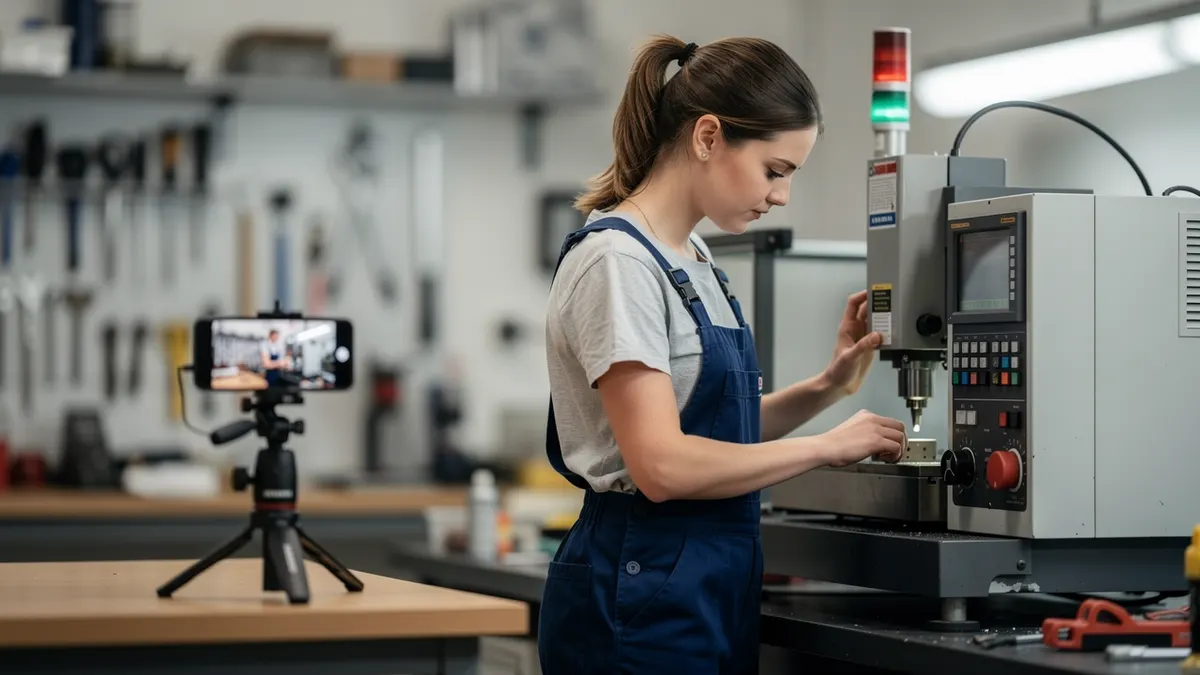
Expect a site induction, mandatory protective equipment, restricted zones, and a person assigned to walk with you the whole time. Expect also that a line will stop for a reason that has nothing to do with you and that half an hour will disappear.
The practical planning rule: budget a full day for what looks like two hours of filming, and agree in advance what can be shown. Many manufacturers have customer confidentiality on the floor, and a competitor's logo in the background of one shot can make an otherwise finished film unusable.
Export changes the edit
Most Belgian machinery companies sell abroad, often to more countries than they have languages. That has a direct consequence for how the film should be built.
Avoid voice-over as the carrier of meaning. A voice-over has to be re-recorded per language, ages badly and doubles the cost of every future update. Build the film so it works with on-screen text and real sound, and the same master serves every market with a subtitle file.
Keep the text short and factual for the same reason: it has to survive translation into languages you will not be able to check. Numbers, units and one plain sentence per idea travel; wordplay does not.
And film enough neutral material. A trade fair loop, a website header and a technical presentation are three different lengths of the same content, and they are all cheaper if the original shoot was planned for three outputs rather than one.