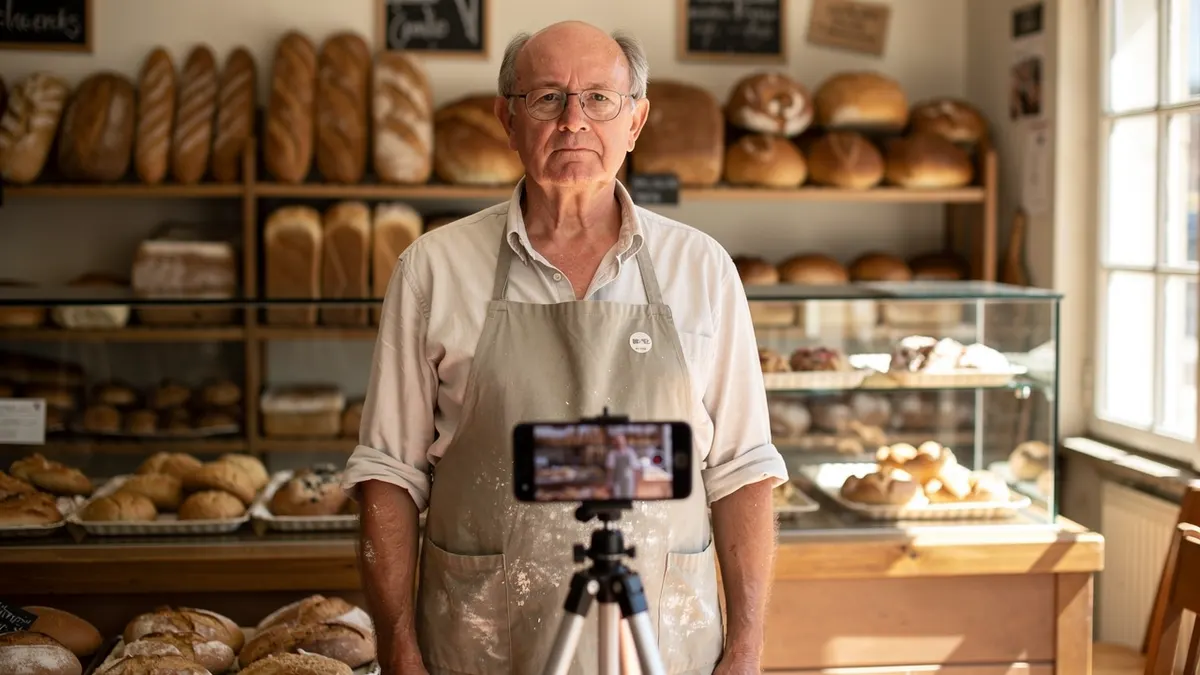
Your reflex is to say no. In a country full of owner-run businesses, that reflex costs you the one thing a competitor cannot copy.
Why yes is almost always the right answer
Three reasons, and none of them is charisma.
The local economic fabric is made of owner-run businesses: the audience knows what a boss from there looks like, and recognises one.
The person knows the product better than anybody, including its flaws, which gives details no creator could invent.
And the commitment is visible: somebody putting their name and face on a claim takes a risk the audience perceives.
One practical consequence: that video ages slowly. It stays usable for three years, while a campaign video dates within six months.
What to have them say
Four subjects, all solid.
Why the company makes this product this way, and not like the others.
What went wrong at the start, and what was corrected.
What people should know before buying, including what the product is not right for.
And what happens when something goes wrong: who answers, within what time.
Four subjects to avoid: the company's history since its founding, the thanks to the team, the values, and the comparison with competitors.
The shoot
Five rules, and they settle the essentials.
Film in the workplace, never in a meeting room.
A fixed shot, at eye level, with no camera movement.
A clip-on microphone, not the camera's: a workshop or a shop echoes.
Two takes maximum per idea: beyond that, the person listens to themselves and loses their naturalness.
And keep the noise of the place: it is what says the scene is real.
One trick that always works: start filming during the conversation before, the one where you explain what you are going to do. The best sentences are almost always said then.
Language
That is the specifically local point, and there is no way around it.
Three simple rules. The person speaks their own language, the one they work and sell in. A second version is shot with somebody else rather than having a text read in a poorly mastered language. And subtitling never replaces a version shot in the target audience's language.
One useful clarification: on commercial material, statements and labelling follow precise language rules depending on the region of distribution, checked with a lawyer before publication.
When to refuse
Three situations, and they must be named.
When the person wants to recite a text written by the marketing department: it is no longer a business owner speaking, it is a spokesperson, and the advantage disappears.
When they want to claim something unverifiable: in a regulated category, their position in the company authorises no additional claim, and that is checked with a lawyer.
And when they refuse any other participant: a campaign carried by a single face reaches a ceiling, because the audience needs to recognise itself in somebody.
What the founder's presence brings, and what it costs
| Effect | What it produces | The trade-off |
|---|---|---|
| Ownership taken | A visible commitment | An image tied to one person |
| Product knowledge | Precise answers | A sometimes too technical delivery |
| Availability | A shoot to schedule | A difficult diary |
What is prepared before putting a leader on camera
Three written questions, a test take, and one simple instruction: answer as you would a customer, never as you would a camera. The rest is cut in the edit.
What is decided before starting
How long the image will be used, and what happens if the person leaves the company. That clause is written from the first shoot, to be confirmed with a lawyer.
How to invoice it
Three lines, separate from the rest.
The preparation: a thirty-minute conversation before the shoot, which replaces a script.
The shoot itself, longer than with an experienced creator.
And the rights, with particular attention: a manager's image comes with its own questions, notably if the person leaves the company or if the company is sold. That point is planned in advance and checked with a lawyer.