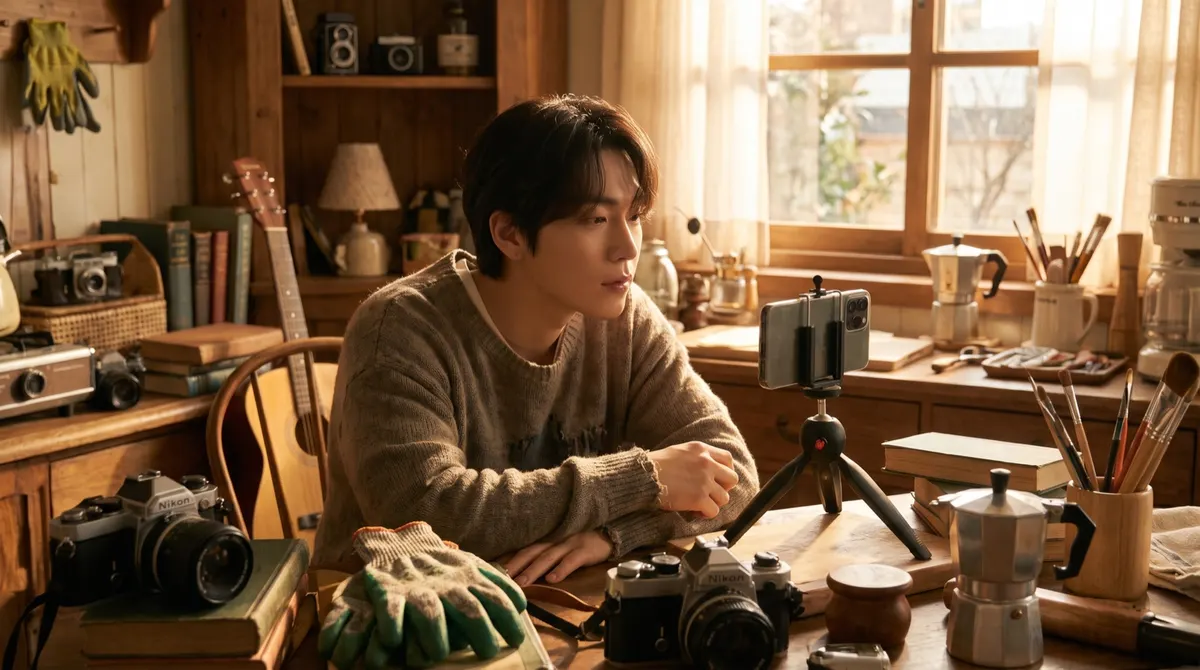
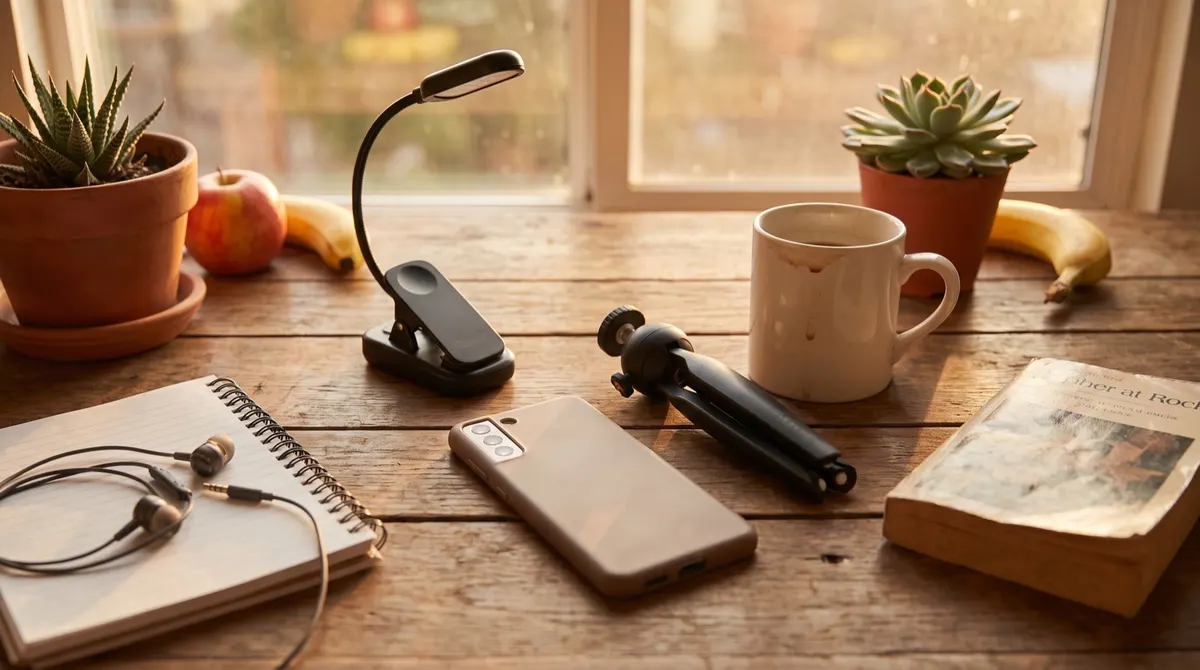
You do not need expensive kit. Here are the four things that really matter, with a zero-euro kit, a fifty-euro one and a hundred-and-fifty-euro one.
The four things that really matter
Six elements, in order of real importance.
The sound, dealt with above.
The light, free if you know your window.
Image stability, solved by a plain tripod.
The framing, which costs nothing.
Sharpness, which mostly depends on a clean lens.
And the edit, doable with free software.
Three kits, from zero to a hundred and fifty euros
Six things you already own.
A recent phone, beauty mode off.
A window, scouted at the right hour.
A stack of books to prop up the device.
A white sheet to soften the light.
A towel on the floor if the room echoes.
And free editing software.
The fifty-euro kit
Six purchases, in this order.
A wired clip-on microphone.
A small table tripod.
A phone holder.
A microfibre cloth.
A memory card or extra storage.
And an extension lead, more useful than you would think.
The hundred-and-fifty-euro kit
Six additions, once the first purchases have paid for themselves.
A wireless microphone, for shoots on the move.
A taller tripod, up to eye level.
A light panel adjustable in temperature.
A diffuser, more important than power.
A second holder for product shots.
And an external drive to archive the rushes.
Natural light, ring light or panel
Six markers for choosing.
Natural light stays the best, when it is available.
A ring light creates a circular reflection visible in the eyes.
A panel adjusts in intensity and temperature.
A diffuser softens any source.
One source beats two badly set ones.
And the hour of the shoot matters more than the kit.
Tripod or stabiliser
Six markers, depending on what you film.
A tripod covers ninety percent of videos.
A stabiliser only helps in continuous movement.
A well-framed static shot beats a blurry moving one.
A low tripod is essential for product shots.
A wall mount or a clamp often replaces an expensive tripod.
And nothing replaces simply setting the device down.
Editing with free software
Six functions are enough, whatever the tool.
Cut and join.
Burn in subtitles.
Adjust the voice level.
Export vertical and horizontal.
Recrop without losing quality.
And save a reusable template.
The gear mistakes that cost the most
Six purchases to avoid at the start.
A professional camera, useless for this format.
A ring light before a microphone.
A stabiliser for static shots.
A green screen, which gives the staging away.
A microphone too directional for an ordinary room.
And an accessory bought before delivering three videos.
How to choose a microphone
Seven criteria, from the most important to the most secondary.
The distance at which it will sit.
Compatibility with your phone, to check before buying.
The presence of a wind cover.
The cable length, if it is wired.
The battery life, if it is wireless.
How discreet it is on camera.
And the price, last.
How to test the sound before buying
Six tests, doable in ten minutes.
Record thirty seconds with the internal microphone.
Record the same sentence again with the microphone you are considering.
Listen to both on headphones, not on a speaker.
Redo the test in the room where you actually film.
Redo the test with the ventilation on.
And keep the best recording as a reference.
What to check on a tripod
Six points, often overlooked.
The real maximum height, once extended.
Stability on a soft floor, carpets included.
The weight, if you travel with it.
The type of phone mount.
The ability to shoot downwards, for product shots.
And how long it takes to set up.
How to look after your kit
Six habits that extend its life.
Clean the lens after every session.
Coil the cables without folding them.
Store the microphone in a case, not loose in a bag.
Remove the batteries from an unused device.
Avoid sudden temperature changes.
And check the mounts before every shoot.
What to borrow rather than buy
Six items, often available nearby.
A tripod, for a first attempt.
A microphone, until the need is confirmed.
A small lamp.
A neutral backdrop, a plain sheet.
A better-lit space than yours.
And a second phone, to film two angles.
What really changes the result
Six free moves, more effective than a purchase.
Wipe the lens before every session.
Move twenty centimetres closer to the microphone.
Film an hour earlier or later.
Switch off the other light sources.
Set the device down instead of holding it.
And redo a take rather than fix it in the edit.
Do brands look at your kit
No, they look at the result. No brand asks which microphone you use, but every one of them hears dirty sound and sees an unstable image. What is judged in a portfolio is consistency: three videos with the same sound level and the same light are worth more than one impressive video followed by two rough ones.
What to plug in before starting
Six checks, two minutes before the first take.
The microphone is actually detected by the app.
The input level is set, neither clipping nor too low.
The wireless microphone's battery is charged.
The phone is in flight mode.
The storage is enough for the whole session.
And a ten-second test take has been listened to.
How to buy at the right time
Six rules so you do not spend too early.
Wait until you have delivered three paid videos.
Buy what fixes an observed flaw, not an anticipated one.
One purchase at a time.
Test before buying a second of anything.
Amortise over the number of videos, not over the month.
And keep the receipt, deductions are checked with an accountant.
What you buy, and in what order
| Rank | The purchase | What it changes |
|---|---|---|
| First | A lavalier mic | Sound goes from amateur to correct |
| Second | A stable tripod | No more shaky shots |
| Third | A continuous light | Shoots no longer depend on the sun |
| Fourth | An articulated phone mount | Overhead shots become possible |
What is not a priority
A dedicated camera. A recent phone films better than what most brands broadcast, and the difference plays out in sound and light, never in the sensor.
What you replace once you earn well
The mic first, the light second. Those two wear out, break and show on screen, whereas a tripod lasts for years without weakening.
What to take for an outdoor shoot
Six items, in a small bag.
The microphone and its wind cover.
A power bank.
A cloth.
A light tripod.
A neutral change of clothes.
And a printed list of the shots to get.
One last marker: buy in this order, a microphone, a tripod, a light. The rest can wait until ten brands have paid you.