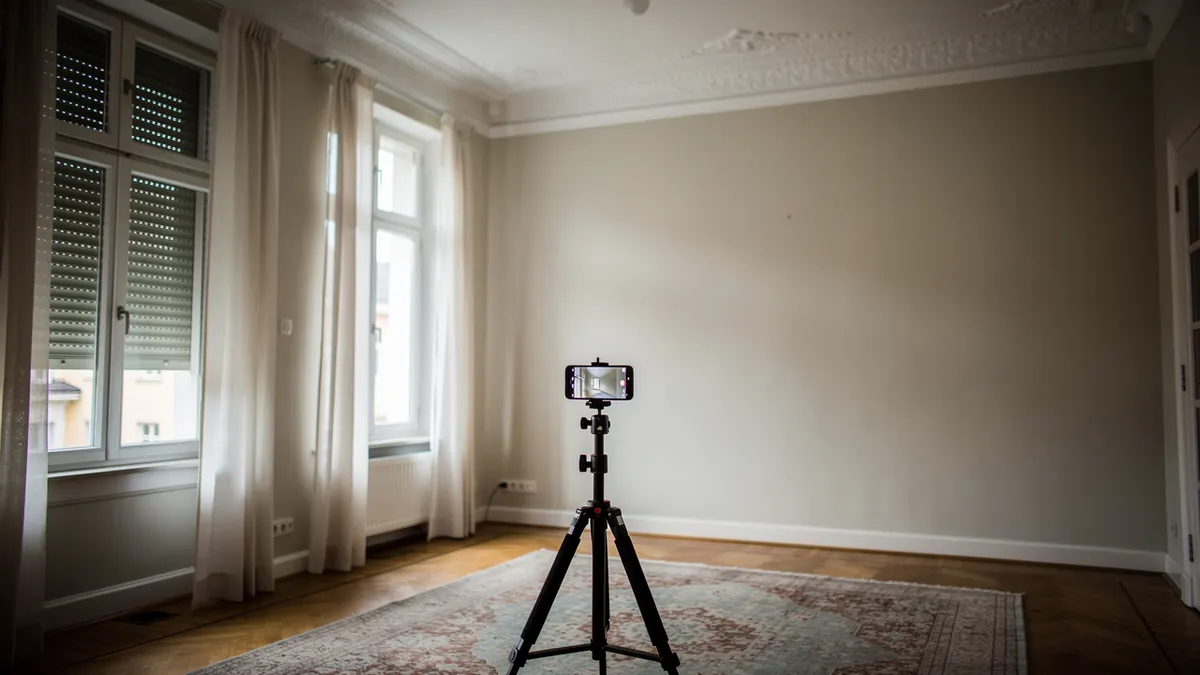
Old buildings with high ceilings, roller shutters and dark winter afternoons: how to set up and what always works.
Setting up a corner that also works in winter
That is the local constraint from November to February.
Useful natural light shrinks to a few hours, and it disappears before the end of the working day.
Four decisions that settle the season.
Choose the corner nearest the window, but never facing it.
Add a single artificial source, placed on the same side as the window, so as not to create two shadows.
Use the roller shutter as a control: half lowered, it softens light that is too direct.
And note, on the same card, the settings that worked: height, distance, shutter position, time of day.
One principle valid all year: a constant, average light is better than a beautiful one impossible to find again the following week.
Sound before picture
That is what old flats make difficult, and it decides whether the material is usable.
Large volumes, wooden floors and bare walls produce a reverberation the ear does not notice in the room and the microphone hears perfectly.
Four corrections, in order of effectiveness.
Bring the microphone closer: that step solves half the problem.
Film in the most furnished room, not the prettiest.
Add textiles: curtains drawn, a rug, a blanket placed out of frame behind the camera.
And cut what hums: ventilation, fridge, fan heater, notifications.
One test to do once: record thirty seconds of silence in the room, listen on headphones, and you will hear what the audience will hear.
The background
Three rules, and they prevent reshoots.
A neutral but inhabited background: a wall with one object, not an empty wall.
No identifiable element: a street sign through the window, mail, a family photograph, a lit screen.
And nothing dating the video: a calendar, seasonal decoration, a newspaper on the table.
One useful note: an over-tidy set is as noticeable as a neglected one. What works is a lived-in room, cleared only of what distracts.
What to prepare before pressing record
Five points, two minutes in all.
The text read aloud once, to spot the sentences impossible to say.
The product out, clean, with the packaging within reach.
The phone in flight mode, the battery above half.
A visual marker at eye level, right beside the lens.
And a first ten-second test shot, listened to on headphones before shooting the rest.
What can be fixed in an ordinary room
| Problem | The cause | The corrective move |
|---|---|---|
| Echoing sound | An empty room | Film in a furnished room |
| Tinted skin | A coloured wall | Step away from the wall |
| A busy background | Too many objects | Two metres of clear wall |
What is set up once and kept
A corner of the room marked on the floor, a lamp always in the same place, and a neutral background. That fixed set saves twenty minutes on every shoot.
What is checked before each take
The direction of the light, the mic level, the absence of personal objects in frame and of reflections in a window. Thirty seconds that avoid a full reshoot.
The routine that saves time
Three habits, held without exception.
Shoot several videos in the same session, while the setup is in place: the cost of one extra video is ten minutes.
Name the files at the end of the session, not three days later.
And keep a version with no burnt-in text at every export, systematically.
One last point specific to this market: if your home appears and is identifiable, or if another person enters the frame, plan for the corresponding permissions, and check with a lawyer what applies to your situation before delivering.