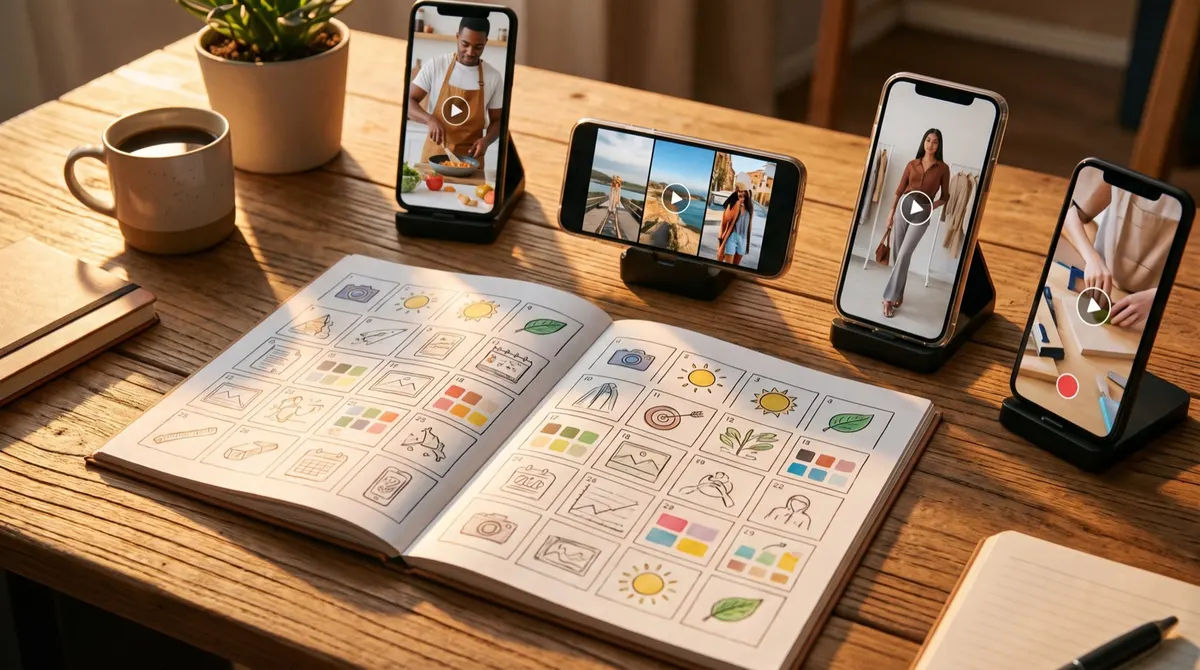

A clear brief is the video you actually wanted. Here are the sections that matter, the mistakes to avoid, and a template ready to copy.
Why the brief makes or breaks the video
Because the creator knows neither your market, nor your customers' objections, nor what your previous ads failed to do. They can only invent from what is in front of them. A vague brief produces a generic video, not from lack of talent but from lack of information. And a generic video is spotted immediately: it could sell any product in the category.
The eight sections of an effective brief
Eight blocks, in this order, never more.
The objective and the distribution platform.
The product and the key messages, ranked.
Hook ideas, given as suggestions.
The list of what to do and what to avoid.
The tone and two visual references.
The deliverables, format, duration, number of versions.
The usage rights, written down in full.
And the delivery date, with the feedback date.
A brief template to copy
1. Objective and platform
What the video must achieve, where it will run, and whether organic or paid.
2. Product and key messages
The product, its price, the main objection to remove, and three messages ranked by importance.
3. Hook ideas
Three opening-line suggestions, presented as examples and not as an obligation.
4. Do and avoid
What must appear, and the list of forbidden words, gestures and places.
5. Tone and references
Two existing videos, each with a one-line note on what to take from it.
6. Deliverables and format
The number of videos, the duration, the vertical format, the sound, and any raw files.
7. Usage rights
The media, the duration, the territory, the exclusivity, and the matching price.
8. Deadline
The delivery date, the number of revisions included, and the brand's own feedback window.
How many concepts and hooks to ask for
Six markers to avoid drowning the shoot.
One concept per video, never two.
Three hooks at most, tested separately.
A single main promise, the same everywhere.
Two possible calls to action, no more.
One mandatory product shot, freely placed.
And one version with no hook, useful in advertising.
What to write in the forbidden list
Seven mentions, often forgotten and yet decisive.
Unapproved claims about the product.
Competing brands visible on screen.
Protected music not covered by a licence.
Children, except with specific written consent.
Places where filming is not allowed.
Dangerous gestures or ones against the instructions.
And anything not in the key messages.
The classic brand mistakes
Six errors that come back almost every time.
A brief too vague, leaving everything to be guessed.
A brief too directive, which kills the naturalness.
Too many messages, six instead of three.
Usage rights forgotten, then claimed afterwards.
No visual reference, therefore no direction.
And a deadline announced without allowing for product delivery.
What the creator must receive with the brief
Six elements, in the same send.
The product, ahead of the shooting date.
The brief, on two pages maximum.
The brand files, logo and colours.
The legal mentions to display, where applicable.
The approving contact, with their hours.
And the purchase order or the accepted quote.
How to word the usage rights
Six lines that head off any later argument.
The permitted media, named one by one.
The exact duration, in months.
The territory, if limited.
The right to recrop and re-edit.
Category exclusivity, and its price.
And what happens at expiry, removal or renewal.
How to set a deadline that holds
Six simple rules.
Count from receipt of the product, never from signature.
Allow three working days minimum for shooting.
Add two days for revisions.
Announce your own feedback turnaround.
Avoid Friday-evening deliveries.
And keep a margin before the release date.
How to give useful feedback
Six habits that save an iteration.
Watch the whole video before writing.
Give feedback in one block, never across several messages.
Quote the precise timecode, to the second.
Say what works, not only what is missing.
Separate the required from the desirable.
And never ask for a change outside the original brief without paying for it.
Adapting the brief, and following through to delivery
Seven adjustments, the same video is not briefed the same way everywhere.
On a very short format, one idea and no introduction.
On a longer format, plan a second hook halfway through.
For paid distribution, ask for a version with no platform reference.
For a product page, ask for a silent version that stands alone.
For emailing, ask for a first frame legible as a thumbnail.
For a horizontal placement, plan a wider framing at the shoot.
And in every case, ask for the burnt-in subtitles separately.
The four blocks of a one-page brief
| Block | What you write in it | Length |
|---|---|---|
| The product | What it does, for whom | Three lines |
| The expected shots | The list, in order | Five lines |
| The exclusions | What must not be said or shown | Three lines |
| The deliverable | Formats, count, date, rights | Three lines |
What is missing from most briefs
Two examples of videos you like and one you dislike. Those three links remove more back-and-forth than three pages of written instructions.
What is reread before sending
One question only: could someone who does not know the product shoot from this document? If the answer is no, information is missing, not an instruction.
From brief to delivered video
On UGC MATCH, the brief travels with the order: the creator reads it before accepting, the brand pays at ordering without the funds being released straight away, the video is delivered in a private space, and payment goes out when the brand approves. The platform is free to join and has no subscription: it retains 10% of the price on the creator side, who therefore keeps 90%, and charges the brand a 6% service fee, with a minimum of 1.50 EUR.
One last marker: a good brief is judged on one thing, the number of round trips after the first delivery. If there is more than one, the gap was in the brief, not in the video.