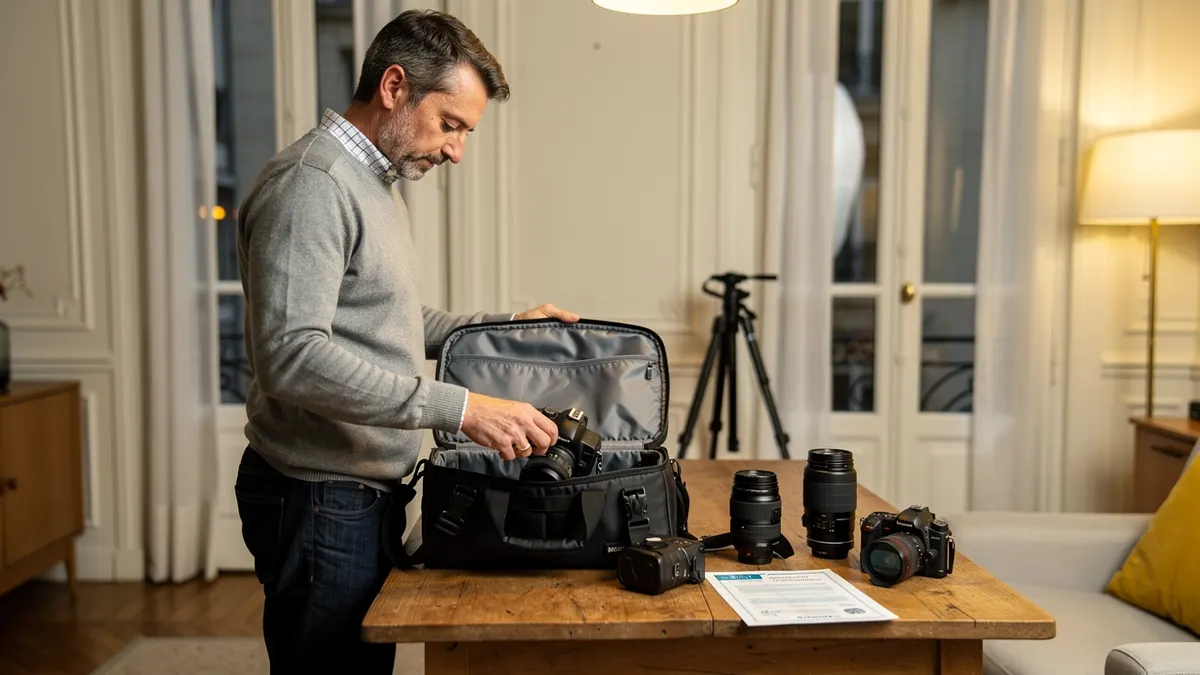
This subject bores everybody until the day a client asks for a certificate, or the day something breaks.
What can really go wrong
Four situations, all commonplace.
A client's product damaged during the shoot: a stained garment, a dropped device, a cosmetic opened and unusable.
Damage caused at a client's premises or in a rented location: a marked wall, a scratched floor, a knocked-over light.
Somebody injured during a job, including at your home.
And the less spectacular but more frequent case: a dispute about the content itself, a contested claim, an image used outside the agreed scope, a third-party complaint.
Equipment theft also happens, but it falls under a different cover, and that is where the most common confusion occurs.
The covers people talk about
Three distinct lines, often mixed up.
Professional liability, which covers damage you cause to others in the course of your activity.
Equipment cover, which covers your own gear, generally with precise conditions on place and circumstances.
And legal protection, which covers support in the event of a dispute, including for an unpaid invoice.
The exact content of each cover, the limits, the excesses and the exclusions vary between policies: they are compared line by line, not on the monthly price.
What insurance does not replace
It does not replace the written agreement.
An agreement stating the rights granted, the duration, the territory and the channels avoids the majority of disputes in this category. A signed authorisation from the people filmed avoids the other half.
Nor does it replace checking claims. What may be asserted about a product depends on the sector and is checked with a lawyer, before the shoot. Insurance does not make legal a statement that is not.
And it does not replace care on set: tidying cables, protecting surfaces, not filming alone in a risky situation.
From when it becomes necessary
Three triggers.
When you shoot somewhere other than your home: at a client's, in a shop, in a rented location.
When clients entrust you with valuable products, or with large quantities.
And when a principal asks for it. Some companies, agencies and administrations require a certificate before registering a supplier, and that request always arrives at the wrong moment.
The situations where the question really arises
| Situation | The risk | What reduces it |
|---|---|---|
| Shooting in a shop | A broken item, a fall | A written agreement and a scout visit |
| A valuable loaned product | A loss or breakage | A photographed condition report |
| Late delivery | A missed campaign | A clear deadline clause |
What to ask an insurer before signing
What is covered while shooting on someone else's premises, the ceiling, the excess and the treatment of loaned equipment, to be confirmed with a professional.
What does not replace insurance
A well-written contract limits disputes, it does not pay for the broken window. Both are useful, for different things.
The practical steps
Four stages, half a day in all.
List what you actually do: shooting locations, equipment, products received, people present.
Reread your existing policies, with the box above in mind.
Ask two or three insurers for quotes, describing the activity in concrete terms rather than by job title.
Then file the certificate with your administrative documents, next to your bank details and your invoicing statements. The day a client asks for it, you answer within the hour, and it is often that detail which decides a first order.
Sources
- Urssaf, official auto-entrepreneur portal
- Service Public, how to become a micro-entrepreneur
- Service Public, crossing the micro-entrepreneur turnover thresholds
Checked on 4 September 2026. Thresholds and rates change: where this guide and the official source disagree, the official source is right.