In this country, half the year is spent in heated, very dry air. It is that fact, and not the commercial season, that should decide what gets filmed.
Claims are regulated
That is the starting point, and it cannot be worked around.
Claims relating to effects, composition, safety, duration of action or a skin condition fall under precise rules depending on the exact nature of the product and its classification.
They are checked before the brief is written, against the applicable rules and with the competent authority, and copied from the approved labelling, never from memory.
Bilingual by default
It is not a comfort option in this category.
Labelling, statements and consumer information are subject to language requirements whose scope depends on the product and the territory. The communication accompanying them follows the same logic, and is checked before distribution.
So plan two shot versions, not one dubbed version: skin, gestures and vocabulary are told differently in each language.
Before and after demands rigour
It is the request that always comes back and the one that puts campaigns at risk.
If it is considered, it requires strict conditions: same framing, same light, same distance, no retouching, a stated duration, and a clear mention of what is not guaranteed. The rules applicable to that kind of representation are checked before the shoot.
In case of doubt, replace it with continuity: the same person, the same gesture, filmed at three moments of the season.
Variety counts for more than polish
That is what separates a campaign that works from one that pleases.
Several complexions, several ages, several skin types, several real bathrooms. One perfectly lit person says nothing to the majority of your buyers, and makes the product hard to picture.
Film under the light people have at home, not under lighting that exists nowhere.
The local calendar
It follows the heating, not the collections.
The dry period creates a concrete demand for several months: repairing, protecting, lasting all day, layering without overloading. Conversely, summer shortens routines and moves demand towards lightness and sun protection.
Shoot both moods within the year, and keep a version with no identifiable season for continuous running.
What this sector orders
| The buyer | Their typical order | Their limit |
|---|---|---|
| A skincare brand | Texture and application | No therapeutic promise |
| A retail chain | The product on the shelf | A faithful rendering of the shade |
| A salon or spa | The professional gesture | Consent from those filmed |
What makes a texture shot sellable
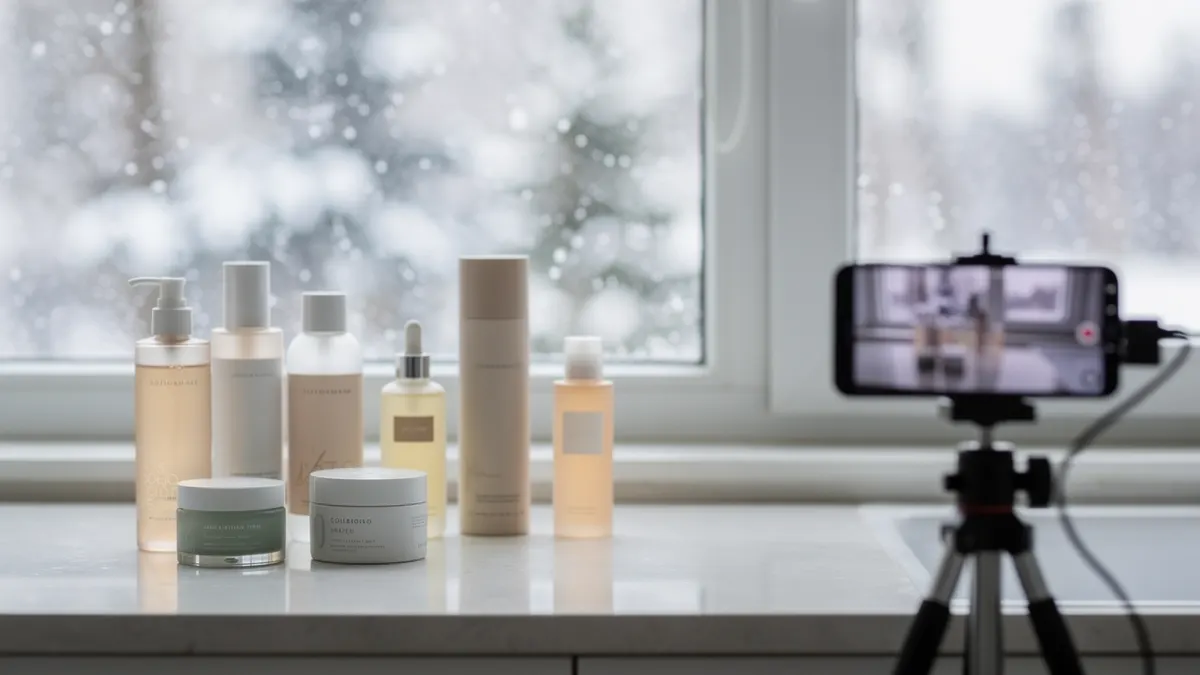
Raking light and slowness. A cream spread in close-up, filmed at reduced speed, shows the material better than any commentary, and that is the shot brands reuse most.
What is never said in a skincare video
A medical effect, a comparison with a treatment, a numerical promise about the skin. The permitted wording comes from the manufacturer, and any health question is referred to a health professional.
What is never filmed
A diagnosis, medical advice, a promise of a result, a person presented as a health professional.
The setting counts as much as the words: avoid anything evoking a clinic or a pharmacy, because the image can suggest what the text carefully avoided.
Sources
Checked on 4 September 2026. Thresholds and rates change: where this guide and the official source disagree, the official source is right.