It is an October holiday, more modest than its neighbour, centred on a meal and a long weekend. Almost all imported content arrives here a month late.
What the day really is
That is the starting point of the right tone.
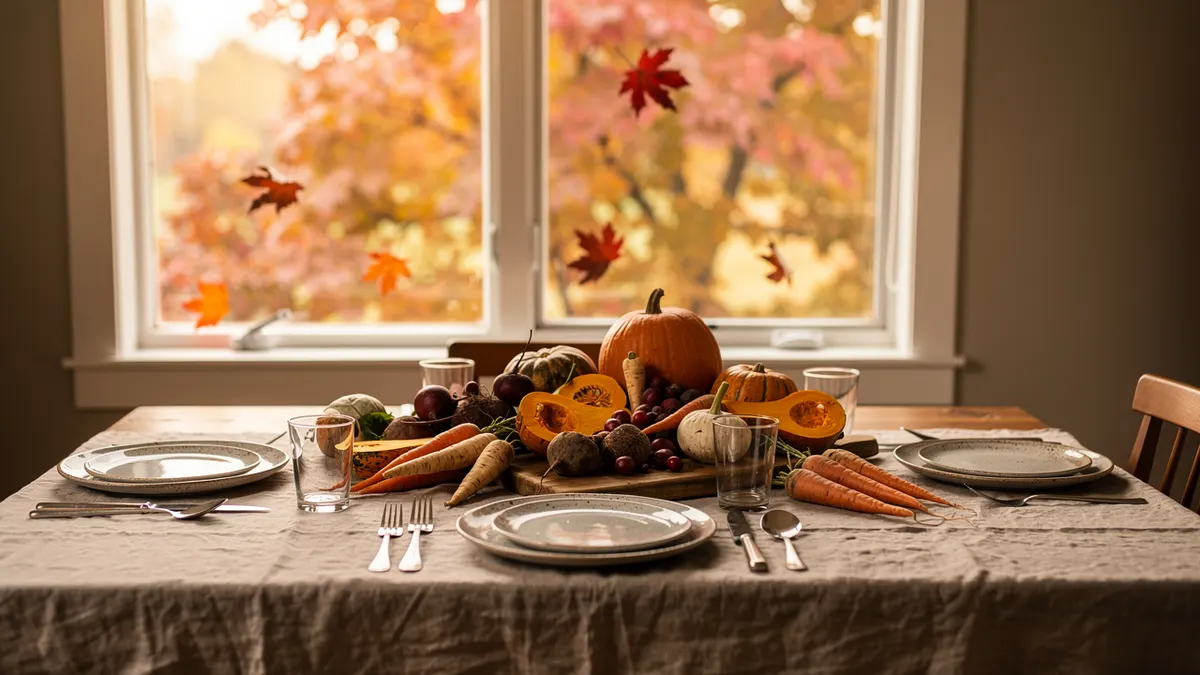
A long autumn weekend, a family meal, often outside the cities, with car journeys and weather that changes everything: possible first snow in some provinces, foliage elsewhere.
It is not a sales day. Nobody queues outside a shop, and a campaign built on discounts looks imported.
Content that works therefore talks about the meal, the journey, the house and the preparation.
What sells around it
Five categories, all concrete.
Food, obviously: the table, the cooking, the leftovers, the storage.
Transport: what is taken along, the boot, the road, the tyres depending on the province.
The house: hosting, tidying, heating, lighting, fitting twelve people around a table meant for eight.
The guest gift, which here is modest and practical.
And mid-season clothing, the only slot where it sells with no competition from the end of year.
Why the American calendar misleads
Three differences, beyond the date.
The scale: it is a family holiday, not a national commercial peak.
The day: it falls on a Monday, which makes the whole weekend the useful period, not the evening before.
And the sequence: here it does not open the end-of-year shopping season. There are six weeks before that subject becomes relevant, and filling the gap with festive content tires the audience too early.
Quebec lives it differently
That is the point national campaigns most often miss.
The day is less invested there than elsewhere in the country: the long weekend exists, the family meal too, but the symbolic weight is lower and the vocabulary differs.
A single translated campaign therefore produces a mismatch. Two options: a distinct version, centred on the autumn weekend rather than the holiday itself, or neutral seasonal content that speaks of the same period without naming the event.
The second option is often the better one, and it has an advantage: it stays publishable for longer.
What the period calls for, week by week
| Moment | What people search for | The useful content |
|---|---|---|
| Three weeks before | Organising the meal | The list and the timeline |
| Ten days before | Shopping and quantities | The size comparison |
| The day before | Last-minute moves | One preparation, in one take |
What is filmed in a real kitchen
The cluttered worktop, hands being wiped, the oven opening. A kitchen that is too tidy undermines everything else in the video.
What is checked before publishing
The quantities stated, the cooking time and the allergens mentioned. A mistake on a cooking time spreads fast and is hard to fix once the video is shared.
The realistic ambition
Three achievable goals, and one to drop.
Achievable: selling products linked to the meal and to hosting, occupying a window where advertising competition is weak, and producing content reusable the following year.
To drop: hoping for a sales peak comparable to the end of year.
Two production rules to finish. Shoot in September, with real autumn colours rather than a reconstructed set. And buy the rights until November: table and hosting content will serve again, and it is better to run it again than to remake it.