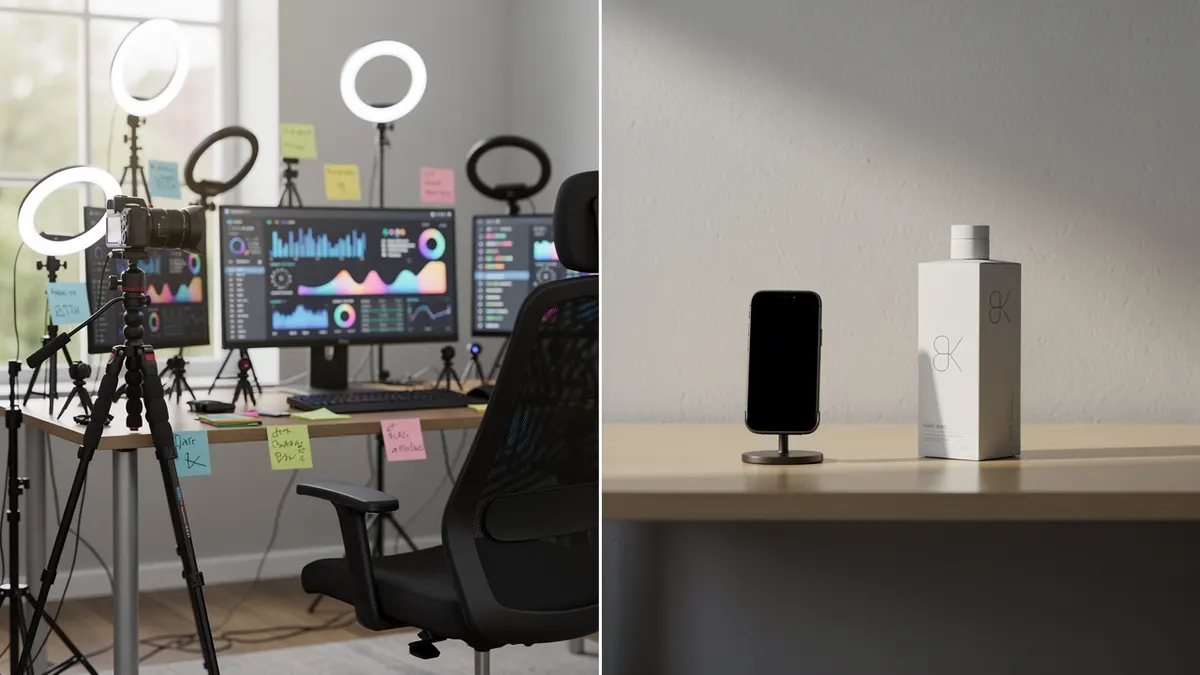
One sold footage. The other sold an audience. Same camera, same product, and only one of them knew which business they were in.
Two businesses, one camera
What you are actually selling
In the first, you sell a file and the right to use it: the brand publishes, pays for distribution, measures the result. In the second, you sell access: your community sees the post on your account, and it is that attention being bought. The equipment is identical, the gesture is identical, but the object sold is not, and nothing that follows works if the two are confused.
Why confusing them is expensive
A creator selling footage while thinking they are selling an audience underprices, because they believe their value depends on their follower count. A creator selling an audience while thinking they are selling footage accepts perpetual rights on content published from their own account, which amounts to handing over their reputation with the video. Both mistakes are paid in the same place: the line on the quote.
The British bundle, and where the money goes
What to separate on the quote
On the British market, the request almost always arrives as a bundle: three videos, sometimes with a post on your account slipped in among them. That is where the money is lost. Systematically separate four lines: the production of the files, the usage licence with its duration, any posting on your own accounts, and exclusivity if it is requested. A bundle presented as a single line is almost always invoiced at the price of the cheapest of the four.
The two cost structures
Six differences that explain everything else.
The footage business has a real marginal cost: every video requires shooting time.
The audience business has a marginal cost close to zero, but an invisible entry cost.
The first can be planned, the second is endured.
The first allows a client to be refused without consequence, the second much less so.
The first tolerates anonymity, the second assumes permanent exposure.
And the first survives a break, whereas the second pays for it for months.
Which to build
Seven questions to ask honestly, in this order.
Can I bear to publish every day, indefinitely.
Do I prefer predictable income or potentially higher income.
Do I want my face publicly associated with brands.
Can I sell to companies, or do I prefer them to come to me.
Do I need income in three months or in two years.
Does my category have a possible audience, or only professional buyers.
And do I accept that the second business depends on decisions I do not control.
How you move from one to the other
Six realistic steps.
Starting with footage, which funds the time the rest requires.
Publishing once a week without expecting a result, for six months.
Using delivered videos as material, where the rights allow it.
Measuring the audience obtained before mentioning it to a client.
Changing the commercial pitch only once the audience is genuinely measurable.
And keeping the first business, which remains the base on which the second is built.
What each business invoices
Seven lines, split between the two.
The production of the files, footage side.
The licence by medium and by duration, footage side.
Category exclusivity, footage side, priced separately.
Posting on your accounts, audience side.
How long that post stays online, audience side.
Expected results, never guaranteed, audience side.
And the advertising disclosure, mandatory on both sides, whose form is checked with the competent authority.
The signs you are in the wrong business
Six signals to recognise.
You are asked for your follower count when you sell files.
You are asked for your delivery times when you sell an audience.
You lower your prices because your account is stagnating, when the client will never look at it.
You turn down decent assignments while waiting for visibility that never comes.
You post on your account videos the brand has already paid for as files.
And you cannot answer when a client asks what is included.
Two trades, two ways of being paid
| Point | Producing for a brand | Influencing |
|---|---|---|
| What you sell | Files and rights | An audience |
| What sets the price | Use and volume | Reach and engagement |
| Where the video runs | On the brand's channels | On your own account |
What cannot be compared
The follower count. A profile with no audience can charge more than a followed account, because the brand is not buying the same thing in each situation.
What combines without conflict
Both, provided you invoice separately. A video posted on your account and the same video handed to the brand are two distinct services, and merging them means giving the second away.
Doing both without sabotaging yourself
Six rules of coexistence.
Two distinct price lists, never one.
Two different presentations, sent according to the counterpart.
A clear rule about videos posted on your account, written before the assignment.
A separate calendar, so that production does not eat publishing.
Particular vigilance about exclusivity, which touches both businesses at once.
And accepting that one funds the other for a long time, which is a normal situation and not a failure.
One last marker: in the United Kingdom the two businesses coexist without difficulty, provided they are named. What costs money is not choosing the wrong one, it is invoicing one at the price of the other for two years without noticing.
Sources
Checked on 4 September 2026. Thresholds and rates change: where this guide and the official source disagree, the official source is right.