Ghent has a large student population, a dense historic centre and more independent businesses per street than anywhere else in Flanders. It also has almost no head offices, which means almost no large marketing budgets.
That combination decides everything about how a creator works here. The city will not give you one big client that carries a year. It will give you fifteen small ones, and the ones who stay are the ones you make easy to work with.
A city of small clients, and what that changes
The maths of a small budget
A single shop, a single restaurant, a single studio. The person paying you is usually the person who owns the business and who will also be in the video, and their entire monthly marketing spend might be what an Antwerp label pays for one shoot.
That does not mean working for nothing. It means shaping the offer to what a small business can actually commit to: a smaller number of videos, delivered more often, at a price that survives being repeated twelve times.
Why repeat beats size
One thousand euros once is a client. Two hundred euros a month for a year is a business. In Ghent the second is far more available than the first, and creators who chase the first spend most of their time pitching.
The practical consequence is that the first job matters less for its fee than for whether it can become a habit. Make the process short, ask for fewer decisions, and deliver on the same day of the month every month.
The food and plant-based scene is a real specialism
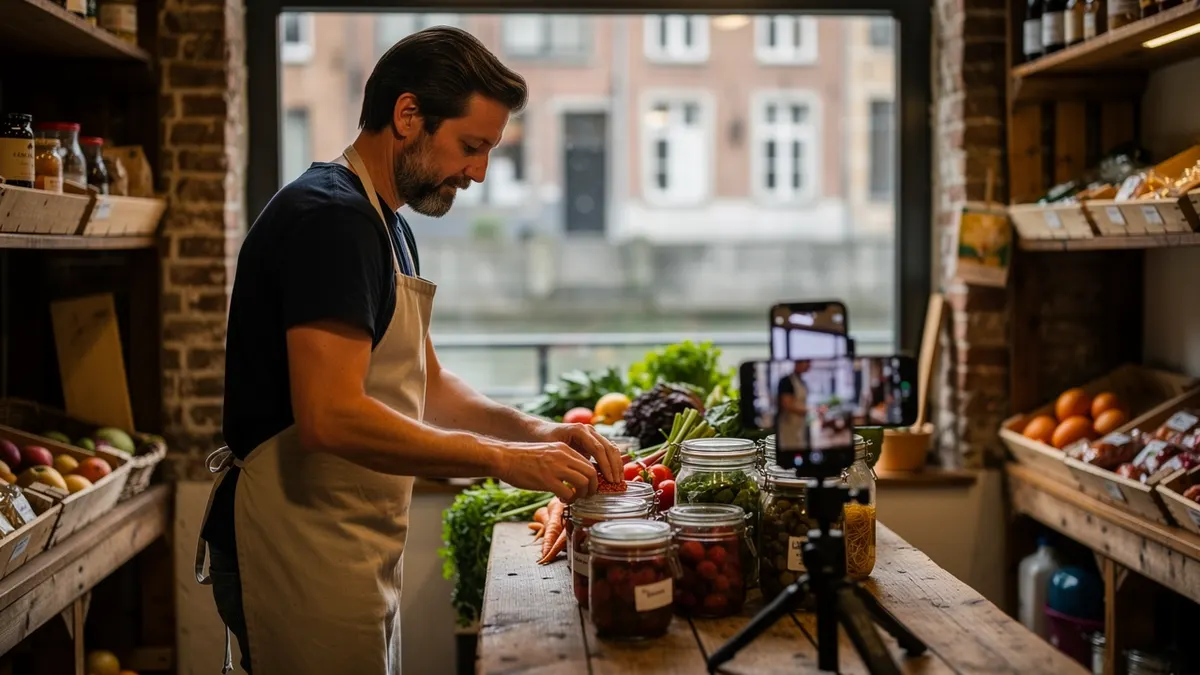
Ghent has an unusually visible vegetarian and plant-based food culture, and it goes well beyond restaurants: producers, small brands, shops, a whole layer of businesses that need food on camera.
Food is also the hardest thing most creators film badly. It moves, it wilts, it changes colour under bad light, and it looks wrong at the wrong angle. A creator here who is genuinely good at food will not run out of work, and it is a skill you can build deliberately rather than wait for.
| What the client sells | What they always ask for | What actually performs |
|---|---|---|
| A restaurant dish | The finished plate, beautifully lit | The moment it is cut, poured or steaming |
| A packaged food product | The pack held up to camera | The pack being opened and used |
| A shop or a market stall | A tour of the whole shop | One person, one product, one reason |
| A producer or a maker | The process, in full | The two seconds that look like nothing else |
The right column is what to propose when a client hands you the left. They are not opposed, and the order matters: shoot what they asked for, then shoot what will work.
The student audience moves faster than the brand
A large young audience is a real advantage: it makes the city an easy place to test formats, and the audience will tell you quickly what is dead.
It also creates a mismatch. The brand you film for often has an older idea of what a video looks like than the audience it is trying to reach, and it will ask for the format that worked two years ago.
What that asks of you
Say yes to the brief and add one alternative. Deliver the version they asked for, and one version cut the way the audience actually watches, and let the numbers settle it. That habit converts more small clients into repeat clients than any argument about trends.
Where to shoot
The historic centre is beautiful and busy, and the two are the same problem. Around Graslei and Korenlei you have the postcard, and you also have crowds from mid-morning in every month with sun.
Patershol gives narrow streets and old brick with far fewer people. The area around the docks and Dok Noord gives industrial texture and space to park a car if you have one. Student neighbourhoods around the university give ordinary, lived-in backgrounds that suit almost every small brand better than the postcard does.