Bilingual labels, regulated nutrition claims, and a grocery shelf where video decides the first purchase.
Claims have rules
Five statements to treat as prohibited by default.
Any mention of a health benefit, which follows a strict framework and authorised wordings.
Any nutritional comparison with another product.
Any claim of the sugar-free, high in, source of kind, whose use depends on precise thresholds.
Any statement about origin or production method not already appearing on the packaging.
And any recommendation addressed to a particular audience, especially children and vulnerable people.
What remains possible: saying what you did with the product, describing a taste, a texture, a use, and reading a mention appearing on the packaging without rephrasing it.
Grocery shelf or direct selling
Two situations that do not call for the same content.
In store, the video serves to make the product recognisable on a crowded shelf: the useful content shows the packaging in situation, its real size and where it sits.
In direct selling, the video has to lift the doubts of buying at a distance: keeping, quantity, delivery, exactly what is received.
One production consequence: those two uses are shot in the same session, with two different scripts and the same product.
Winter changes the category
Four seasonal switches.
Hot preparations replace the quick, cold formats.
Keeping becomes an argument, notably for deliveries.
Meals happen indoors, which changes the light and the setting.
And the festive periods move the subject towards sharing and quantities.
One note: winter is not a trough in this category, it is the most favourable season, because cooking takes a central place again.
Show the preparation, not just the plate
Five shots that sell, in order.
Opening the packaging and the real quantity obtained.
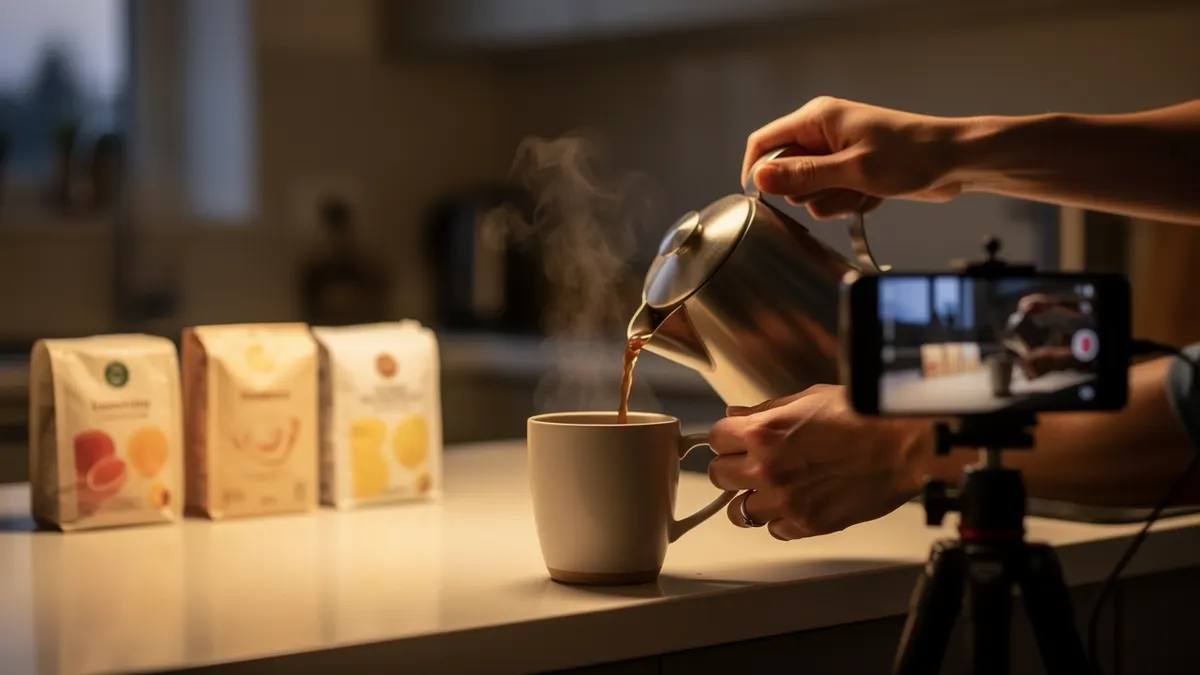
The gesture of preparing, filmed continuously and with no quick cuts.
The real time, stated and verifiable.
The texture at the moment of serving, in close-up.
And the next day: what becomes of the leftovers, a question everybody asks and nobody handles.
Bilingual content
Four production rules.
The French version is shot, it is not subtitled.
The two versions must be equivalent in content, not only in length.
The compulsory mentions appear in the language of the version.
And the packaging shots, dealt with above, serve both versions if they are filmed correctly.
What is filmed in a food chain
| Subject | What it brings | Access constraint |
|---|---|---|
| The raw material | A visible origin | Clothing and hygiene |
| The processing | Know-how and scale | Controlled-access zone |
| The packaging | The product as bought | No other batch in frame |
What protects the shoot
A hairnet, overshoes, no jewellery, and an escort who knows the zones. A shoot refused on the day costs more than half a day of preparation.
What is read on the label, never from memory
A composition, an allergen, an origin, a shelf life. Each mention is confirmed with the manufacturer, and nutrition claims are checked with the competent authority.
What to measure
Four useful indicators, and one to ignore.
The retention rate over the first ten seconds, which says whether the product is recognised.
The cost per genuinely usable video.
The lifespan of a creative before it wears out.
And the return or complaint rate, which falls when the video is honest about quantities.
To ignore: the number of views, which says nothing in a category where the purchase is decided in store.
One last marker: in food, the video that sells is not the one making the dish perfect, it is the one proving that the result obtained at home resembles the one shown on screen.