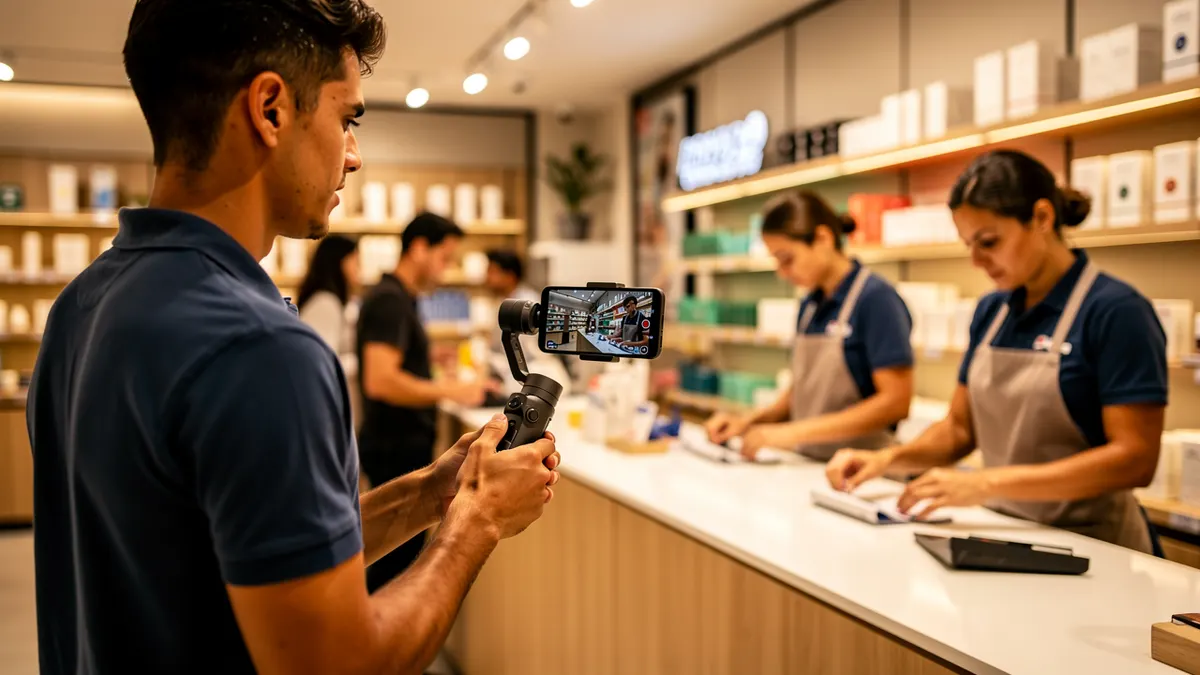
One brand, two hundred outlets, two hundred accounts. The central content almost always exists, and it almost always sits unused.
Why the brand's material goes unused
Three reasons, always the same.
It does not feel local
The country has neither a single accent, nor a single climate, nor a single purchasing power. A video shot in a large southern city plays badly in the north-east, and the audience sees it in three seconds. The franchisee knows it before clicking.
It does not match their need
Head office produces brand campaigns. The outlet needs to say it is hiring, that it opens on Sunday, that places remain, that this month's product has arrived. These are two different jobs and only one is funded.
It arrives late and is hard to find
A kit sent the day before the launch, in a folder ten levels deep, with unreadable file names, is not a kit. It is one more problem in an already full day.
The model that works
A common base, a local layer, and an update rule.
Central base, local layer
Head office funds what does not depend on the place: the product, the demonstration, the promise, the source files. The outlet adds what can only come from it: its team, its queue, its neighbourhood, its voice.
One kit per outlet
A useful kit holds four elements: two videos ready to publish, one open version to customise, the files with no text, and one page saying what to publish, where and when.
Short rules
Five prohibitions beat a thirty-page charter. What is never changed, what may always be changed, and who to write to in case of doubt.
Approved local creators
A list of creators per region, already through legal and brand approval, with a negotiated rate. The outlet picks from the list instead of searching, and head office keeps control without arbitrating every order.
One single place
A single link, readable file naming, and an expiry date visible on every campaign.
What must be in the contract
The point that derails networks.
A licence bought for the brand does not automatically cover two hundred separate legal entities, nor their own accounts, nor their paid advertising. That is written explicitly, with the list of beneficiaries, the duration, the territory and the channels.
The framework applicable to the rights granted, to the people filmed and to advertising disclosures depends on your situation and is checked with a lawyer, before distribution across the network.
What a network of outlets does differently
Six rules for multiple locations.
A template each outlet can reshoot.
A fixed order of shots.
A text field that fits the local name.
Head office approval before release.
A file name that states the outlet.
And a rights line covering every location.
Who decides what in a network
| Level | What it controls | What it cannot do |
|---|---|---|
| The head office | The charter, the messaging, approved visuals | Film in every outlet |
| The franchisee | The place, the team, the diary | Change the charter |
| The creator | The shoot and the edit | Arbitrate between the two |
What is approved before shooting
The script, the shot list and the mandatory notices, by the head office, not only by the outlet.
What is produced once and serves everywhere
An edit with no city and no price mentioned, plus a ten-second ending that each outlet can swap.
The classic mistake
Treating the franchisee as a distribution channel.
They are an internal client, with a budget, limited time and priorities that are not head office's. A kit they use is worth ten campaigns they ignore, and the only measure that counts is the number of outlets that published.
Sources
Checked on 4 September 2026. Thresholds and rates change: where this guide and the official source disagree, the official source is right.