A decorative contact lens is a medical device, and a creator who bought hers without a prescription at a Halloween store is showing something the Food and Drug Administration calls illegal. The FDA's page on decorative lenses says it in its first two sentences: all contact lenses must be prescribed by a doctor, including decorative lenses, and any contact lenses that are not prescribed by a doctor are illegal and could cause harm. The page names the lenses by their retail names, Halloween contact lenses, fashion contact lenses, colored, cosmetic, theatre lenses, and says never to buy them from a street vendor, beauty supply store, flea market, novelty store or Halloween store. For a brand that sells the eyes, the face or the costume of an American Halloween, that page and two others decide what a creator video may show.
The creative side of the season, the transformation, the before and after, the reveal, is craft this guide leaves to the brief; what a filmed account has to contain is in the guide to what a testimonial video is, and this cocoon's beauty guide covers the claim rules for cosmetics and the limits of the before and after. This guide is about the three American texts specific to Halloween products: the FDA on decorative contact lenses, the FDA on novelty makeup and its color additives, and the Consumer Product Safety Commission's flammability standard, which names costumes.
The eyes: a prescription, or nothing
What the FDA says a decorative lens is
The FDA's page states that decorative contact lenses change the look of the eyes and may not correct vision, and that they are medical devices whose safety and effectiveness the FDA oversees, just like corrective lenses. The consequence is the one the page opens with: a prescription, from a licensed eye doctor, with the brand name, the correct lens measurements and an expiration date, after an eye exam that checks the fit. The page lists the risks of lenses obtained without a prescription or used incorrectly, a cut or scratch on the top layer of the eyeball, allergic reactions, decreased vision, infection and blindness, and the signs of infection that call for a doctor at once.
What that does to a creator video
A creator who films a cat-eye or vampire look with lenses she ordered from a costume site, with no prescription behind them, has filmed what the FDA's page calls illegal. A brand that sells decorative lenses lawfully, by prescription, has a video to make and a video not to make: the one it makes shows the exam, the prescription and the fit, because those are the product; the one it does not make shows the lenses as a novelty picked up with the wig. And a brand that sells costumes or makeup, not lenses, has a line for the brief that costs nothing: no lenses in the video unless the creator has a prescription for the pair on screen. The creator program guide in this cocoon describes why the brand answers first for what a paid video shows.
The label the page tells you to believe
The FDA's makeup page makes a point about the eye area that the brief carries from lenses to paint: some products say on the label that they are not for use near the eyes, and the page says to believe this even if the label has a picture of people wearing it near their eyes. A creator's video is that picture. A brand that lets a creator draw a glow-in-the-dark line along the lash line with a product whose label says not near the eyes has made the picture the FDA warns against, in motion.
| What the video shows | The text that governs it | What the brief says |
|---|---|---|
| Decorative lenses in the creator's eyes | FDA: medical devices, prescription only; non-prescribed lenses are illegal | No lenses on screen without a prescription for that pair; a lens brand shows the exam and the fit |
| Face paint or makeup on the skin | FDA: color additives must be approved for use in cosmetics, including face paints | Every color in the ingredient list is on the FDA's Summary of Color Additives, or the product does not appear |
| Neon or glowing color near the eyes | FDA: none of the eight approved fluorescent colors is allowed near the eyes; luminescent zinc sulfide is not for near the eyes | Glow effects stay off the eye area; the label's "not for use near the eyes" is followed on camera |
| A costume, cape or gown on the creator | 16 CFR 1610, the flammability standard for clothing textiles, applies to garments and costumes finished for consumer use | Costumes sold by the brand meet the standard; the video does not stage flames next to fabric |
| A mask that covers the face | FDA: a mask can make it hard to see where you are going and watch out for cars | The reveal shows the mask; the walk to the party does not |
The face: color additives, and where they may go
The FDA's page on novelty makeup states the law in one line: color additives have to be approved by the FDA for use in cosmetics, including the color additives in face paints and other cosmetics used around Halloween, and theatrical makeup, and the FDA decides how they may be used based on safety information. A color that is allowed on fingernails or hair may not be allowed on skin, and a color allowed on most of the skin may not be allowed near the eyes. The page tells the reader to check two places, the list of ingredients on the label and the FDA's Summary of Color Additives, and says that if a color in the makeup is not on that list, the company that made it is not obeying the law.
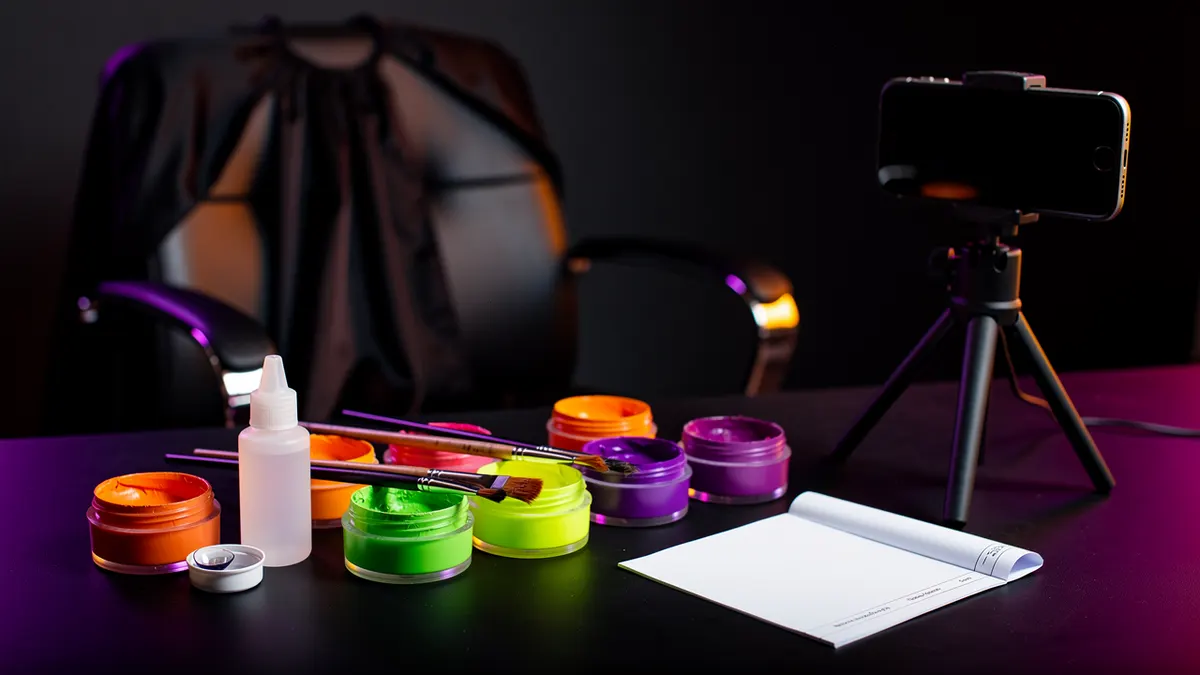
The glow effects are the Halloween shelf's own colors, and the page is specific. There are eight fluorescent colors approved for cosmetics, D&C Orange No. 5, No. 10 and No. 11, D&C Red No. 21, No. 22, No. 27 and No. 28, and D&C Yellow No. 7, with limits on how they may be used, and none of them is allowed for use near the eyes. There is one luminescent color approved for cosmetic use, luminescent zinc sulfide, approved in August 2000 for limited use, not for every day and not for near the eyes. A creator's neon eye look, filmed under black light, is the exact use the page rules out, whereas the same colors on a cheekbone, a hand or a collarbone are outside the one exclusion the page names, within the limits the Summary of Color Additives sets for each. The page also tells the reader to test a new product on the arm for a couple of days before the face, to throw away paint with a very bad smell, and not to sleep in the makeup, all of which a brand can put in the brief as the routine the video shows.
The costume: a textile with a standard
The Consumer Product Safety Commission's Standard for the Flammability of Clothing Textiles, at 16 CFR part 1610, exists, in its own words, to reduce danger of injury and loss of life by providing standard methods of testing and rating the flammability of textiles for clothing use, thereby prohibiting the use of any dangerously flammable clothing textiles. It establishes three classes of flammability and sets the requirements textiles must meet. The sentence that matters for Halloween is in its applicability clause: the requirements apply to textile fabric or related material ready for use in an article of wearing apparel, including garments and costumes finished for consumer use. The standard has exceptions, hats that do not cover the neck, face or shoulders, gloves of fourteen inches or less that are not part of another garment, footwear other than hosiery, interlinings, and it exempts certain fabrics from testing, plain-surface fabrics of 2.6 ounces per square yard or more and fabrics made entirely of acrylic, modacrylic, nylon, olefin, polyester or wool. What the exceptions do not name is a costume. The exemptions run by fabric, not by article: a costume made entirely of polyester is exempt from the testing that supports a guaranty, and it stays a textile the standard's requirements apply to. A brand that sells one is selling a textile under the standard, and a creator video that stages the costume beside a candle, a fire pit or a sparkler has staged the hazard the standard is written against. What usually stops a brand from briefing this is that the costume is the product and the flame is the mood; the standard is written about fabric, not about mood.
The brief for Halloween creator video
- No decorative lenses on screen unless the creator holds a prescription for the pair; a lens brand films the exam and the fit, not the novelty.
- Every makeup product in the video has its color additives on the FDA's list, and the brand checks the label against the list before the product ships to the creator.
- Fluorescent and luminescent colors stay off the eye area; the label's "not for use near the eyes" is followed even when the look calls for it.
- Costumes in the video are the brand's own, made to the flammability standard, and no scene puts fabric next to a flame.
- The video shows the routine the FDA's pages describe, the patch test, the removal, the mask off for the walk, because that is what the brand can stand behind.
Sources
- U.S. Food and Drug Administration, Decorative Contact Lenses for Halloween and More
- U.S. Food and Drug Administration, Novelty Makeup
- eCFR, 16 CFR part 1610, Standard for the Flammability of Clothing Textiles
Checked on 21 September 2026. This guide is not legal advice. Where this guide and the official source disagree, the official source prevails.