One sentence is enough to turn a video into a risk. But people almost always forget that the image says as much as the text, and that it is never proofread.
What cannot be asserted
Claims relating to health, treatment, prevention, cure or the effect on a condition fall under precise rules.
They depend on the exact nature of the product, its classification and its registration. They are checked before the brief is written, against the applicable rules and with the competent authority, and with a specialist in the sector in case of doubt.
One practical rule fits in a sentence: nothing that is not written on the approved packaging is said in the video, neither out loud nor on screen.
What can be recounted
A great deal, and that is what makes the category interesting.
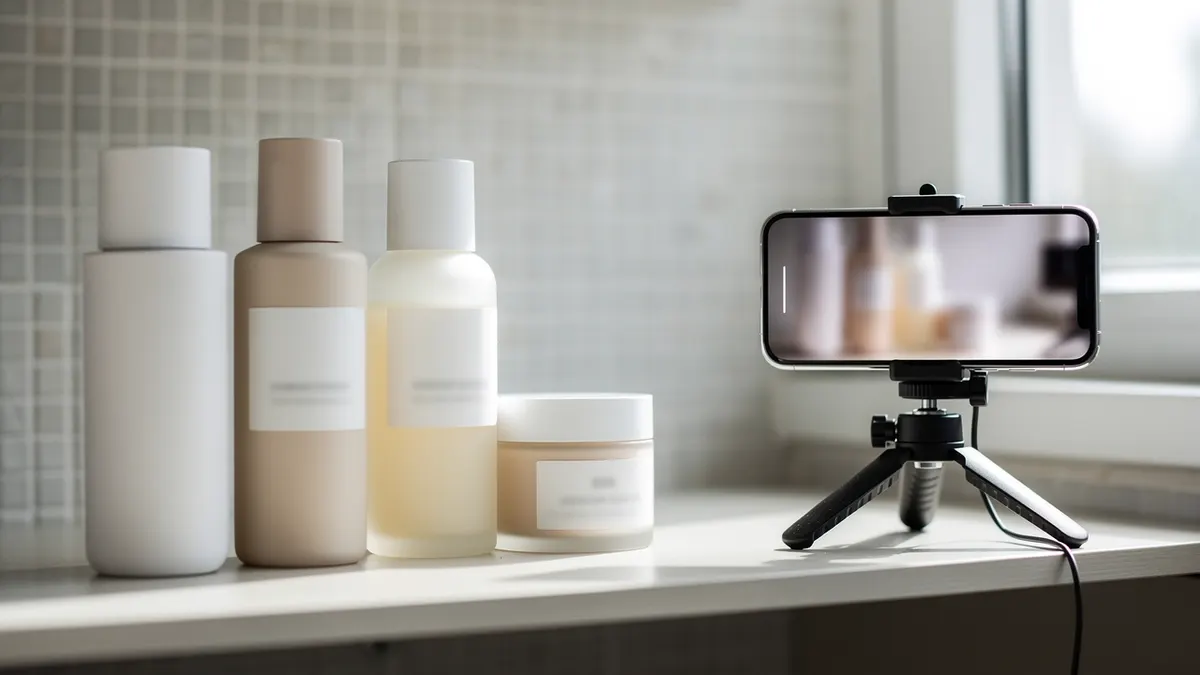
The gesture and its moment in the day. The texture, the smell, the absorption, what it leaves or does not leave on the skin. The format of the container, the pump, the cap, what breaks when travelling. The quantity used and the real lifespan of a bottle.
Those elements are observable, they constitute no claim, and they are what decides the repurchase.
Before and after demands rules
That is the request that always comes back, and the one that puts the campaign at risk.
If it is considered, it requires strict conditions: same framing, same light, same distance, no retouching, a stated duration, and a clear mention of what is not guaranteed. The rules applicable to that kind of representation are checked before the shoot.
In case of doubt, replace it with continuity: the same person, the same gesture, filmed at three moments. You are telling a habit, not a transformation.
Who speaks matters
A creator speaks in their own name, of their own experience, in the past tense and in the first person.
They never speak on behalf of a profession, give no directions for use, recommend no dosage and do not address somebody describing a symptom. The boundary is not in the subject, it is in the position of the person speaking.
The brief protects both parties
Two columns, one page, signed by both.
On the left, the authorised facts, copied from the packaging. On the right, the forbidden wordings, including spoken and improvised ones, and the objects forbidden in frame.
That document protects the brand from non-compliant communication, and the creator from a request they cannot accept.
What has to be delivered as well
Two versions, always.
A complete version and a version without the most sensitive sentence, delivered together. If an ad platform or an internal review asks for a removal, the campaign continues the same day instead of stopping for a week.
What this sector orders and what it forbids
| The buyer | Their typical order | Their limit |
|---|---|---|
| A pharmacy skincare brand | Texture and routine | No therapeutic promise |
| A pharmacy | In-aisle advice | No individual medical opinion |
| A laboratory | Explaining a use | A script approved internally |
What vocabulary changes legally
Moisturising is not treating, soothing is not curing. Permitted claims are defined by the applicable regulation, and the exact wording comes from the manufacturer, never from inspiration on the day.
What the creator should politely decline
Showing a condition, comparing with a treatment, or asserting a result on the skin. Any such question is referred to a health professional, and the video limits itself to describing a gesture and a sensation.
What to measure
Not the views.
The repurchase rate, the fall in support questions about use, and the number of returns linked to a disappointed expectation. Those are the three figures that say whether the video told the truth.
Sources
Checked on 26 August 2026. Thresholds and rates change: where this guide and the official source disagree, the official source is right.