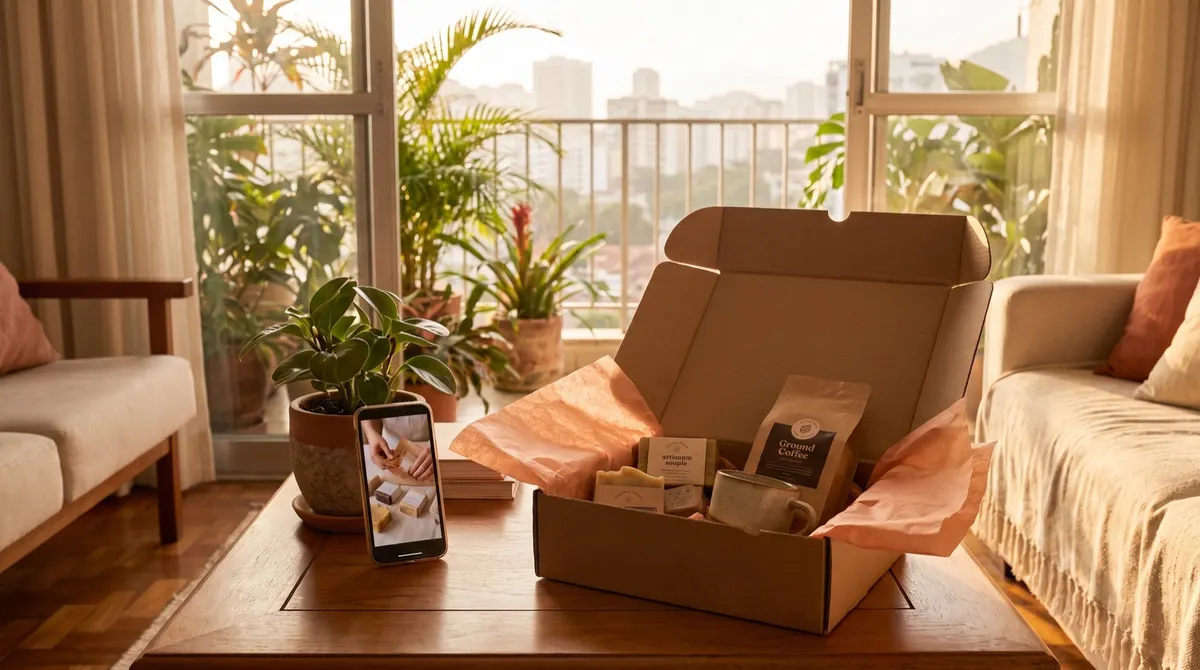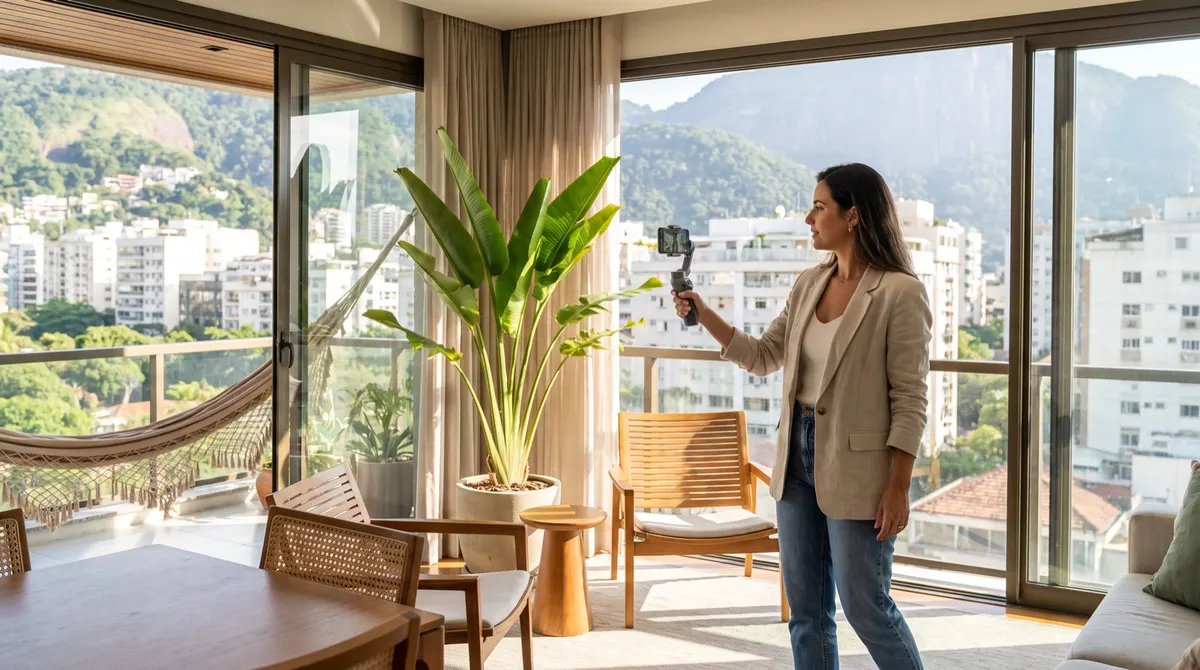
How agents, developers and proptechs in Brazil use UGC, the tour and testimonial formats, and how creators shoot them.
Why UGC works in Brazilian real estate
Seven reasons that explain the format's fast adoption.
The buyer starts the search on their phone, often while commuting.
Professional photos have become suspect from being too beautiful.
Vertical video shows real volumes, which a wide angle distorts.
Distance is an obstacle: many buyers are looking at another city, even another state.
The short-stay rental market has accustomed the public to judging a home on video.
The cost of a video stays far below that of a physical viewing arranged for nothing.
And an agent who films themselves builds a local reputation, which no listing does.
The formats that actually sell a property
Six formats, from the most useful to the most decorative.
The continuous tour, uncut, which proves no room is being hidden.
The testimonial of a neighbourhood resident, which answers the real question of a buyer from elsewhere.
A typical day in the building: entrance, lift, common areas, parking.
The objection format, where the agent handles a known weak point of the property, which increases trust.
The before and after of a renovation, for a property needing work.
And the neighbourhood tour, bakery, school, transport, shot on foot in a single take.
How creators film clean tours on a phone
Seven moves that separate a watchable tour from one people abandon.
Filming while walking slowly, phone held at chest height, two hands.
Entering each room from the doorway, to give a sense of the circulation.
Opening the curtains and switching on every light before starting.
Filming windows from inside, exposing for the room, not for the outside.
Avoiding the extreme wide angle, which suggests areas the physical viewing will contradict.
Recording the commentary separately if the street is noisy, which is common.
And ending on a static shot of the living room, which will serve as the thumbnail.
Where the content circulates: feeds, portals and WhatsApp
Five circuits, each with its own logic.
Listing portals, where video increases time spent on the page.
The agency's social accounts, where the aim is local reputation, not an immediate sale.
Paid advertising targeted by neighbourhood, which consumes variants rather than a single video.
Groups and private conversations, dealt with above, which are the real sharing vector.
And the agency's website, where the same video serves as proof of seriousness.
Who produces: the agent, a creator, or both
Seven set-ups, with their real cost and what they make possible.
The agent films themselves, which costs time but builds a local reputation nothing else replaces.
A creator shoots the tour, which gives better pacing and frees the agent for prospecting.
A neighbourhood resident records the testimonial, a format the agency cannot produce alone without losing credibility.
A creator edits rushes shot by the agent, the cheapest formula on the market and the fastest to set up.
A production team steps in for a new development, where the budget and the marketing period justify it.
The developer orders a batch of variants from several creators, to feed advertising throughout the programme.
And the agency keeps one person responsible for rights, failing which files keep circulating after the sale with nobody taking them down.
Empty or furnished: what furniture changes on screen
Six observations that often contradict intuition.
An empty home looks smaller on screen, because the eye no longer has a scale of comparison.
A furnished home gives that scale, but dated furniture ages a property that is not old.
Staging has to stay honest: whatever was removed for the shoot is stated in the listing.
An occupied property is filmed with the occupant's written agreement, which also governs access at useful hours.
Mess costs more than the flaw it hides, because it casts doubt on everything else.
And a clean floor filmed in a wide shot corrects a large part of the general impression on its own.
What is filmed in a property
| Sequence | What it proves | The rule |
|---|---|---|
| The entrance and the flow | The real volume | A continuous shot, no cut |
| A whole room | The proportions | A wide frame, never distorting |
| The exterior and the access | The surroundings | No identifiable neighbour |
What is asked before coming
The owner's written consent, no occupants during the shoot, and the removal of every personal item. An occupied property is filmed with the residents' agreement, never by tolerance.
What is never said without a document
A floor area, a survey, a charge, a building right or an energy rating. Each is read on an official document, to be confirmed with the professional holding the mandate.
Rights, licence and first steps
Seven points to settle before shooting, bearing in mind that the rules on property advertising and the display of professional details are checked with the competent authority and with a lawyer.
The owner's written authorisation to film and publish the interior.
The building's agreement for common areas, often forgotten.
The fate of visible personal belongings, to be removed rather than blurred.
The licence period, which has to cover the whole marketing period.
Removal of the video after the sale, which has to be provided for in the contract.
The distinction between production and paid distribution, invoiced separately.
And the professional details to display, whose exact nature is checked with the competent authority before first publication.
One last marker: in Brazil, an agent who publishes an honest tour, street noise included, gets fewer physical viewings but far better qualified ones. That is precisely the desired effect, because the real cost of the job is not producing the video, it is the travel for buyers who already knew, deep down, that the property would not suit them.