Long distances, departures at minus twenty and arrivals at thirty: it is a market where the product is judged on very concrete constraints, and never on a beach image.
The winter departure is the honest set
That is what distinguishes a local video from an imported one.
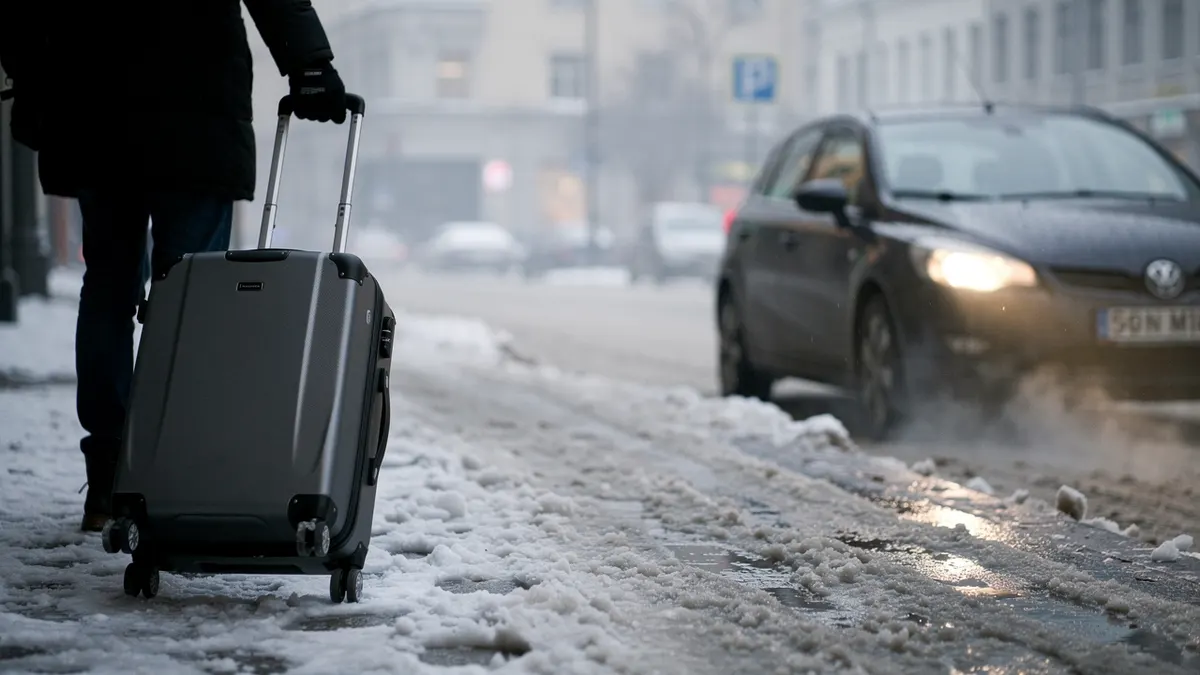
Here a trip rarely starts in the sun: it starts in a snowy car park, with gloves, a car to clear and a drive to the airport in the dark.
So film that moment: the case dragged through melting snow, the wheels jamming, the bag put into a boot, the handle gripped with mittens.
It is also the best proof of durability there is, and it costs nothing to produce, since it matches a real journey.
Airline rules are the practical question
They decide the purchase more than the style does.
Three elements come back: the cabin bag dimensions, the permitted weight, and what counts as a personal item.
Those rules differ from one airline to another and change regularly. So never quote them from memory, do not burn them into the image, and refer to the airline's site for the exact value.
What stays in the video is the demonstration: the bag fits, or it does not.
Distances change the requirement
That is the country's particularity, and it can be filmed.
A domestic trip can mean several hours of flying, a transfer, a car, then a snowy road. Equipment is handled far more often than in Europe.
So show the real wear points: the handle stitching, the zip after twenty openings, the wheels on gravel, the protection against melted water.
And add a shot nobody takes: the bag after a flight, in the baggage hall, with the marks.
The buying window precedes the season
That is what decides the production calendar.
Travel equipment is bought before departure, not during: the useful windows are therefore pre-winter, for warm destinations, and early spring, for summer holidays.
Shoot accordingly: winter departure images are filmed in January and serve the following November, with a simple change of text.
What to ask the creator for
Five deliverables, written into the brief.
The volume demonstration with real clothes, not folded towels.
The sizer test described above.
The weight said out loud, measured on screen.
A one-handed handling sequence, with a child or an extra bag in the other.
And a long take with no cut while crossing an obstacle: kerb, stairs, snow.
What a buyer wants to see before travelling
| Doubt | The shot that answers it | Length |
|---|---|---|
| What it really holds | The packing, sped up | 15 s |
| Cabin acceptance | The bag in the sizer | 6 s |
| Durability | Wheels on cobbles, the handle | 10 s |
What is filmed on a real trip
The belt, the stairs, the car boot, the waiting. A bag filmed in a studio says nothing the traveller wants to know, and it shows.
What is not promised
Compatibility with every airline, indestructibility or a guarantee. Cabin rules differ by carrier, to be confirmed with the airline.
The bilingual point
It counts more here than in other categories.
Travel is a search subject: people type questions before buying, and they type them in their own language.
So record the French version separately, with the words used locally, and give it its own title rather than a translation of the English one.
Finally check the claims: durability, warranty, waterproofing and compatibility with an airline are claims, and are checked with the brand before publication.