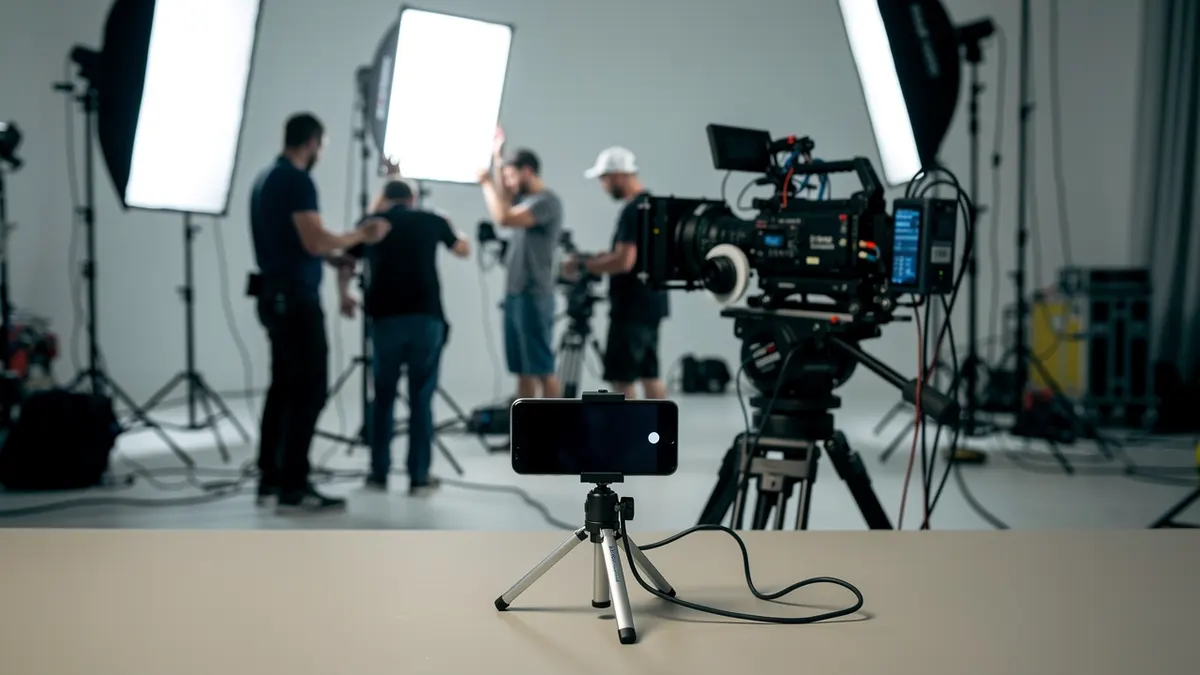
The question arises as soon as a brand needs visuals: buy from a stock library, or commission videos from real people?
In Germany the comparison is not only about the look. It is also about what each option requires beforehand.
Two models, two administrative loads
A stock image arrives with its licence already settled. You know what you may do with it, where, and for how long. That is its real value: it is immediately usable, with nothing to document.
A UGC video shows a real person. Its use therefore assumes a clear written agreement about that person's image, about the channels, the duration and the territory. That is not a formality: it is what makes the video safely publishable, and it is what is most often missing when a collaboration was agreed through messages.
The German public and legal teams pay attention to this, and a brand discovering the point after the campaign ends up withdrawing content that was working.
What stock does better
It is fast, predictable and cheap per unit. For a background, a texture, an abstract illustration, a blog visual, it remains the right tool and nobody should do without it.
It is also the only option when the subject cannot be filmed: a dangerous situation, an inaccessible place, a season that is not the current one.
What UGC does better
It shows the actual product, in an actual hand, in an interior resembling the customer's. That is exactly what a stock image cannot do, since it was produced before your product existed.
It also brings what a still image lacks: the gesture, the sound, the duration, the reaction. In advertising, that is what separates an ad people notice from one they skip.
And it ages differently. A heavily used stock image becomes recognisable and makes the brand look generic. A video shot for you exists nowhere else.
The honest calculation
Comparing unit prices makes no sense, because you are not comparing the same thing.
On one side, an immediate licence on a visual others also use. On the other, a shoot, a written agreement, a lead time, and content that exists only for you.
The right question is the use: to illustrate, stock is enough and costs less. To convince someone to buy, you need someone using the product, and no library supplies that.
The combination that works
Most brands do not have to choose. They use stock for framing and secondary visuals, and UGC where a purchase decision is at stake: the product page, advertising, answering objections.
That split has a useful side effect: it concentrates the video budget where it is measurable, and avoids paying for production for decorative use.
What each option covers
| Criterion | Stock library | Commissioned content |
|---|---|---|
| Lead time | Immediate | A few days |
| Real product | No | Yes |
| Exclusivity | None | Negotiable |
What combines without trouble
A purchased background and a product shot filmed at home: the edit holds if the light and the colour match.
What demands your own footage
A claim to prove, packaging to show, a person who resembles the target customer.
What to ask for in both cases
For stock: the exact scope of the licence, and whether it covers paid advertising, which is often excluded from the cheapest offers.
For UGC: the written agreement on the person's image, the duration, the channels, and the original file rather than a recompressed send. In both cases these are the same questions, asked of two different suppliers.