A homeowner choosing a plumber is not running a procurement exercise. They are deciding whether to give a stranger a key, a working day and access to the room where their children sleep.
That decision is made on trust, and it is usually made from a photograph of a van and three reviews. The trades that appear in video win it before the quote is even sent, and almost none of them do.
The customer is buying a person, not a price
Ask any homeowner what went wrong last time and you will not hear about money. You will hear that nobody turned up, that the job was left half finished, that the mess stayed for a week, that the person did not explain what they were doing.
What actually reassures
Four things, and all of them are filmable in the course of a normal day.
The face of the person who will knock on the door. The state the property is left in. Someone explaining a decision in plain language rather than trade shorthand. And evidence that the same firm has done this exact job before, on a house that looks like this one.
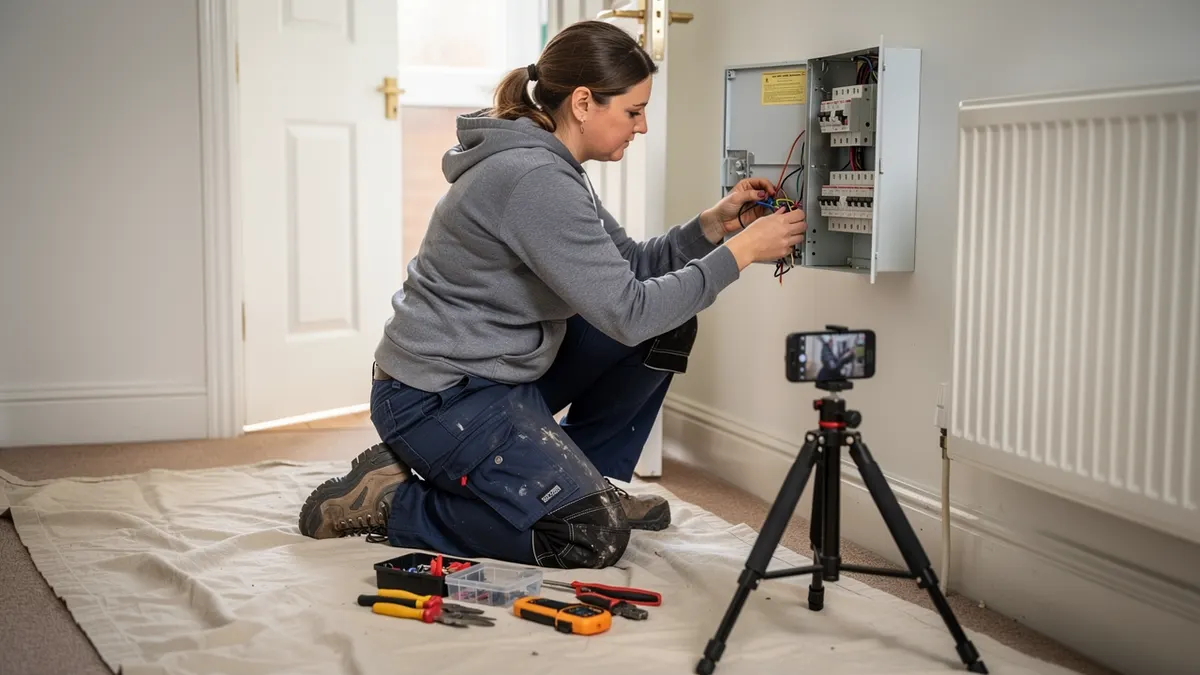
None of that requires a script or a studio. It requires a phone, and the discipline to film for two minutes on a job you were doing anyway.
Before and after is the entire format
Every trade already produces the strongest content format there is and throws it away. The bathroom before, the bathroom after. The roof with three slipped tiles, the roof finished. The consumer unit from 1974, the consumer unit today.
The four shots that make it work
Wide before, from the doorway, taken before anything is touched. A close shot of the actual fault, because that is what proves the diagnosis. A shot of the work in progress, hands and tools, which is what makes it real rather than staged. Wide after, from the same doorway, at the same height.
The same doorway and the same height are what turn two photographs into a result. Move the camera and the viewer sees two different rooms.
The price question, answered on camera
Trades avoid pricing in public, and the avoidance is what makes customers assume the worst.
| What the customer searches | What most trades post |
|---|---|
| How much to replace a boiler | A photo of a finished boiler |
| Why is my electrician charging a call out fee | Nothing |
| Do I need a rewire or just a new fuse board | A five star review screenshot |
| How long will my bathroom be out of use | A van with a new logo |
| Is this quote too high | A discount offer |
The left column is what people type at eleven at night when something has failed. Answering it is not giving away your prices: it is explaining what makes a job cheap or expensive, which is exactly the conversation that ends with a customer who does not haggle.
A short piece explaining why two boiler quotes can differ by a thousand pounds will out-perform every finished-job photo you ever post, because it is the question your customer is actually afraid to ask.
Where a trade’s video is really seen
Not where most people assume.
Google is the platform, social is the reinforcement
Somebody with a leak searches. They do not scroll. The video that matters most is the one attached to your Google Business Profile and your reviews, followed by the one embedded on the page about that specific service.
Social video still does work, but it does a different job: it is what a customer watches after they have found you, while deciding whether to call. Treat it as the reassurance layer rather than the discovery layer, and the content you make changes accordingly.
The practical order is: film the job, put the strongest before and after on your profile and your service page, and use the offcuts for social. Most trades do exactly the reverse and wonder why the phone stays quiet.