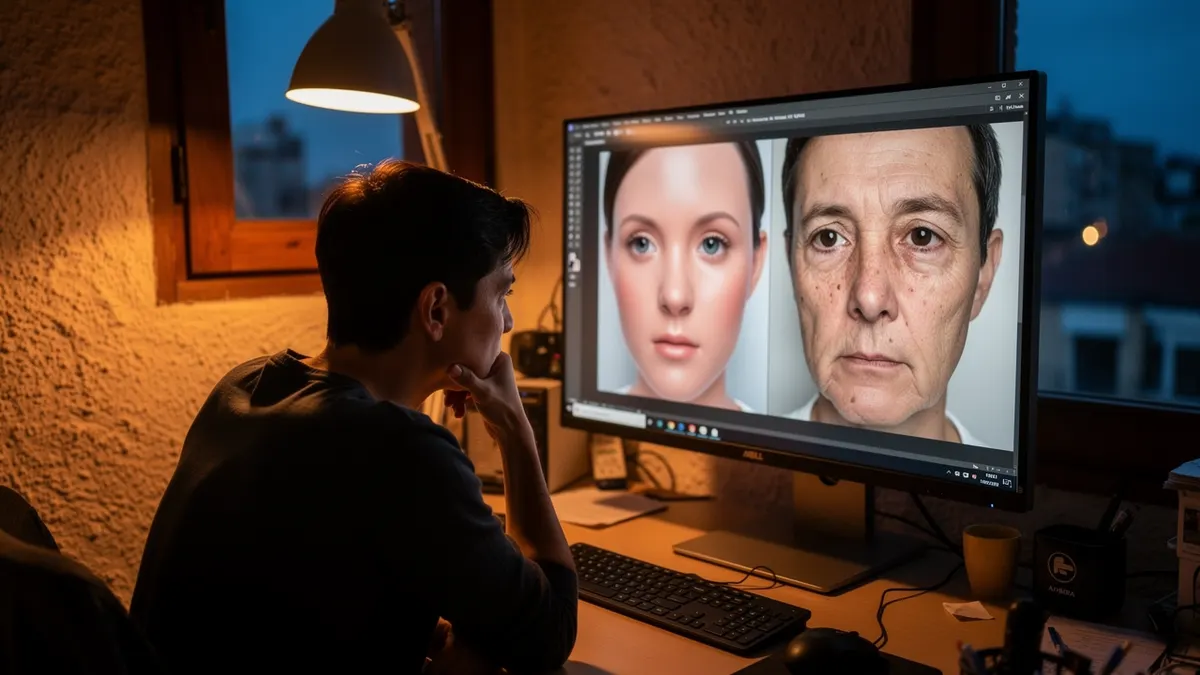
The question is no longer whether a generated video is feasible. It is, it costs little, and it comes out in minutes.
The real question is elsewhere: does it speak to the person you are addressing. In Spain, that is where most of these videos give themselves away.
What is noticed first is not the image, it is the language
A synthetic voice in Spanish almost always comes out in a pan-Hispanic register, the one that must be understood everywhere and belongs nowhere.
A Spanish audience hears it within a sentence. The collective informal address disappears in favour of a form that sounds administrative, everyday vocabulary is replaced by correct equivalents that are not said here, and the music of the sentence matches no region.
The viewer does not think "this is artificial intelligence". They think "this is not for me", and they move on. The result is the same, and it is harder to diagnose.
What generation does well
Rejecting it outright would be absurd. It is excellent for whatever has no body.
A background, an animation, a map, on-screen text, a format variant, a colour variation, a test of ten hooks before deciding which deserves a shoot. There it saves time and money, without promising anything false.
It is also useful to prepare a real shoot: showing the creator what you have in mind costs less in generated images than in rounds of brief revisions.
What it does not do
It cannot show your product in a real hand. It never held it, and the gesture is missing: the way a texture spreads, a clasp resists, a fabric falls.
Nor can it say "I have been using it for three months". That is not a technical limit but a limit of truth: nobody used it.
Yet that sentence is precisely what makes people buy. Content imitating confidence without the experience behind it produces an unease the viewer cannot name, which shows up as a drop in attention.
The disclosure question
Presenting a generated video as a customer testimonial is a false statement about the product, whatever the quality of the render.
Obligations to indicate that content is generated are evolving, and they are not identical across media and messages. For what applies to your case, the competent authority or your adviser remains the reference; what does not move is that a brand caught passing a generation off as a customer loses more than the campaign.
The split that works
Keep generation for framing, variants and tests. Keep real shooting for the moments when someone has to be believed: the demonstration, the opinion, the answer to an objection, the before and after.
That split has a measurable side effect: it concentrates the shooting budget where it changes a purchase decision, and stops spending it on illustrative shots a generated image supplies for nothing.
What each option allows
| Criterion | Generated video | Real creator |
|---|---|---|
| Identifiable person | No, or with consent | Yes, with written consent |
| Product held in hand | Simulated | Filmed |
| Proof of use | No | Yes |
What must be disclosed
Any generated image presented as a testimonial, any cloned voice, any scene that never happened.
What stays out of reach of a generator
The clumsy gesture that makes it credible, the real texture of a material, the reaction of an animal or a child.
What to check before publishing
That the language is the one of the target region, including everyday words. That nothing in the video suggests a person tried the product if nobody did. And that the short version, the one seen first, holds without sound: that is where the flaws of a generation show most.