The Argentine rule on alcohol advertising is not about strength, or broadcast hours, or how long a shot may last. It is about four associations that cannot be made, and two sentences that have to be there.
That simplifies the work far more than it sounds: an alcohol script is reviewed by looking for those four things, and if none of them appears and both legends are present, the piece passes. What complicates it is that three of the four are ordinary narrative devices, not obvious mistakes.
The four associations the law prohibits
Article 6 of Law 24.788 lists what advertising for alcoholic drinks may not do. These are content prohibitions, not format ones.
Performance
You cannot suggest that drinking improves physical or intellectual performance. It is the easiest one to break without noticing, because it does not require saying it: showing it is enough.
The glass before going out to play, the toast that precedes the brilliant idea, the "this wakes me up" said as a joke. All of it builds the association the rule names, even though nobody claims anything.
Sexuality and violence
Nor can consumption be used as a stimulant of sexuality or violence. On video this almost always arrives through editing: the sequence that goes from the drink to the encounter, or from the drink to a fight treated as fun.
The practical test is to ask what causal relation the order of the shots suggests. If the drink comes first and the result after, the association has been made.
Minors, on screen and as an audience
There are two distinct prohibitions worth keeping apart. One is using people under eighteen drinking in the piece. The other is that the advertising be directed at people under eighteen, which is decided by the whole: who speaks, how, in what format and to whom it is shown.
The second is the hardest to control from the shoot, because it depends on media decisions the creator does not make. Which is why it gets asked before accepting.
The two legends, which are the part people forget
Everything above is what cannot be done. This is the only positive obligation, and the one most often missing.
Advertising for alcoholic drinks must carry the legends "Beber con moderación" and "Prohibida su venta a menores de 18 años".
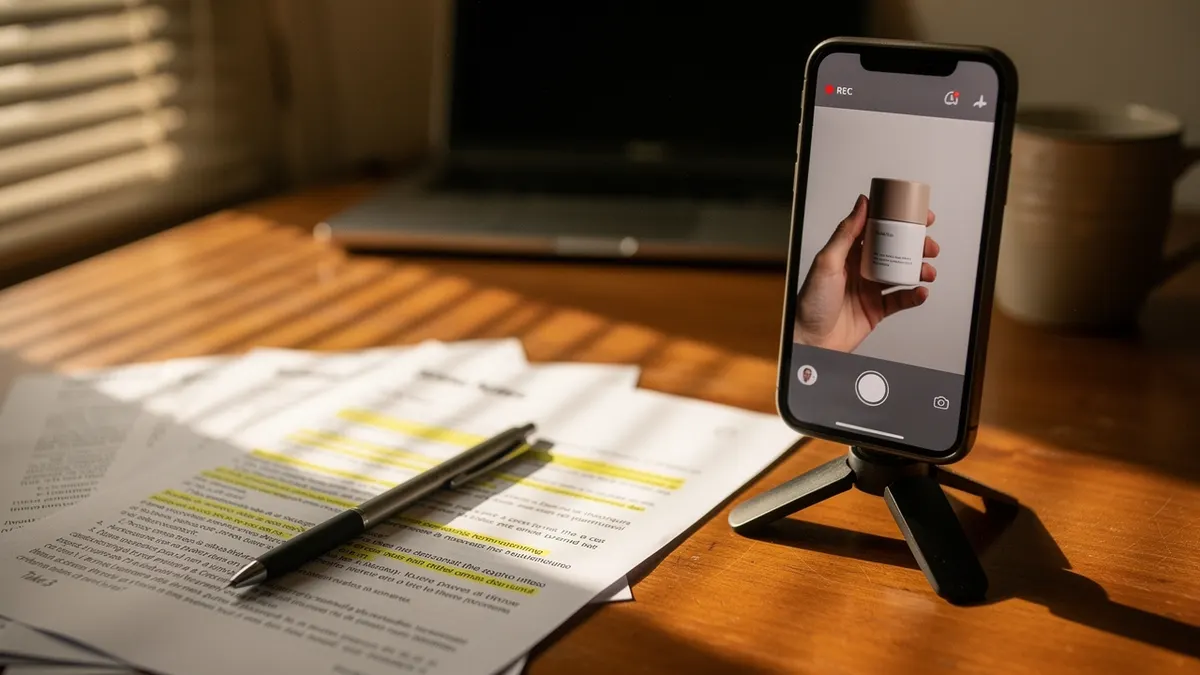
For a vertical video that has production consequences rather than editing ones. The legend has to be legible in the format it will actually be seen in, that is on a phone with the platform interface on top: if it sits under the username or behind the buttons, it is not there. And it has to last long enough to be read, which in practice means leaving it on screen rather than flashing it at the end.
The safest version is the one almost nobody uses: the legend fixed for the whole piece, in a zone no platform occupies.
What the law does not say, and everyone thinks it does
Three beliefs circulate as if they were the rule and are not, and all three cost work or produce pointless arguments with the brand.
There is no national time window for posting on social media. Protected hours exist in other media and under other rules, not in this article.
There is no alcohol strength above which the rule changes. The article speaks of alcoholic drinks, without tiers.
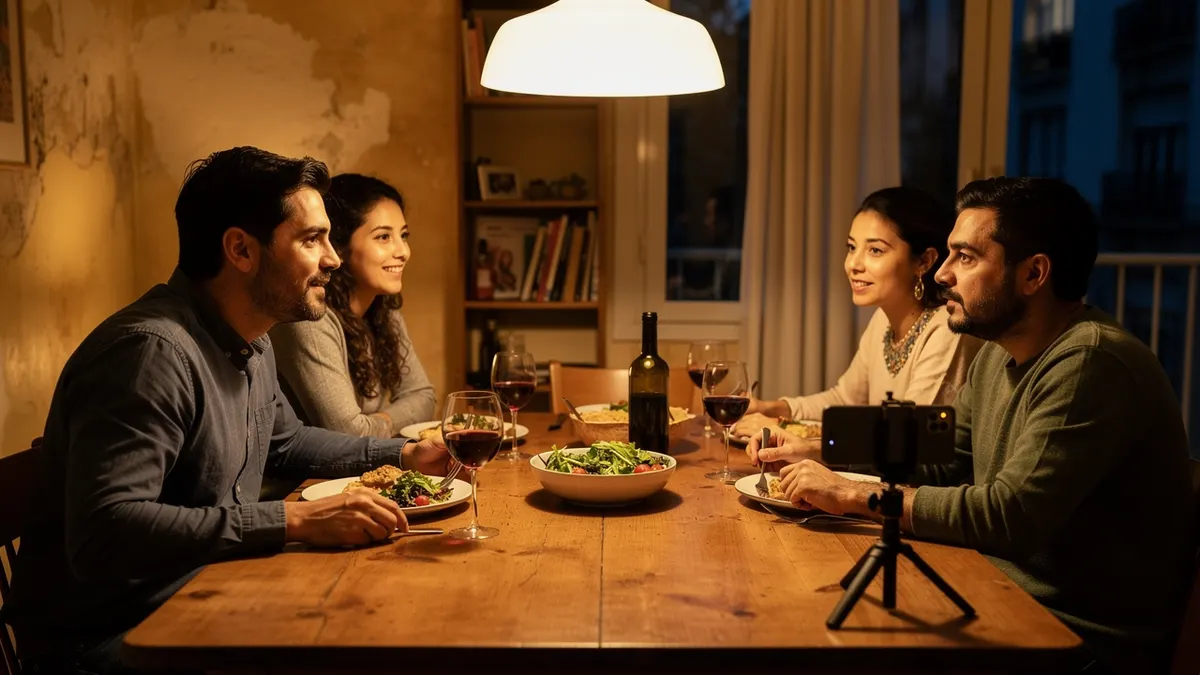
And there is no prohibition on showing somebody drinking. What is prohibited is the association, not the act: an adult drinking at a meal is not, on its own, any of the four cases.
What an alcohol piece can still show
Quite a lot remains, and it is worth defending in front of a brand arriving with an impossible script.
You can show the product, pour it, describe its taste, its origin, how it is made. You can film a table of adults, a gathering, a meal. You can talk about what to pair it with, what temperature to serve it at, how far a bottle goes. You can tell why that winery or that brewery does what it does.
What collapses is the shortcut: the piece that instead of selling the drink sells what supposedly happens after drinking it.
Barter is still advertising
In drinks, barter is the most common working arrangement: two bottles arrive, a video is requested, there is no invoice involved and nobody calls it a campaign. That changes the accounting, not the rule.
If there is consideration and the piece promotes the product, it is advertising, and the same four prohibitions and the same two legends land on it. The absence of money does not turn it into a spontaneous opinion.
There is also a practical consequence worth anticipating. In a barter nobody sends a brief, nobody reviews the script and nobody defines the media plan: the creator is left alone with the decision, and it is usually the case where the legends are missing.
The simple fix is to treat barter as a small job rather than a gift: ask in writing what is expected of the video, agree that the legends go in, and state how long the piece stays up. Three messages, and barter stops being the only format in the category done with no rules at all.
Before signing an alcohol campaign
- Read the script looking for the four associations, one pass each. It is faster than reading it four times looking for "problems".
- Decide where the legends go and how long they last, before the shoot, looking at the real format on a phone.
- Ask for the media targeting. A correct piece becomes an infringement if shown to the wrong audience.
- Agree who reviews the final cut, by name, and that the review happens before publication rather than after.
The brand's usual objection is that all of this makes the piece dull and that competitors do the same without trouble. It may well be true that others do it; it does not change who answers for your video. And the way out is not a grey piece, it is a different axis: the drinks campaigns that work best here lean on the product and the occasion, not on the effect.
Sources
- Law 24.788 on the Fight against Alcoholism, full text
- Decree DNU 274/2019, Lealtad Comercial
- Law 24.240 on Consumer Protection
Checked on 12 September 2026. This guide is not legal advice. Where this guide and the official source disagree, the source prevails.