
The situation: you have budget for one channel, not two
You sell in Spain, you have a physical product, and you want to use creator video to sell more. Amazon offers you a huge catalogue and a buyer whose card is already saved. TikTok Shop offers you discovery and a video that can sell on its own. Both ask for creator content, and each asks for a different kind.
The useful question is not which is better. It is which of the two converts your type of product on the video budget you can sustain for three months.
What the video actually does on each platform
This is the underlying difference, and it explains almost all the others.
On Amazon, the video closes a doubt
The Amazon buyer is already searching. They typed "drip coffee maker" or arrived from Google, they are comparing three listings, and what stops them is a specific doubt: the real size, the noise, whether the part is plastic or metal. The video that works there does not seduce, it resolves. It plays inside the listing, with sound off most of the time, and it competes with the photos, not with other videos.
That shapes the format. Amazon accepts video in the product gallery and, for registered brands, in A+ content and the Store. Useful length sits between twenty and fifty seconds. A close-up of the product has to appear before the five-second mark, and on-screen text is effectively mandatory because nobody turns the sound on.
On TikTok Shop, the video creates the need
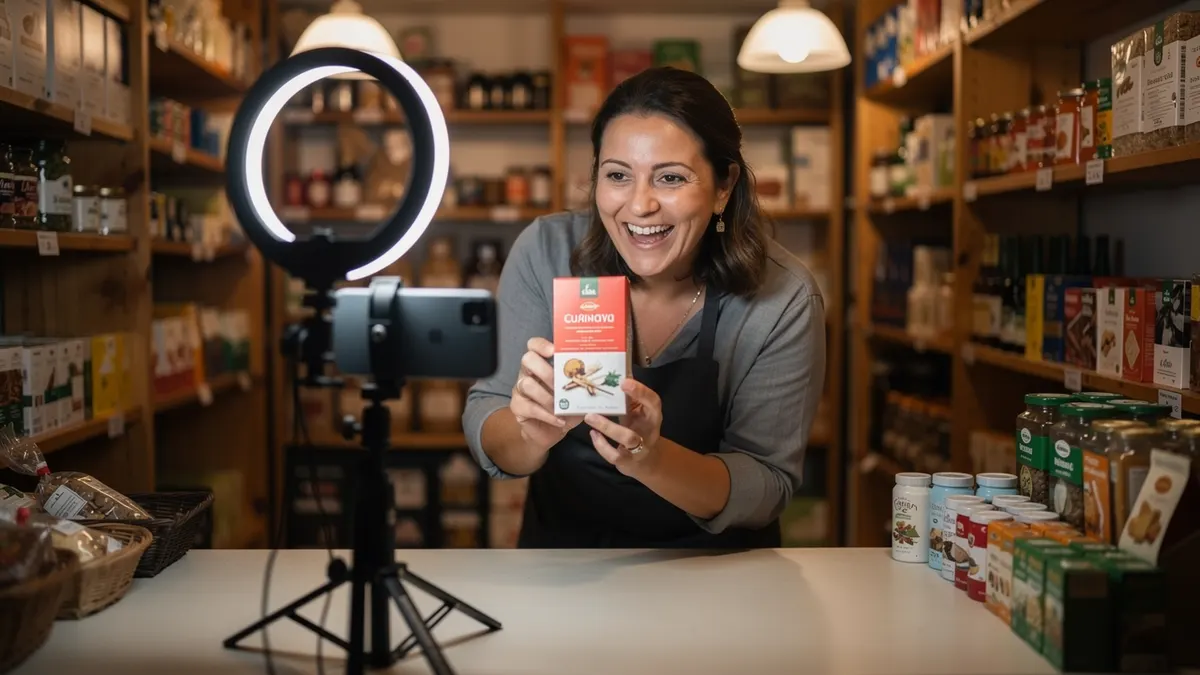
The TikTok buyer was not looking for anything. They were passing time. The video has to interrupt, give a reason to watch, and reach the product without looking like an ad. It plays full screen, with sound, and it competes with everything else in the feed.
That asks for another script: a strong hook, a fast demonstration, and a close that pushes towards the listing. Useful length sits between fifteen and forty-five seconds, and the formats that perform are different: the discovery video, the honest review, the before and after, and the live.
What each channel costs in content
The figures below reflect the open Spanish market. They are not official rates from any platform.
| Item | Amazon | TikTok Shop |
|---|---|---|
| Pieces needed to start | 2 to 4 per listing | 8 to 15 per month |
| Price per piece | 120 € to 250 € | 80 € to 180 € |
| Useful life of a piece | 6 to 18 months | 2 to 6 weeks |
| Renewal needed | low | continuous |
| Usual licence | open-ended use on the listing | 3 to 6 months, advertising included |
| Typical first-quarter cost | 500 € to 1 200 € | 1 500 € to 3 000 € |
The row that decides is useful life. A well-made video on an Amazon listing is still working eighteen months later. A TikTok Shop video burns out in weeks. Amazon is an investment that amortises; TikTok Shop is a recurring cost. Neither of those is bad, but confusing them destroys budgets.
It is worth doing the arithmetic with concrete numbers, because intuition misleads. Imagine a coffee-machine brand with four listings and a content budget of 2 000 € for the quarter.
On Amazon, that budget buys three videos per listing at an average of 160 €, so twelve pieces for 1 920 €. Those twelve pieces are uploaded once and stay on the listings twelve or eighteen months later. Cost per month of useful life is around 130 €, and it falls every month that passes.
On TikTok Shop, the same amount buys about sixteen pieces at 125 €. Spread over three months that is a little over five a month, which is below the threshold at which the channel starts working. At the end of the quarter nothing has accumulated: the pieces are spent and so is the budget.
The reading is not that TikTok is worse. It is that 2 000 € is enough to do Amazon well and not enough to do TikTok Shop well. At 5 000 € a quarter the conclusion reverses, because then the ten or twelve monthly pieces the channel asks for are sustainable and discovery starts to compound.
That threshold is the variable almost nobody calculates before starting, and it is the one that decides whether the money works or evaporates.
The hidden cost on Amazon
It sits in the restrictions. Amazon prohibits, in product content, a set of things a creator would say naturally: references to price, to promotions, to shipping, comparisons with named competitors, or calls to action pointing off the platform. A video shot without knowing those rules gets rejected, and redoing it costs another piece.
The hidden cost on TikTok Shop
It sits in the rhythm. Eight or fifteen pieces a month are not bought once, they are bought every month. A brand that starts enthusiastically and stops after two months loses the algorithm's momentum and returns to the starting point. If you cannot sustain the flow for a full quarter, the channel will not return what you put in.
Which product wins where
There is a fairly stable pattern here.
Amazon works better with products people search for: small appliances, tools, homeware, spare parts, office supplies. These are intent purchases, where the doubt is technical and video clears it.
TikTok Shop works better with products people discover: cosmetics, accessories, mid-priced fashion, gadgets, impulse food. These are purchases nobody was planning and that a video can trigger.
There is a real middle ground. Supplements, hair care and small kitchen appliances work on both, and they are exactly the categories where it makes sense to consider both channels with different content rather than the same video reused.
How to tell which side your product is on
There is a simple and fairly reliable test. Write the generic name of your product, without the brand, and ask whether anyone would search for it that way. "28 cm non-stick pan" is a search: there is a prior need and a buyer comparing. "Serum that does this" is not a search, it is a discovery: nobody types it because nobody knows it exists.
If your product is described by a category people type, Amazon will find it. If your product is only understood when someone sees it working, TikTok will show it and Amazon will not.
The second indicator is price. Below twenty-five euros, impulse buying is realistic and TikTok makes sense. Above sixty, the buyer almost always compares first, and that comparison happens on Amazon or in a search engine.
There is a third effect that rarely enters the calculation: what each channel does with returns. A video that shows the real size, the weight and the material reduces returns driven by unmet expectations, and that return costs outbound shipping, return shipping and often the product. In categories with high return rates, such as fashion or small appliances, an honest video on the listing pays for itself by avoiding two to four returns.
On TikTok Shop the opposite happens more often than brands admit. A highly persuasive video about a product that does not deliver produces a fast sale and an equally fast return, with negative reviews on top. The channel rewards persuasion and later punishes exaggeration, and that punishment arrives late, once you have already bought more content on the same promise.
Rights, which are not the same
A detail that gets overlooked and costs money. The video you upload to an Amazon listing stays there indefinitely: you need an open-ended or very long licence, or you will have to pull it when the term expires. The TikTok Shop video, by contrast, usually needs an advertising licence because it will end up promoted, and that licence has an end date.
Buying the same kind of licence for both channels means overpaying on one of them. Spanish intellectual property law requires the assignment to define format, scope and duration, so the contract has to state explicitly which of the two uses you are buying.
How to decide, and how to do both if you can
If your product is searched for and your content budget is under a thousand euros a quarter, start with Amazon. Two or three good videos per listing, restrictions respected, and let them work.
If your product is discovered and you can sustain eight pieces a month for three months, start with TikTok Shop. With less than that, do not start.
How the brief changes by channel
The same creator can shoot for both in one session, but the brief has to differ on four concrete points.
The first second. For Amazon, the product must be identified on screen before five seconds, ideally in the first. For TikTok, the first second belongs to the hook and the product can appear at the third or fourth.
Sound. The Amazon video has to be understandable in silence, with on-screen text carrying the whole message. The TikTok one is designed with sound and loses a lot without it.
Vocabulary. On Amazon, references to price, promotion, shipping and named competitors are out. On TikTok, those same references are often the hook.
The close. Amazon does not allow calls to action pointing off the platform, so the video ends on the demonstration. TikTok needs an explicit close that pushes towards the listing.
If you do both, do not reuse the video. The Amazon video that opens on a close-up of the product is exactly the video TikTok ignores, and the TikTok hook is exactly what Amazon rejects as promotional. Commission both scripts from the same creator in the same session: the shoot is shared, the edit is not, and the saving is twenty to thirty per cent against two separate commissions.