A family already living in Brussels is choosing between three schools. They have read all three websites, which say approximately the same thing, and they have booked two visits.
Everything that happens between those website visits and the decision is where video does its work, and almost none of it is aimed at the people actually deciding.
The decision is made by three people
Two parents, who often do not have the same first language and do not weigh the same things. One is thinking about academics and continuity if the family moves again. The other is thinking about whether the child will be happy in November.
And the child, who has a veto that is rarely written down and frequently decisive.
A video addressed to a single rational adult buyer misses two of the three, which is why so much school content feels like it is speaking past the family.
What a family actually watches
The playground, not the classroom
Every school films a classroom, and classrooms look alike. What families study, and what nobody publishes, is the playground: who is playing with whom, whether groups are open, what happens to a child standing alone.
That is also where the real language question lives. Not the language of instruction, which is in the brochure, but the language children speak to each other at break, which decides whether a newcomer is included in the first month.
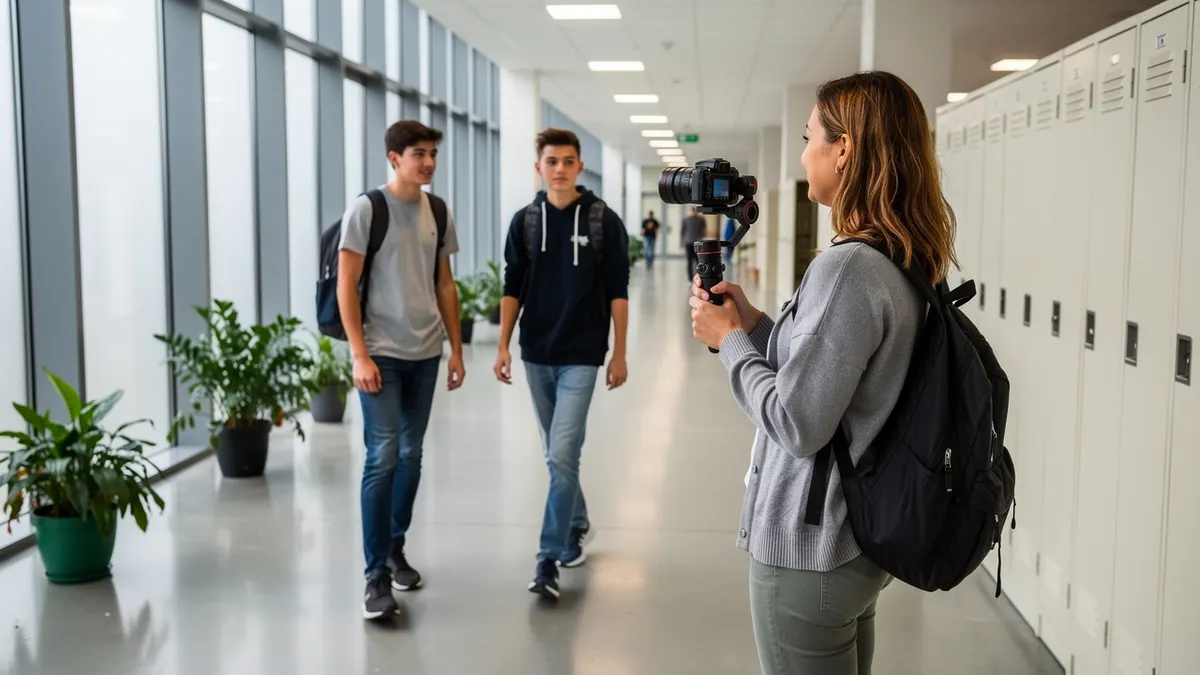
The corridor between two lessons
Ordinary movement tells a family more about a school than any staged shot. How adults speak to children in passing, whether it is calm or chaotic, how big the building feels to a small person.
The journey
Nobody sells a school on transport and every family calculates it. The walk from the tram, the drop off at half past eight, how long it takes from the neighbourhoods where these families actually live.
| What schools publish | What the family is weighing |
|---|---|
| The curriculum | Whether their child will have a friend by October |
| A bright classroom | The playground at break, unstaged |
| Facilities | The corridor, the noise, the calm |
| Results | What happens to a child who arrives mid year |
| A head teacher's welcome | The teacher their child will actually have |
The fourth row is the most specific question in this market and the least answered. Families in Brussels arrive at odd times because of contracts and postings, and a school that shows how a mid year arrival is handled is speaking directly to a situation most of its buyers are in.
The child's opinion outranks the brochure
Any content that a twelve year old finds embarrassing works against the school, because the child will say so and the parents will listen.
That is an argument for less polish rather than more. Students talking about their own school, unscripted and allowed to be unenthusiastic in places, are more persuasive to both audiences than a produced film, and they are the only source a child will believe.
Which requires the same care as any content featuring young people: consent from families, agreement on where it will run, and a clear line about what is not filmed.
The two languages, in one shoot
Bilingual families do not want two separate videos, they want to see that both languages exist in the building.
The cheapest way to show it is not to translate anything. Film a corridor where both are spoken, an announcement in one and a reply in the other, a teacher switching mid sentence. That footage says something a subtitle cannot, and it costs nothing extra to capture.