Sell a coat and the buyer can judge it. Sell a chair and they can sit on it. Sell a stone and the buyer has no way of assessing what they are looking at, and they know it.
That is the defining condition of this category, and it explains why so much jewellery content fails. The video is trying to prove quality to someone who has no means of evaluating the proof.
The sparkling close up is the weakest asset
Every jewellery business in the world publishes the same shot: a stone rotating under a light, throwing colour. It is beautiful and it proves nothing, for two reasons.
The first is that it is identical everywhere. That footage is interchangeable between a serious house and an anonymous seller, which means it carries no information at all.
The second is worse. Because it is exactly what an unscrupulous seller would post, a sophisticated buyer discounts it automatically. The content that is supposed to build confidence is the content most associated with its absence.
Where trust actually comes from
If the product cannot prove itself on camera, trust has to be transferred from somewhere else. There are three sources and all of them are filmable.
The hand that does the work
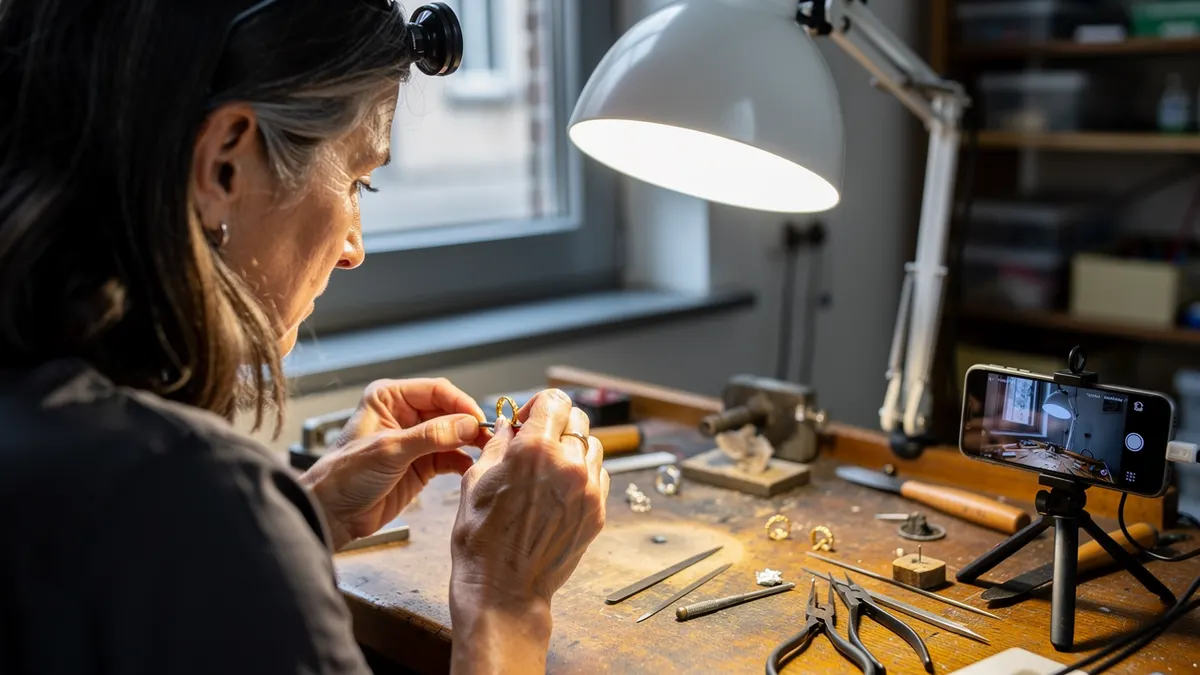
Setting a stone, sizing a ring, polishing a bezel, adjusting a claw under a microscope. This is genuinely difficult work, it looks difficult, and almost nobody films it properly.
A buyer who watches two minutes of a setter working concludes something a caption cannot make them conclude: that this business does the thing rather than reselling it.
The person who will answer the email
High value purchases made remotely are decided by whether the buyer believes there is somebody accountable at the other end. A named person, on camera, explaining how an order works and what happens if something is wrong, does more than any amount of production value.
The document, explained rather than claimed
Whatever paperwork accompanies a stone, the useful video is the one that shows what the buyer will receive and explains how to read it, without making claims about grades or guarantees, which belong to the house and its own obligations rather than to a marketing brief.
That is a subtle distinction and it is the whole game. Explaining what a document is does not require asserting anything about a specific product.
The price, explained rather than displayed
A number on its own invites comparison with a cheaper number elsewhere. The same number, with the work behind it visible, invites a different judgement.
That is not a justification video and it should not sound like one. It is simply showing the hours: the setting, the finishing, the fitting, the guarantee of a repair in ten years. A buyer who has seen those hours stops comparing a figure and starts comparing two offers.
| What the sector publishes | What it proves | What to publish instead |
|---|---|---|
| A rotating stone under a light | Nothing, it is universal footage | The setting being done, uncut |
| A model wearing the piece | That it photographs well | The piece on a real hand, at real scale |
| Claims about quality | Nothing, unverifiable by the viewer | What the buyer will physically receive |
| A shop interior | That a shop exists | The person who answers, by name |
| A price | That it is expensive | What is included: sizing, repair, return |
The second row deserves attention. Scale is the most requested and least answered question in online jewellery: buyers cannot tell how big anything is. A piece on an ordinary hand, next to an ordinary object, answers a question that stops more purchases than price does.
The remote buyer changes everything
Antwerp sells to the world, and increasingly a purchase happens without anyone entering a shop. That means the content has three jobs the shop used to do.
Reassure that the business is real, which is what the workshop footage does. Answer the physical questions, which is what scale and material footage does. And explain the after purchase, which is where most of the anxiety actually sits: resizing, repair, insurance valuation, what happens in five years.
That last one is almost never made and it is the one an expensive purchase turns on.
Two things not to film
A safe, a vault door, or anything that dramatises security. It reads as theatre and it invites a question nobody wants asked.
And a stone being handled without gloves in a way that looks casual. It is often perfectly normal in the trade, and to an outside viewer it reads as carelessness with something they are being asked to pay a great deal for.
The one video most houses are missing
An unedited walk through of an order: the conversation, the choice, the workshop, the finished piece, the packaging, the document. Six minutes, one take per stage, no music.
Nobody in this category makes it because it is not glamorous. It is also the single most convincing thing a jewellery business can put on the internet, because it shows a process that a dishonest seller could not film.