In renovation, the client does not choose between two firms. They choose between doing the work and waiting another year, and that changes everything about the content.
What postponing means, from the inside
Postponing is not a decision, it is the absence of one, and it is comfortable. It costs nothing immediately, it avoids mess, it avoids spending, and above all it avoids choosing. Content that wants to shift that position has to make postponement uncomfortable without frightening, which means showing concrete consequences rather than brandishing arguments.
The product disappears
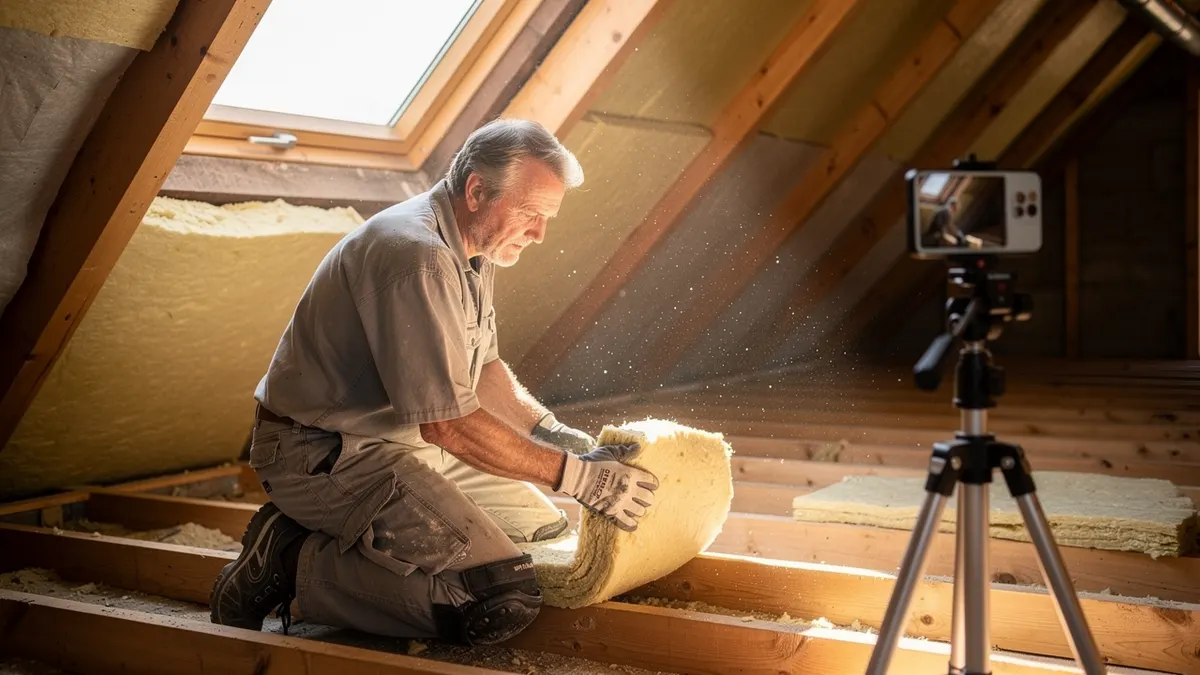
There is no product to film: a renovation is a site, a team, dust, a duration. What can be shown is not an object, it is a sequence. So useful content resembles a site diary more than a demonstration, and it benefits from lasting longer than the usual short format.
What to order instead of a product video
One long piece per typical job
A video of several minutes following a job from the first day to the handover of the keys, with the bad surprises included. It is the content that converts best, because it answers the real question: what does my life look like during the work.
Short formats each answering one question
Seven questions, one video each.
How long without a kitchen or a bathroom.
Where the occupants sleep during the work.
What happens if a hidden problem is discovered.
How a typical day on site unfolds.
What remains the client's responsibility.
How the handover works.
And what costs more if you wait a year.
Your people, not actors
The credible people here are your fitters, your site manager, your works supervisor. They speak badly, show their hands, know the details. An outside creator who has never fitted a window produces content the audience identifies immediately as an advertisement.
The Belgian specifics that matter here
Support schemes are regional
Support schemes and their conditions differ by region, and they change regularly. A video announcing a precise amount becomes wrong quickly, and wrong information on this subject costs dearly in trust. The prudent phrasing is to say that support exists, that it depends on the region and the situation, and that it is checked with the competent body before signing.
The language border runs down the street
Two neighbouring municipalities can fall under different language regimes, so one campaign can speak the wrong language a few kilometres away. Targeting is done by postcode, not by approximate region, and two versions beat one hybrid version.
What to settle with the client before filming at their home
Seven points, written and signed.
Permission to film in the home, with its limits.
The rooms where filming is not allowed.
The people who may appear, children included.
What must not be identifiable, address and neighbourhood.
The client's right to have a passage cut after viewing.
How long the video will be run.
And what the client receives in return, in black and white.
When to publish these videos
Six moments that matter more than frequency.
Before the season when enquiries rise, not during.
In the evening, when household decisions get made.
After a spell of bad weather, which makes the problem visible.
At the moment energy bills arrive.
Just after a job finished in the same municipality.
And never during your own saturated periods.
What must never be said
Six phrasings to avoid absolutely.
A support amount, dealt with above.
A lead time promise the weather can contradict.
A price per square metre, which means nothing without a visit.
A guaranteed energy result with figures and no study.
A direct comparison with a named competitor.
And a promise of no dust at all, which nobody believes.
How to film a site without getting in the way
Six practical rules.
Warning the team the day before, not the same morning.
Filming at the start and end of the day, never during risky phases.
Getting written consent from the client to film at their home.
Showing nothing that would identify the address.
Cutting any conversation that was not authorised.
And having the client approve the video before release.
What reassures most in a site video
Five details, in the order they count.
The floor protected, visible from the first shot.
The evening tidy-up, filmed once.
The same face from the first day to the last.
A bad surprise shown and resolved.
And the house handed back clean, at the end of the video.
What is filmed on a renovation site
| Sequence | What it proves | The constraint |
|---|---|---|
| The before state | The comparison point | Film before touching anything |
| The technical gesture | Real know-how | A safety distance |
| The result | What it looks like | The same angle and the same light |
What makes a comparison honest
The same framing, the same hour, the same focal length. Change one of the three and a proof becomes an illusion, and viewers feel it without being able to explain it.
What is never said without a document
A standard, a compliance, a warranty or an energy performance. Each is proven by a document from the tradesperson or the manufacturer, to be confirmed with a building professional.
What to measure
Five indicators, none of them views.
The number of technical visit requests.
The proportion of requests coming from the right area.
The number of questions already answered by the video.
The time between first contact and signature.
And the share of clients who mention a video at the meeting.
One last marker: in this sector, a video does not sell renovation work, it makes postponing less comfortable. It is a more modest aim, and the only one that produces appointments.