Belgium has an unusual density of clubs for its size: football at every level, hockey, volleyball, cycling teams and a long tail of provincial clubs with real followings and no marketing department.
Nearly all of them have something a brand would pay a great deal for and cannot buy: an audience that is emotionally attached before a single word is said.
A club already owns the attachment
A supporter does not need to be convinced to care. They already care, which inverts the usual content problem: the job is not to create interest, it is to avoid wasting the interest that exists.
What that changes
It means polish is not the point. A club that produces slick brand-style content is competing with professional advertising on its worst ground, and it is throwing away the one thing that advertising cannot manufacture.
What supporters want is access and belonging: things they would not see from the stand, people they recognise, moments that feel like the club rather than like a campaign.
Matchday is the worst time to film
It feels like the opposite. Matchday is when everything happens, and it is also when the club is at its busiest, the access is at its most restricted, the emotions are unpredictable and everybody with a phone is filming the same thing.
What to shoot instead
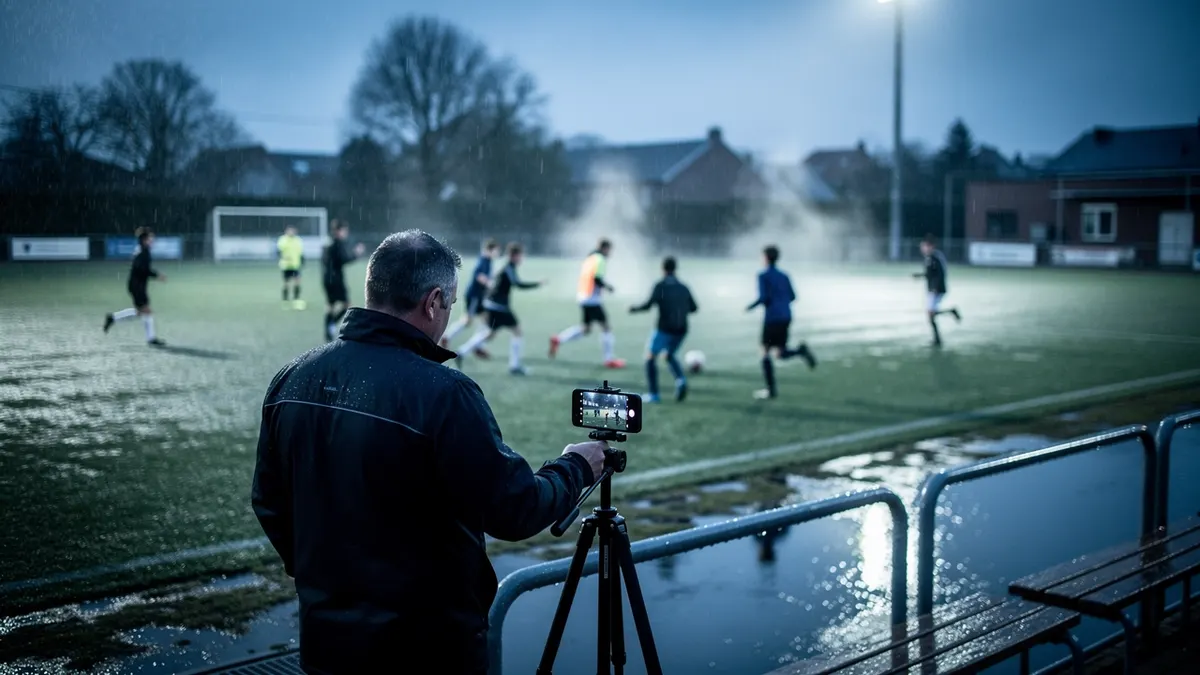
Tuesday. Training in the rain, the kit being prepared, the physio room, the volunteer who has done the same job for twenty years, the youth team arriving in the dark.
That material is what nobody else has. It is filmed calmly, it is usable all season, and it produces the sense of access that makes a supporter feel inside the club rather than in front of it.
| What clubs film | What actually performs |
|---|---|
| The goals | The bus, the tunnel, the dressing room afterwards |
| The first team only | The youth teams and the women's teams |
| The president speaking | The kit manager, the physio, the volunteers |
| A polished season trailer | One player explaining something ordinary |
| Sponsor logos on a board | A sponsor's own people at the ground |
What clubs forget to film
Three things, and all three are free.
The people who are always there. Every club has ten volunteers who make it exist, and they are the most watched content a small club ever publishes.
The youth and the women's teams. They have their own parents, their own supporters and almost no coverage, and the club that films them builds an audience that stays for twenty years.
The ordinary week. Not the highlights. The bus, the meal, the tape being cut, the pitch being marked at seven in the morning.
Sponsors are an audience, not a logo
Most clubs treat sponsorship as a placement problem: how many logos, how visible, on what. That is what a sponsor asks for and it is not what they actually want.
What a local sponsor actually wants
What a local sponsor wants is to be seen as part of the club by people who live nearby. That is achieved by filming their people at the ground, their apprentice on the pitch at half time, their van at the training session, and it is worth far more to them than a board in the background.
It is also how a club turns a one-season sponsor into a five-season one, which is the only sponsorship metric that matters at this level.