A Flemish client, so you send the invoice in Dutch. Good reflex, wrong object: the language of your documents follows your place of business.
The principle nobody explains
Three elements that decide, and one that does not.
The location of your place of business, which determines the language regime applying to your documents.
The nature of the document: invoice, employment contract, social document, each with its own rules.
And the official language of the region concerned.
What does not decide: the client's language, their preference, or the language of the conversation you had with them.
It follows you, not the client
Three practical consequences.
You do not have to change invoicing language according to your clients: a creator established in one region always issues in the same language, whoever they are dealing with.
A client established elsewhere in the country therefore receives a document in a language that is not theirs, and that is normal.
And moving your place of business changes your obligations, which means updating your templates.
The question to ask once
Four questions to put to an accountant, all at once, at the time of registration.
Which language regime applies to my place of business.
Which documents are concerned, and which are not.
How to handle clients located outside the country.
And what form any attached translation should take.
One note: those four answers fit on one page and serve for years. It is the best ratio of time spent to problems avoided in a creator's whole administrative life.
What the courtesy version is for
Four legitimate uses of a translation.
Making reading easier for somebody who does not speak the document's language.
Speeding up internal approval at the client's, where people have to understand what they approve.
Avoiding pointless questions about the detail of the lines.
And showing commercial attentiveness, which counts in a lasting relationship.
Three rules so that this version causes no problem.
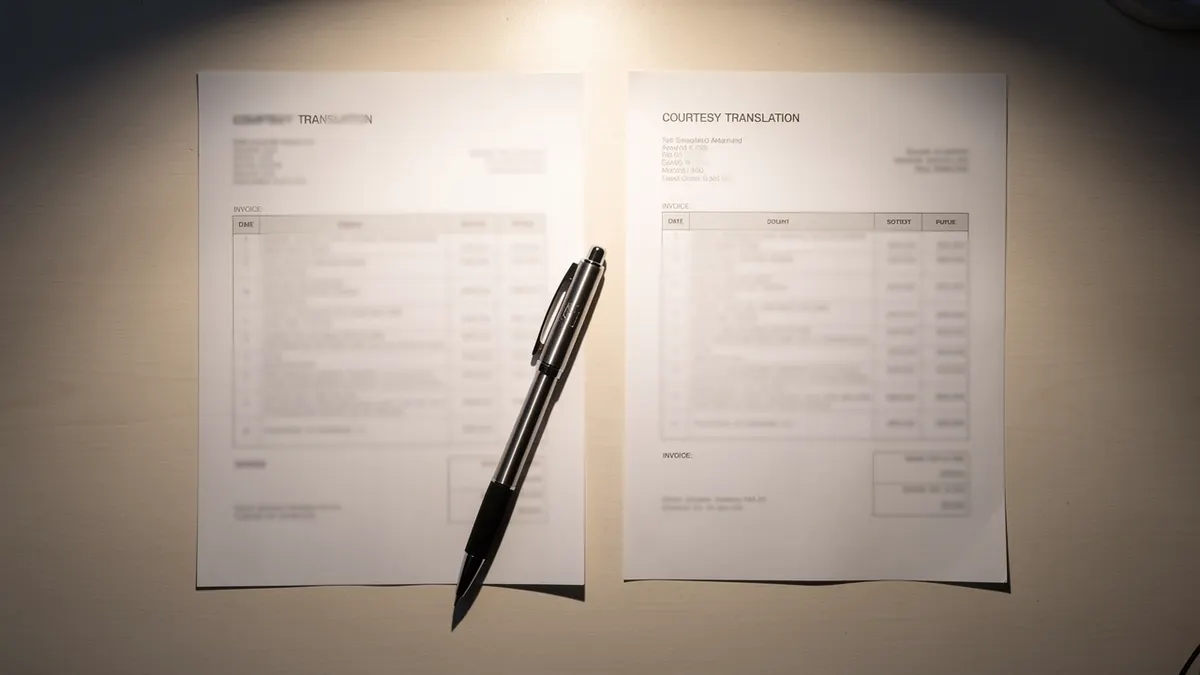
It is attached, never substituted for the original.
It carries a mention stating that it is an unofficial translation.
And it repeats exactly the same amounts and the same lines, with no rounding or simplification.
What decides the language of each document
| Document | Language to use | Why |
|---|---|---|
| The quote and the contract | The client's | They must understand what they sign |
| The invoice | The one their administration accepts | It serves as an accounting record |
| The video's voice | The target audience's | It has nothing to do with the other two |
What is settled in one line on the quote
State the language of the deliverables and the language of correspondence. An order where the brand writes in one language and expects a voice in another is hard to fix after the shoot.
What is verified before issuing
The mandatory mentions, the accepted language and the retention rules applying to your situation. These are confirmed with an accountant, they vary by place of establishment.
What it does not change
Five things that stay identical whatever the language.
The compulsory mentions on the invoice, all of which have to appear.
The continuous numbering, with no gap in the series.
The payment terms and the agreed conditions.
The treatment of the tax, which depends on the client's status and not on the language.
And your document retention obligations.
One last marker: the language of your documents is not a mark of attentiveness, it is a characteristic of your business. What pleases a client is a correct invoice that passes through accounting first time, not a translated document that will have to be redone.