Belgium is small enough that the train is not a compromise. Brussels to Antwerp, Brussels to Ghent, Antwerp to Bruges: these are commuter distances, the stations sit in the centre of town, and a client's shop is usually a walk away from the platform.
That makes a real difference to a working day. No parking to find in a city centre that does not want your car, no hour lost circling, and the return journey is time you can spend backing up files instead of watching a motorway.
The connections that make this work
Not every pair of cities is equal. The spine that carries most of this work is Brussels to Antwerp and Brussels to Ghent, both frequent and both short, with Bruges, Leuven and Liege close behind. Those are the routes where filming in another city stops being a trip and becomes a morning.
Where it stops being easy
Away from that spine the arithmetic changes. A client in a business park, a warehouse on a ring road or a village address can add two connections and a bus, and at that point a car is simply the right tool. Check the address, not the city, before you decide how you travel.
The rule that actually decides everything
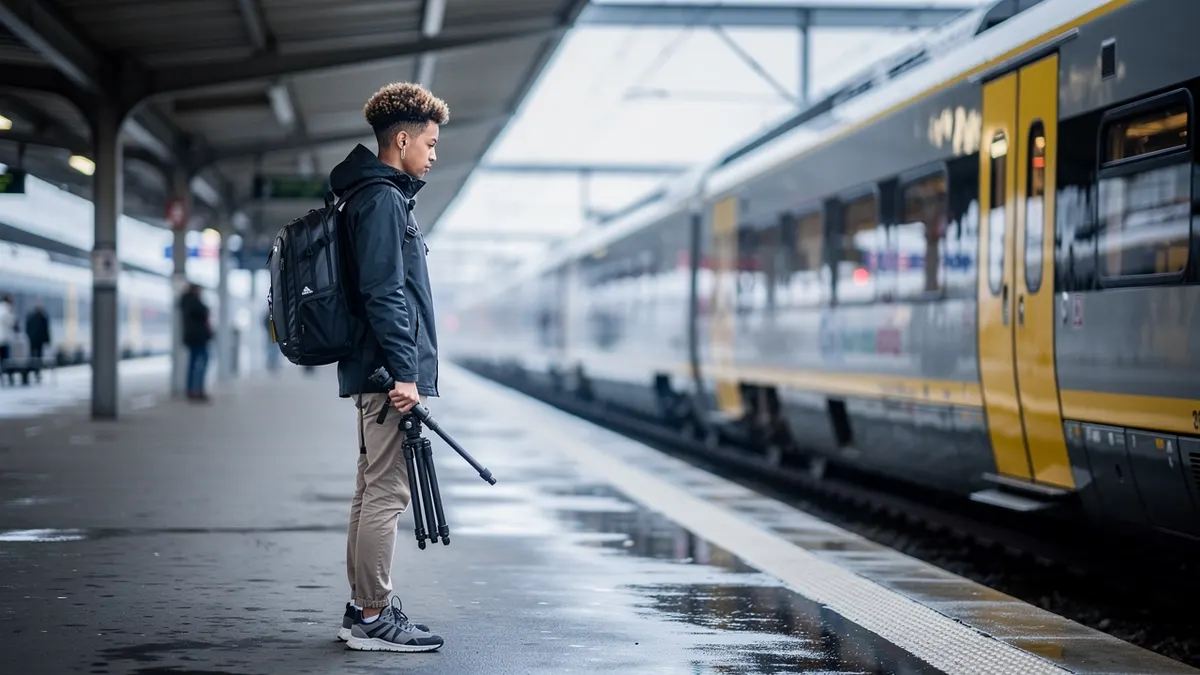
You carry it all in one trip, from the platform to the location, with no car to go back to.
This is the whole constraint, and it is not about weight. Twelve kilos in a good backpack is fine. Twelve kilos split across a backpack, a light stand bag and a hard case is not, because you have two hands and one of them keeps holding a door open.
What that means in practice
One bag on your back, one small item in a hand, nothing else. Everything either fits in the bag or stays home.
Why it changes the shopping list
A creator who drives buys the bigger softbox because there is room in the boot. A creator on trains buys the one that folds, and discovers the folded one is used four times more often, because it is the one that is actually there.
| Item | The car version | The train version | What you give up |
|---|---|---|---|
| Key light | Large panel, mains powered | Compact panel with a battery | Some output, not much shape |
| Stand | Heavy steel, very stable | Light aluminium, or a clamp | Stability in wind, so shoot indoors |
| Tripod | Full size, video head | Travel size, or a small gimbal | Height, rarely needed for product |
| Audio | Boom and a stand | Two clip mics in a pouch | Nothing, for the work we do |
| Backup | Drives in a case | One SSD in a pocket | Nothing |
The right column is the honest one. On UGC work, almost none of what you give up is visible in the finished video.
The two things that go wrong
The last kilometre. The station is central, the client is not always. Check the walk before you book the shoot, not the morning of. Fifteen minutes with a full bag is a warm-up; forty is arriving damp.
The return with more than you left with. Clients hand you product. A shoot for a food brand can end with four boxes, and there is no boot. Say beforehand that you will film it and leave it, or bring a folded tote and accept that you take what fits in it.
What it does to the rate
Nothing, and that is worth being clear about with yourself. Travel time is part of a shoot day whichever way you go, and the train tends to be the cheaper of the two once parking is counted.
The gain is not financial, it is that a day with two clients in two cities is possible by train and rarely is by car. That is the version of this that changes an income.