The urge to buy a camera generally arrives when the real problem is elsewhere. What clients notice fits in three points, and the sensor is not one of them.
What clients really notice
Three points, in this order, and nothing else.
The sound: a covered voice, the echo of an empty room or a constant hiss eliminates an application in ten seconds.
The light: a badly lit face gives an impression of amateurism before the product is even visible.
And the framing: a clean vertical format, with nothing cut off at the top or bottom, with a stable image.
What nobody notices: the brand of the device, the depth of field, the quality of the sensor. No client has ever refused a video for that reason, and none has ever paid more because of it.
The order the money follows
First, what is not equipment
Five free or almost free investments, to make before any purchase.
Choosing a fixed spot near a window, and never changing it.
Filming at the hours when the light is usable, which decides everything in a country with an often overcast sky.
Reducing echo with textiles already present: bed, curtain, coat hung out of frame.
Bringing the microphone closer to the subject, a gesture that improves the sound more than any device.
And learning to export cleanly, in the right format and with the right naming.
Then, the sound
Three purchases, in order of usefulness.
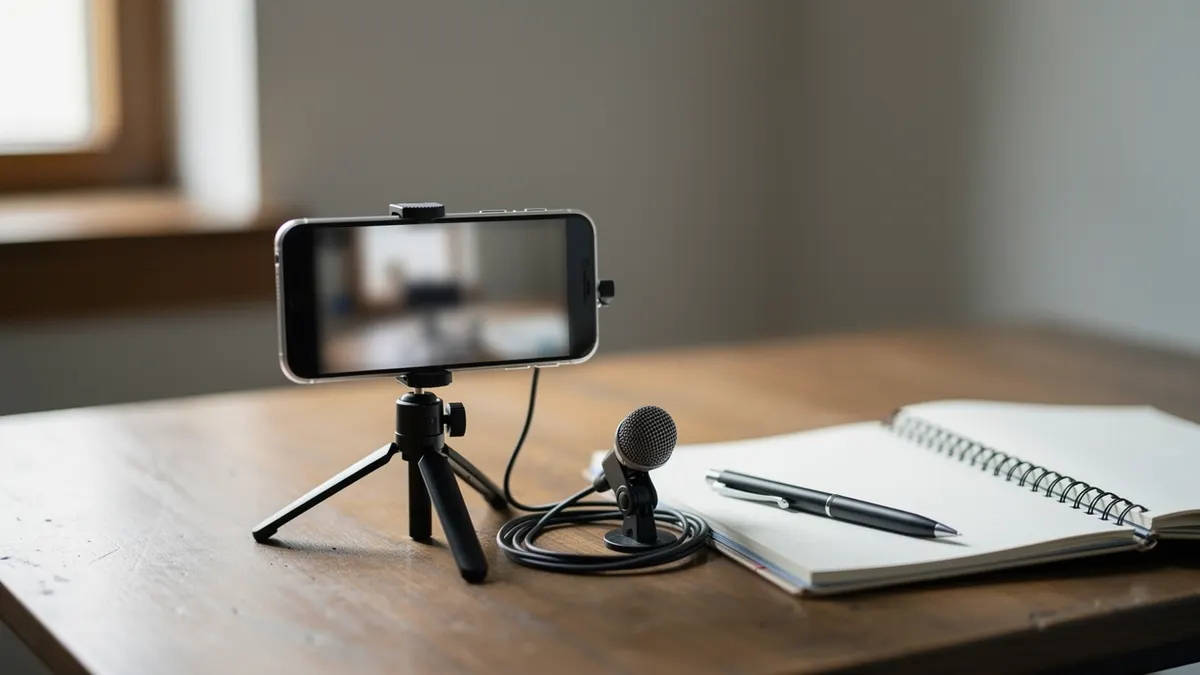
A wired lavalier microphone, the best ratio between price and perceived quality.
A windshield, indispensable as soon as a shot is taken outdoors.
And a recorder or an adapter, only if your device does not handle an external input properly.
Only then, light and image
Four purchases, in this order.
A lamp with adjustable temperature, which makes shoots possible on a late November afternoon.
A reflector, or simply a rigid white sheet, to fill in the shadow.
A tripod with a clamp, which holds on a table.
And, last, a dedicated camera, only if a specific order has demanded it.
What you buy, and in what order
| Rank | The purchase | What it changes |
|---|---|---|
| First | A lavalier mic | Sound goes from amateur to correct |
| Second | A stable tripod | No more shaky shots |
| Third | A continuous light | Shoots no longer depend on the sun |
What is not a priority purchase
A dedicated camera. A recent phone films better than what most brands broadcast, and the gap plays out in sound and light, not in the sensor.
What you replace once you earn well
The mic first, the light second. Those two wear out, break and show on screen; the tripod lasts for years.
How to decide on a purchase
Five questions to ask, in order.
Which order did I refuse or deliver badly for want of this equipment, dealt with above.
How many extra videos a month does this purchase make possible.
What income do those videos represent, at the real rate and not the hoped-for one.
In how many months is the purchase repaid by that income.
And what happens if those orders do not come.
One rule of budget prudence: a purchase that is not repaid within three months of real production waits. Equipment depreciates fast, and a more recent model will come out anyway.
One local note: prices, warranty and after-sales service vary with the country where you buy, and professional equipment is deducted according to precise rules. The professional share, any depreciation and the receipts to keep are checked once with an accountant, before the purchase rather than at declaration time.
One last marker: in this trade equipment does not make the difference, it makes a defect disappear. A sound defect costs orders, a mediocre sensor costs none, and that is why the order of purchases matters more than their amount.