The box in your creator video is subject to labelling rules, and a unilingual pack on screen is a visible problem.
What appears on screen is part of the message
Three practical consequences.
A pack readable on screen is treated as information given to the buyer, not as scenery.
The language requirements applying to labelling do not disappear because the medium is a video: they are checked with a lawyer before publication.
And a mandatory statement unreadable on screen, too small or cut by the frame, does not do its job.
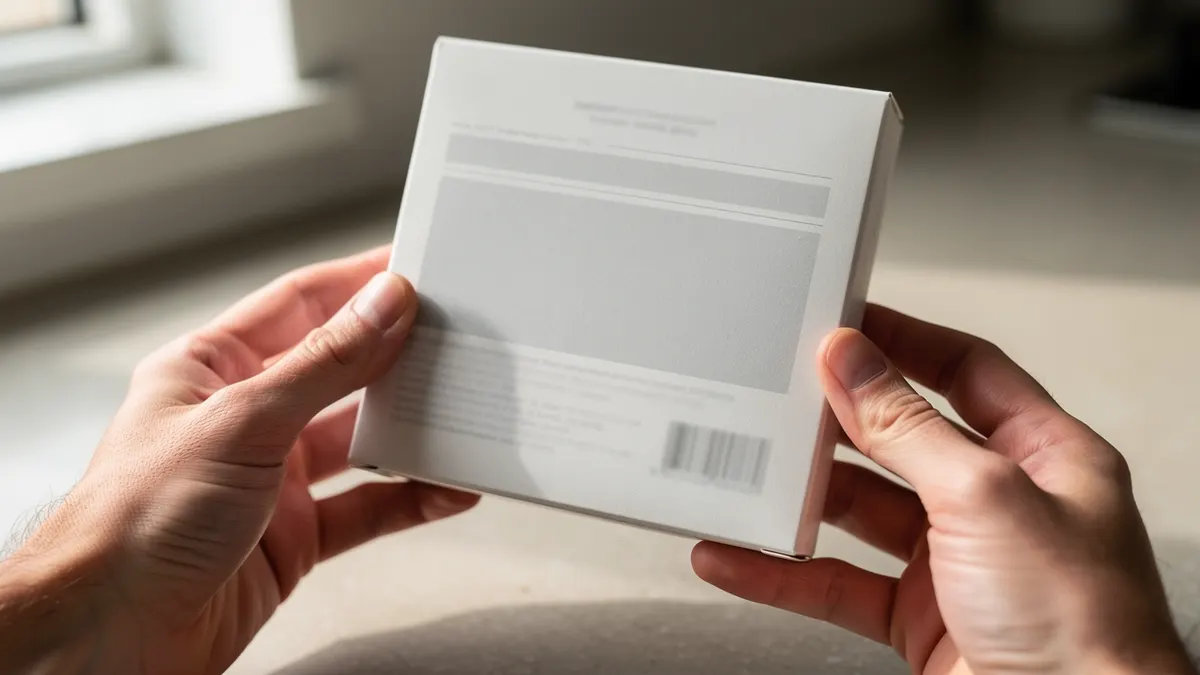
One simple shooting rule: if the pack appears in close-up, it has to be filmed sharp, whole and in its commercial state.
Show what the buyer will really receive
Four shots bringing returns and complaints down.
The closed box, with its label readable.
The real opening, with no cut, to show what is packed inside.
The complete contents laid side by side: what is included, and what is not.
And the real quantity or size, compared with an everyday object.
One note useful to brands selling in several sizes: film the size the campaign makes people buy. Showing the large model and delivering the small one is the commonest source of bad ratings.
The case of on-screen statements
Three distinct situations, often confused.
Statements printed on the pack: they come under labelling and have to be accurate.
Statements added at the edit, as burned-in text: they come under advertising, and have to be readable long enough to be read.
And statements said out loud: they complete, but do not replace, what has to be written.
One clarification avoiding many reshoots: text burned in one language makes the video unusable for the other version. So plan the burned-in text at the edit, never at the shoot.
Consistency between the languages
Three points of vigilance.
Both versions have to say the same thing: a stronger promise in one language than in the other is a discrepancy, not an adaptation.
Quantities, prices and durations have to be identical, including in the subtitles.
And the product name is handled as a whole: if it is translated on the pack, it is translated in the video too.
One organisational consequence: have both versions reread by two different people, each in their own language, before publication. Cross-checking by one bilingual person lets differences of tone through.
What is filmed on a package
| Element | What must be shown | The trap |
|---|---|---|
| The front face | Both languages on screen | Filming only one |
| The ingredient list | Readable text, in close-up | Blurred text |
| The warnings | The complete notice | A frame that cuts it |
What is checked before the shoot
That the unit filmed carries the labelling actually sold. A pre-production package or one meant for another market makes the video unusable.
What is shown rather than paraphrased
The official text, read on screen. A loose rephrasing of a mandatory notice becomes a breach, to be confirmed with a lawyer.
The practical version
Four rules settling almost every case.
Send the commercial product, not a sample.
Film the pack sharp, whole, in its selling state.
Add burned-in text at the edit, per language version.
And archive the published version with its date and the name of the person who approved it.
One last, often forgotten marker: when the pack changes, existing videos become out of date. Note the date of the change, and plan to reshoot the shots concerned rather than letting videos circulate showing a box that no longer exists.