Why a measured tone beats an enthusiastic one, the exercises that unlock stiffness, and how many takes are normal.
This trade does not require exposing yourself
That is the misunderstanding stopping many people before they try.
A commissioned content creator is not a public figure: no audience to maintain, no private life to stage, no comments to manage under their own name.
Three concrete differences. The video is distributed by the brand, not by you. It has a lifespan defined by a contract. And your name appears nowhere, unless you decide otherwise.
One reassuring consequence: you can do this work while staying discreet, and many people do.
Sobriety is an asset there
That is the point creators trained on other markets take longest to understand.
An enthusiastic tone, a rising voice, a strong promise: all of that triggers wariness there, not agreement.
Four settings that work. Speak a little more slowly than usual. State a real drawback before the advantage. Use numbers rather than adjectives. And end with no slogan.
What improves with practice
Three things, and none of them is charisma.
Articulation, which improves by reading aloud five minutes a day.
Breathing, corrected by pausing before each sentence rather than in the middle.
And immediate memory, which allows three sentences to be held without reading, enough for most formats.
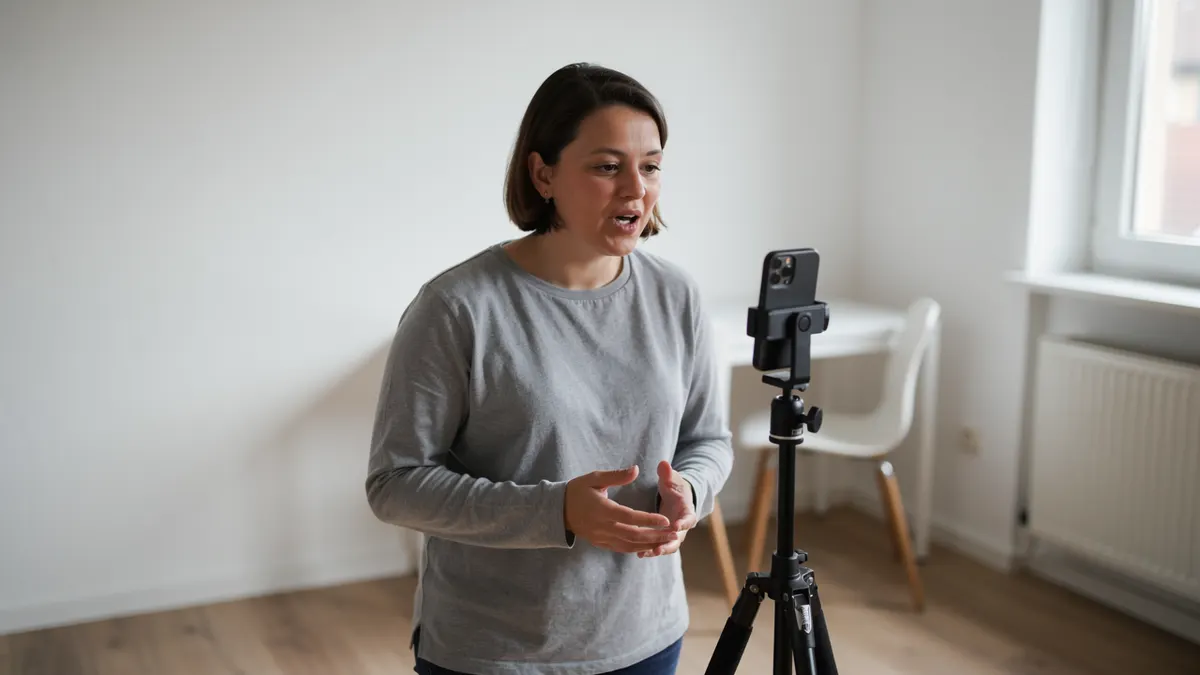
One useful exercise, to do once: film yourself explaining to somebody how to get to your home. It is the most neutral version of speaking to camera, and it shows exactly what needs correcting.
Sound decides more than the gaze
That is what everybody discovers when comparing two tries.
An average image with clean sound gets watched; a beautiful image with hollow sound gets closed.
Four moves that fix half the problem. Record in a furnished room, never in a corridor or a bathroom. Bring the microphone closer, even hidden under clothing. Cut what hums: fridge, ventilation, notifications. And listen back on headphones before shooting the next take.
How many takes are normal
Three to five per sentence at the start, one or two after a few weeks.
Two markers for stopping. If the tenth take is no better than the third, the problem is in the text, not in the performance. And if you always stumble in the same place, the sentence is not spoken language: rewrite it, do not repeat it.
One reassuring note: stumbling, restarting, hesitating for half a second bothers nobody. It is the over-perfect takes that sound like an advert, and they convert less.
What can be worked on, and how long it takes
| Flaw | Exercise | Visible progress |
|---|---|---|
| The voice rising | Read a text quietly before the take | From the first session |
| The wandering gaze | Stick a dot next to the lens | In two sessions |
| Filler words | Listen back to a full take | In two weeks |
What replaces a memorised script
Three cues written on a sheet off camera: the fact, the proof, the closing line. The rest is said in your own words, and it can be heard.
What counts particularly here
Precision rather than enthusiasm. An exact sentence said calmly carries further than an energetic tone on a vague claim.
What not to look for
Three things that waste time.
Imitating a creator from another market: the rhythm and the formulas do not transpose.
Technical perfection: a clean shot is enough, and the budget spent on equipment never makes up for a badly written text.
And putting yourself forward: what is bought there is the clarity of a demonstration, not a presence.
One last practical point: whole formats exist with no face, shot on the hands, on the screen or on the product. They sell at the same price, and they make it possible to start without ever filming yourself.