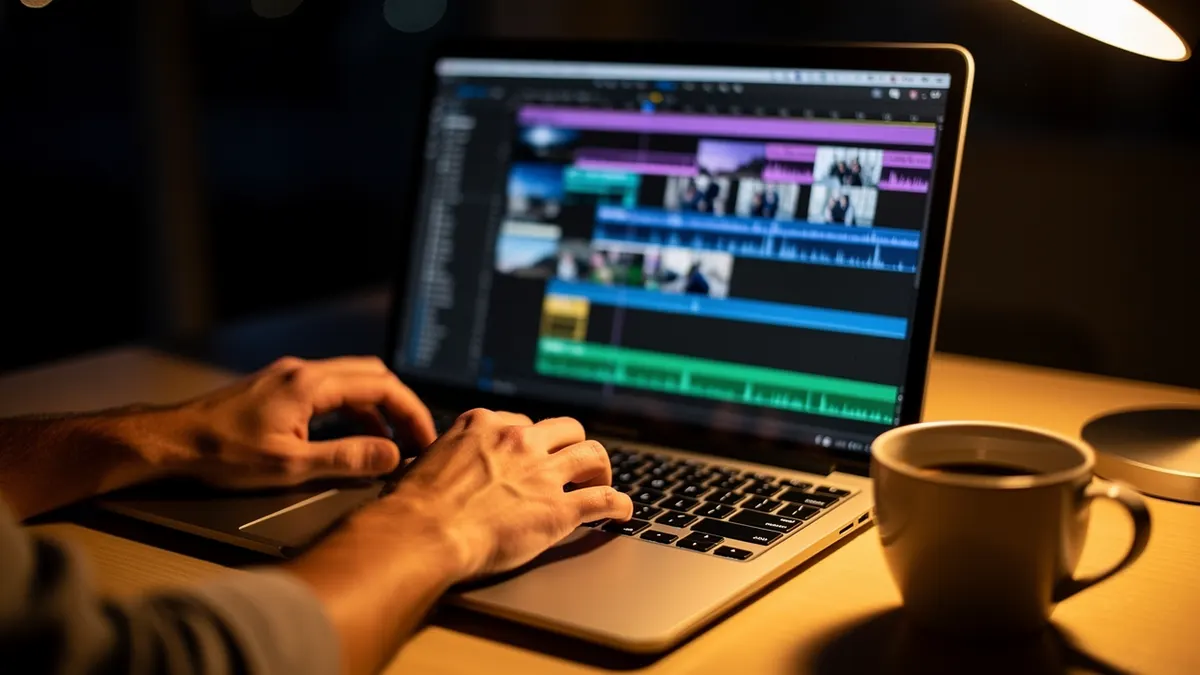
That is where you warm up, and where good rushes die. UGC editing is subtractive, and almost every reflex the software encourages is additive.
UGC editing is subtractive
What adding signals
Every added effect is a signal, and the signal is always the same: this is an advert. A transition, an abrupt zoom, music mixed too high, animated text, all of it tells the viewer they are watching a manufactured object. Yet you are selling exactly the opposite. The practical rule is brutal: if an element does not help understanding, it signals, and so it has to go.
Put the best sentence first
Your best sentence is almost always the third, because the first two were warming up. Editing consists first in finding that sentence, placing it at the opening, then rebuilding what follows around it. That move alone improves retention more than any effect.
The Portuguese subtitle trap
Automatic subtitles come out in Brazilian Portuguese
That is the most frequent problem in Portugal, and it costs entire redos. Automatic tools are massively trained on the Brazilian variant: vocabulary, some conjugations and even punctuation carry the trace. The Portuguese client sees it immediately, and a Brazilian brand will see it too if you deliver the reverse. So proofread every line by hand, check the words the variants distinguish, and keep the same variant from beginning to end.
What to deliver
Seven elements of a clean delivery, which immediately marks out a professional.
The final edit in the requested format and length.
A second version in the complementary format, when that is planned.
The file named according to the convention the brand imposes.
The separate subtitle file, when subtitles are not burnt in.
The shot list if the brand wants to re-edit, only if that is part of the order.
The requested resolution and file size, never the heaviest possible file.
And a three-line accompanying message saying what has been delivered, what can still be changed and by when.
The order of operations
Seven steps, in the order that saves the most time.
Listening to the rushes once without watching the picture, to spot the best sentence.
Assembling the voice first, without worrying about the picture.
Cutting the long silences, keeping the breaths, dealt with above.
Then placing the shots on the voice, not the other way round.
Adding subtitles only once the edit is locked.
Setting the sound last, once nothing else will move.
And watching the edit on a phone before delivering, never only on the editing screen.
What gets cut first
Six elements to remove before anything else.
The introduction where you present yourself, which makes the viewer leave.
The sentence announcing what the video will show, instead of showing it.
Repetitions of the same idea, very frequent in improvisation.
Thanks to the brand, unless they are requested.
Long hesitations, keeping the short ones that create the naturalness.
And the ending that drags on after the last useful piece of information.
Sound, the only part you add
Six settings that are enough.
Levelling the voice volume from start to finish, before anything else.
Removing the light background hiss, without going so far as to make the voice metallic.
Keeping some ambience, since a voice over total silence rings false.
Placing music very low, if it is useful, and never under a key sentence.
Checking the result on headphones and then on a phone speaker.
And also delivering a version without music, which brands often reuse.
What is edited, and in what order
| Step | What you do | Real time |
|---|---|---|
| Reviewing the footage | Discard the failed takes | 10 min |
| Assembly | Lay down the structure | 15 min |
| Subtitles | Make it legible without sound | 10 min |
| Export | Check every format | 5 min |
What wastes the most time
Hunting for a shot in a badly named folder. Renaming files at the shoot costs two minutes and saves twenty on every subsequent edit.
What is checked before delivering
The sound on headphones, subtitle legibility on a phone, and the opening shot with no cut. Three two-minute checks that prevent almost every client return.
The mistakes that get an edit refused
Six most frequent grounds for return.
Subtitles that overflow the frame on some devices.
Text placed under the app interface, and therefore hidden.
A voice level that changes from one shot to the next.
A cut on the word, dealt with above, which makes the edit audible.
A logo or disclosure burnt in when the brand wanted to handle it itself.
And a file delivered in a format the marketing team cannot open, the silliest and most common cause of delay.
One last marker: in Portugal, what separates a paid editor from an amateur is not the software, it is the discipline of subtraction and the proofreading of subtitles. Both take twenty minutes per video, and they are enough to bring the brand back the following month.