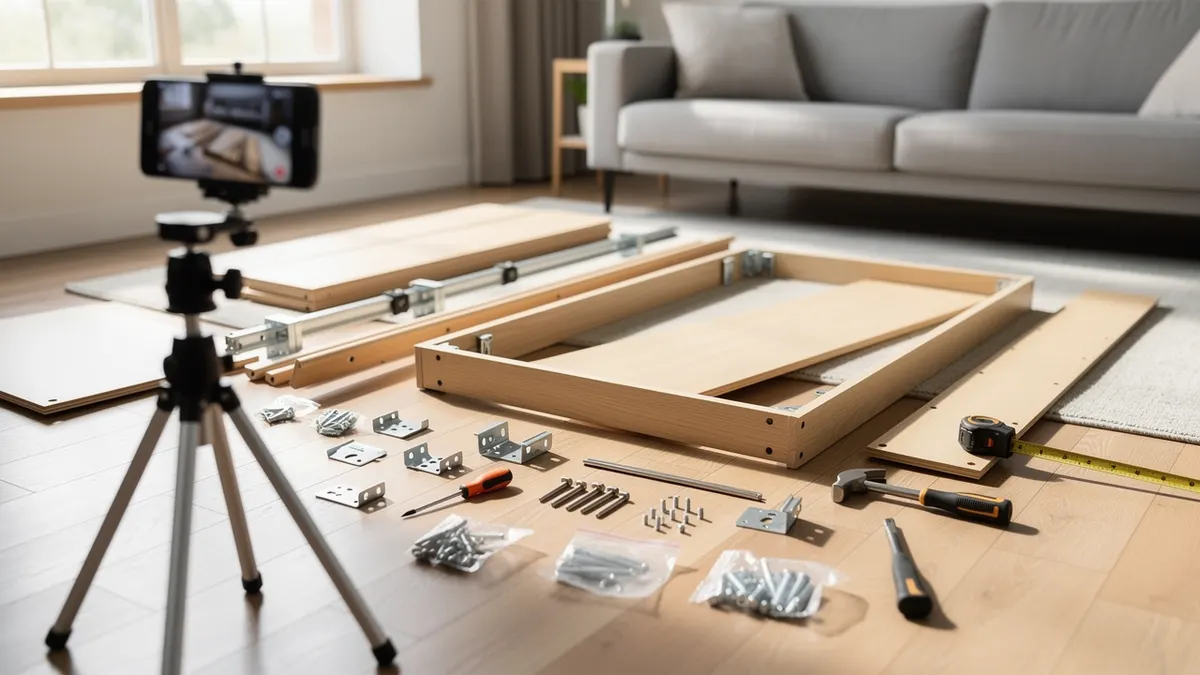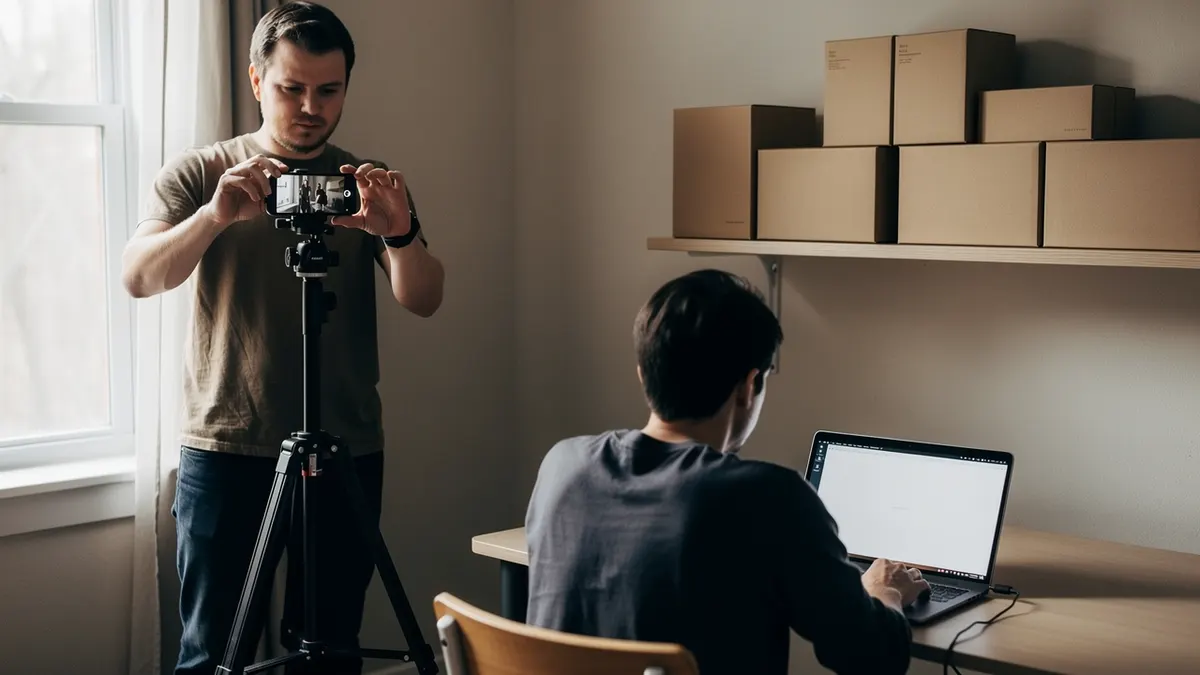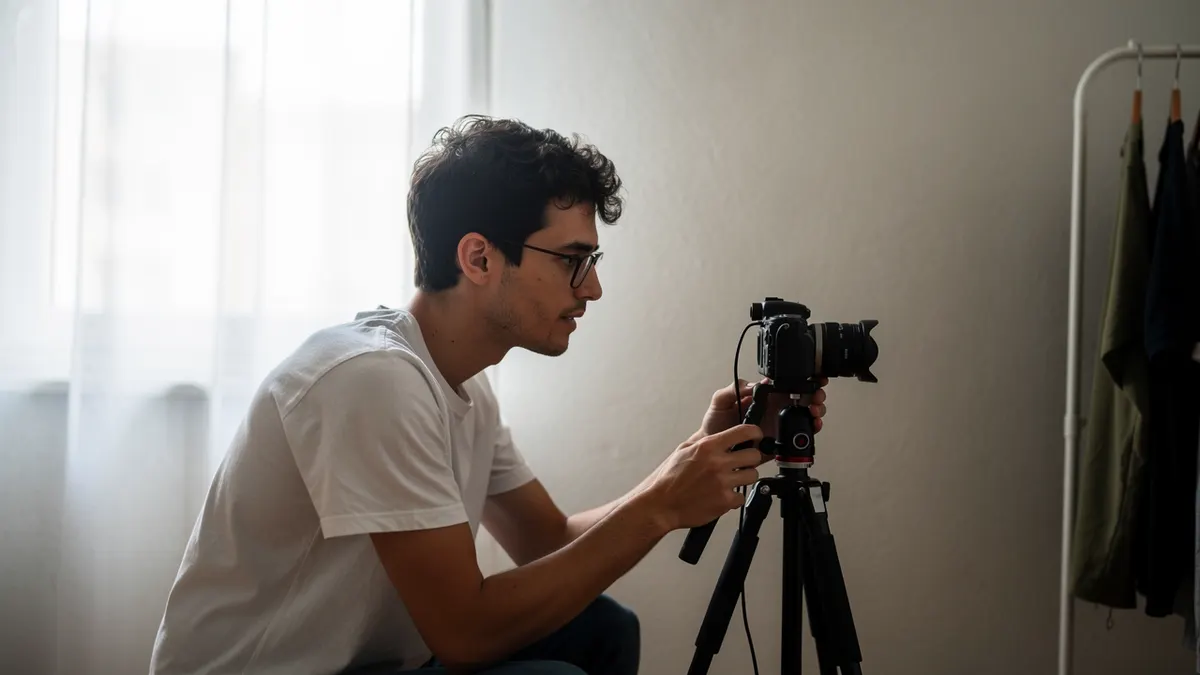
Setting up in a small flat, handling street noise and power cuts, and the corner that always works.
A corner that stays set up
Three reasons to fix one spot rather than reinstalling every time.
You gain consistency: same light, same background, same framing, which makes a series of videos coherent for a brand.
You remove the half hour of setting up that discourages filming.
And you can shoot a retake three days later without the join showing.
In practice: one square metre is enough. A free wall, a waist-height table, a window to the side, and a mark on the floor to find the exact position again.
Street noise
Four sources, four answers.
Continuous traffic is handled by timing: it weakens before eight in the morning and in the early afternoon.
Horns and sirens cannot be filtered at the edit. They are waited out: cut, breathe, take the sentence again.
Roadworks and deliveries are worked around by filming the wordless shots while they last, and the spoken parts afterwards.
And background ambient noise is reduced by bringing the microphone closer, never by raising the volume.
One flat-dweller's trick: textiles do the work. A bed, a drawn curtain, clothes hung out of frame are enough to kill the echo of an empty room.
Power cuts
Three measures, in addition to the rule dealt with above.
Charge overnight, systematically: device batteries, power bank, rechargeable lamp.
Keep one self-powered light source, a small battery lamp placed near the window, which lets you continue a series already started.
And adapt the schedule: cuts are more likely at peak demand hours, in summer and in the late afternoon.
The small space, solved
Four constraints, with their solution.
There is no room to step back: film closer in a tight shot, and change angle rather than retreat.
The background is cluttered: do not tidy everything, clear only the strip appearing behind you.
The table is too low: raise it with books, it stays stable and invisible.
And the light only comes from one side: bounce it back with a white sheet or a box lid, placed on the dark side.
The seasons change your hours
Three effects to anticipate.
In summer the light is hard and direct for much of the day. Film early, or diffuse it with a light curtain.
In winter the window gives soft but short light. The useful slots shrink to a few hours.
And heat warms phones, which then stop recording. Film in short series, let them cool between two.
Three corners of a home, three uses
| Corner | What it serves | What to fix |
|---|---|---|
| Facing a window | The face shot | A white curtain against backlight |
| The worktop | The gesture and the product | A side lamp |
| A bare wall | The product shot | A stretched sheet, no creases |
What is handled before the image
Noise. A machine, a street, a fan: cut what you can, close the rest, and speak thirty centimetres from the mic.
What stays in place between shoots
The floor marks, the tripod height, the lamp setting. Getting your set back in two minutes is what makes regular production sustainable.
The real minimum kit
Five objects, and nothing more to begin.
A recent phone, which is amply enough for vertical video.
A tripod with a clamp, which holds on a table.
A wired lavalier microphone, the purchase that most changes the perception of quality.
A rechargeable lamp, for autonomy as much as for lighting.
And an external storage medium, for the immediate copy.
One last marker: what separates a video shot at home from an amateur video is neither the setting nor the camera, it is the sound and the consistency. Settle those two points and the rest becomes a matter of taste.
Sources
Checked on 4 September 2026. Thresholds and rates change: where this guide and the official source disagree, the official source is right.