In December you have a few usable hours, and they are exactly the ones when your clients are at the office.
Overcast sky is the light, not the obstacle
Four reasons grey is an opportunity.
It diffuses evenly, which no cheap accessory reproduces properly.
It removes hard shadows on the face, the main flaw of shooting in full sun.
It keeps colours stable from one take to the next, which simplifies editing.
And it lasts: an overcast day offers constant light for several hours, whereas a clear sky changes every twenty minutes.
What that changes in practice
Five simple settings.
Stand near the window, facing it, not with your back to it.
Bounce the light back with a white sheet on the dark side, the only truly necessary accessory.
Film at eye level, because diffuse light is unforgiving of low angles.
Avoid white backgrounds, which turn grey under this sky.
And expose for the face, even if it means leaving the window blown out behind.
Rain is an image, not a cancellation
Four uses of bad weather.
The sound of rain is a credible and free background, provided the microphone is brought closer.
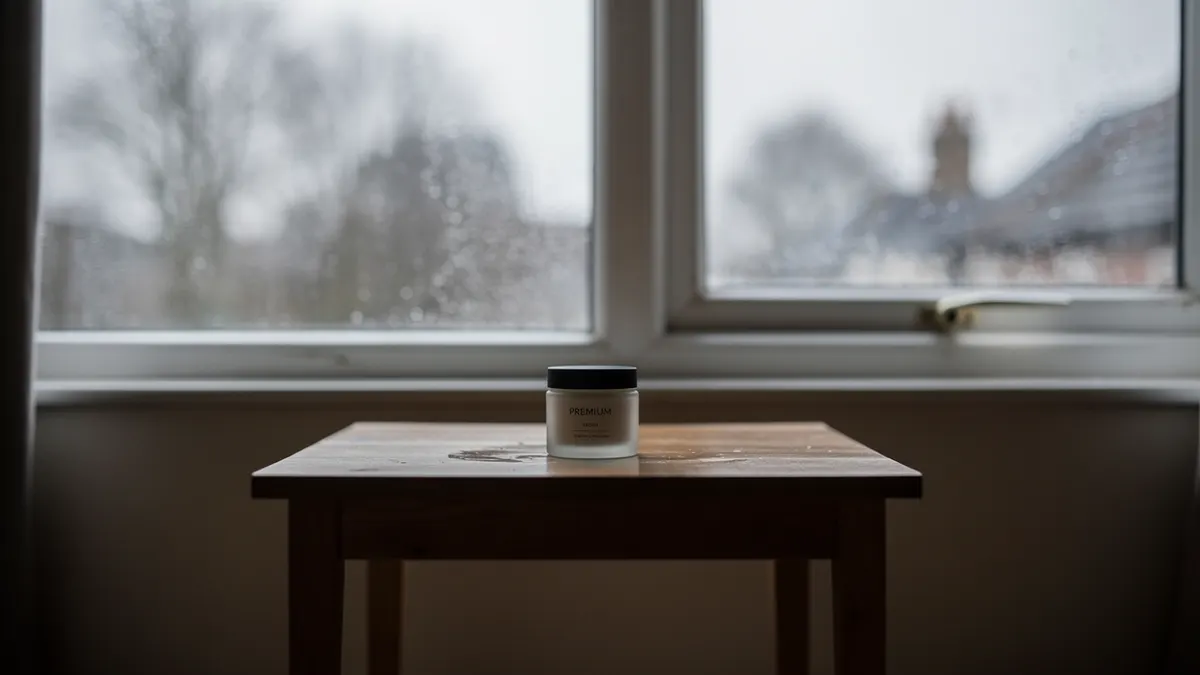
A wet window produces a texture nobody obtains in a studio.
Objects brought in, dried, wiped give real and rare shots of use.
And the indoor-outdoor contrast becomes an argument for any product linked to comfort, heating or drying.
What breaks is the schedule
Five calendar constraints specific to winter.
The useful window shrinks to a few hours around midday, exactly when approvals arrive.
The light changes fast: a series started at two in the afternoon no longer matches at four.
Product deliveries slow down, which pushes back the start of the shoot.
Genuinely bright days are rare and cannot be ordered.
And clients, for their part, think in fixed dates.
Three practical answers: block two fixed midday slots a week, shoot all the pieces of one series in the same slot, and quote deadlines in working days rather than precise dates.
What you shoot according to the sky
| Conditions | What films well | What you avoid |
|---|---|---|
| An even overcast sky | Faces and products | Nothing, it is the best light |
| A downpour | The product in the rain, if waterproof | Unprotected gear |
| A sudden ray | Wide shots | A face in full sun |
What is prepared so you do not lose the window
Gear ready in a waterproof bag, the shot list in order, and an indoor fallback already scouted. The light window sometimes lasts ten minutes.
What rescues a grey day
Nothing, and that is good news. An overcast sky is a giant diffuser: shadows are soft, colours are true, and the result is steadier than in full sun.
Switch off the ceiling light
Five lighting mistakes that cost a reshoot.
Mixing daylight and a household bulb, which produces two colours on the same face.
Adding a frontal lamp that is too strong, which flattens the relief the overcast sky gives for free.
Filming under a ceiling light alone, which hollows the eyes and ages the face.
Using a lamp with no adjustable temperature, unusable in daytime.
And compensating for weak light by raising the camera's sensitivity, which adds grain without solving anything.
One checking method: film ten seconds, look at the image on a screen other than the camera's, and correct before the real take. That check takes a minute and avoids discovering the problem at the edit.
One last marker: under this sky the constraint is not the light, which is excellent and free most of the time. The constraint is the length of the day and the impossibility of planning. A creator who organises their year around those two facts produces as much in February as in June, and is the only one in their category able to deliver an outdoor shot in midwinter.