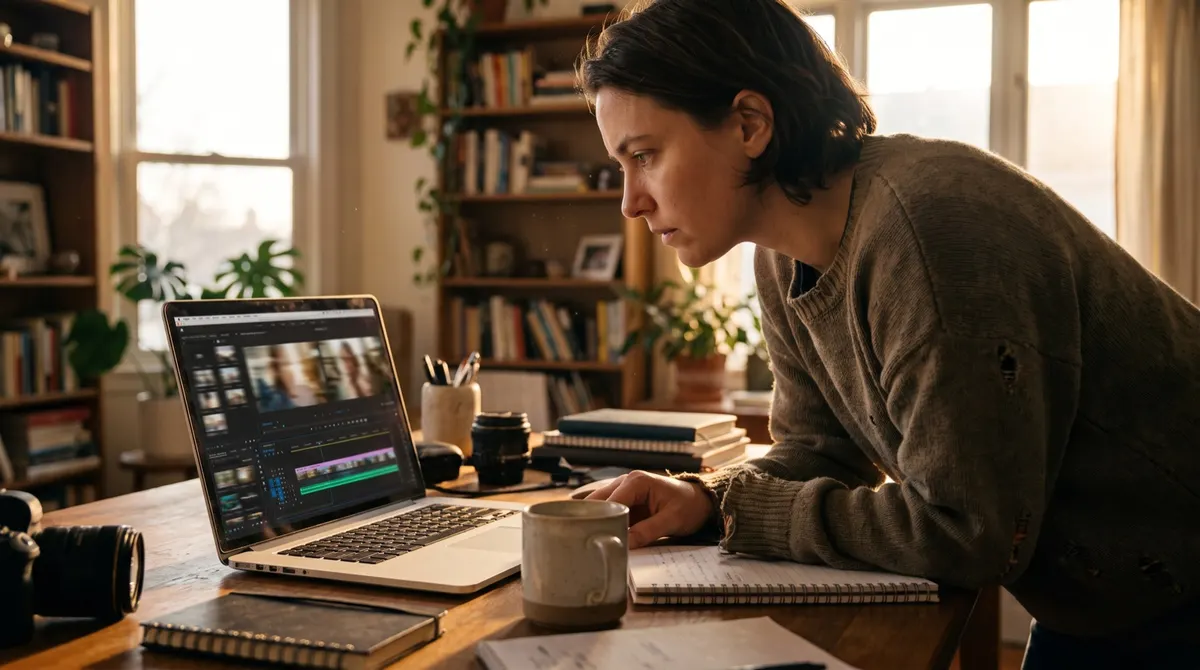
Here are the high-impact fixes first: better opening, better light, clean sound, tighter pace, clear call to action. And how to diagnose a video that falls flat.
Why your video does not convert
Six causes, from the most frequent to the rarest.
Sound, dealt with above.
An opening that talks about the product before talking about the problem.
Too slow a pace in the first ten seconds.
A promise the product does not keep.
A call to action that is missing or buried.
And a badly chosen audience, with the video not to blame.
The four fixes to make, in order
Seven openings that work, to test in this order.
The problem shown, not described.
The situation before, recognisable in one second.
The objection said out loud, then answered.
The result shown up front, before the explanation.
The question put directly to the person.
The unusual gesture, which holds without explaining.
And the short sentence that contradicts a common belief.
Are light and sound sabotaging your credibility
Six free fixes, applicable today.
Facing a window, never with your back to it.
Filming at hours when the light is soft.
Avoiding ceiling lights, which hollow out faces.
Filming in a furnished room, for the sound.
Switching off whatever hums.
And redoing a take rather than fixing it at the edit.
How to tighten the pace
Six cuts that make a video watchable.
Removing the opening greeting.
Removing the self-introduction, unless it serves the argument.
Cutting any sentence announcing what is about to be said.
Removing pauses for thought, keeping pauses of intent.
Trimming every shot by one second, systematically.
And ending on the action, not on a thank you.
Make the call to action impossible to miss
Six rules, all simple.
One call to action per video.
A concrete action, not an intention.
Spoken and shown at the same time.
Placed before the end, never on the last shot.
Phrased in the language of the target audience.
And consistent with the page the video sends people to.
Which small changes make a big difference
Seven low-cost improvements.
A microphone, before any other purchase.
A stable support, even improvised.
Subtitles proofread by hand.
A version with no music, delivered as standard.
A cutaway added every five seconds.
A background that is tidy but lived in.
And a second take of the first sentence, always better.
How to test two versions without fooling yourself
Seven rules, all essential.
Changing only one element between the two versions.
Running on the same audience, at the same time.
Keeping the same budget on both sides.
Waiting for enough volume before concluding.
Comparing over the same period, never over a partial week.
Writing the conclusion down, with the date.
And keeping the losing version, often useful elsewhere.
What to cut first
Seven passages that weigh down almost every video.
The introduction announcing the subject.
The list of technical features.
The second demonstration of the same gesture.
The transition sentence between two ideas.
The thank you at the end.
The repetition of the call to action.
And any shot you keep because it cost you time.
The fixes that change nothing
Six changes that almost never move the results.
Adding trending music.
Changing the subtitle font.
Adding transition effects.
Filming with a more expensive camera.
Making the video longer to explain everything.
And republishing the same video at another hour, changing nothing else.
What to reshoot rather than fix
Six situations where editing can do nothing.
Sound recorded too far away.
Backlight, which puts the face in shadow.
An opening delivered with no conviction.
A badly held product, illegible on screen.
A setting that contradicts the message.
And a take where the person recites instead of speaking.
Watch your video like a viewer
Watch with no sound
That is how most people will see it. If nothing is understandable, the problem is visual.
Watch only the first three seconds
If you would not have carried on yourself, nobody will.
Sleep on it
The next day you will hear the sound you had stopped hearing.
Send it to somebody who does not know the product
Ask them what they understood, not whether they liked it.
How much time to spend on each fix
Six markers, so as not to spend the week on it.
Sound is fixed at the shoot, in five minutes.
The opening is rewritten in ten minutes, never more.
The pace is tightened in one editing pass.
The call to action is changed in two minutes.
The subtitles are proofread in a quarter of an hour.
And beyond an hour of fixing, it is better to reshoot.
What you fix, in order of impact
| What you change | The perceived effect | The cost |
|---|---|---|
| The sound | The strongest | An entry-level mic |
| The light | Strong | A window, free |
| The stability | Moderate | A tripod |
| The camera | Weak | The most expensive |
What you improve without buying anything
Framing at eye level, distance to the mic, a tidy background, and a first second with no greeting. Those four habits change the result more than any purchase.
What you measure to know whether you are improving
The number of takes needed to get the right one. When it drops from five to two, the progress is real, whereas perceived quality is hard to judge on your own.
What to measure to improve
Six indicators, in this order.
The retention rate at three seconds.
The full-view rate.
The click rate on the call to action.
The cost per action, if the video runs in advertising.
The number of questions left unanswered in the comments.
And the comparison with your own previous video, never with another brand's.
One last marker: a video that does not convert is almost always fixed by one correction, not ten. Fix the sound, then the opening, then the pace, in that order, and measure again between each.
Sources
- Portal do Empreendedor (MEI), Brazilian government
- Receita Federal, Brazilian tax authority
- Simples Nacional, official portal
Checked on 4 September 2026. Thresholds and rates change: where this guide and the official source disagree, the official source is right.