The verdict, in two lines
For UGC, the phone wins on ninety per cent of jobs. The camera wins when the client asks for real depth of field, when you routinely shoot in dark interiors, or when you sell a product whose detail a small sensor cannot hold.
Buying a camera before having clients is the purchase that has burned the most money in this trade.
What actually separates the two
It is not resolution. A mid-range phone has shot 4K for years and no brand has ever rejected a video over it.
Sensor size, which is the honest difference
A large sensor gathers more light and produces the background blur associated with professional video. A phone imitates it in software, and on most shots the result is indistinguishable. It shows at the edges: hair, glasses, steam from a cup. If your product has complicated outlines, the difference is real.
Behaviour in low light
Here the gap is real and software does not close it. Shooting at seven in the evening in November, in a living room without a large window, produces visible noise on a phone and a clean image on a camera. For a creator who works by day next to a window, this never matters. For one who films after their day job, it matters every day.
Audio, which decides more than the image
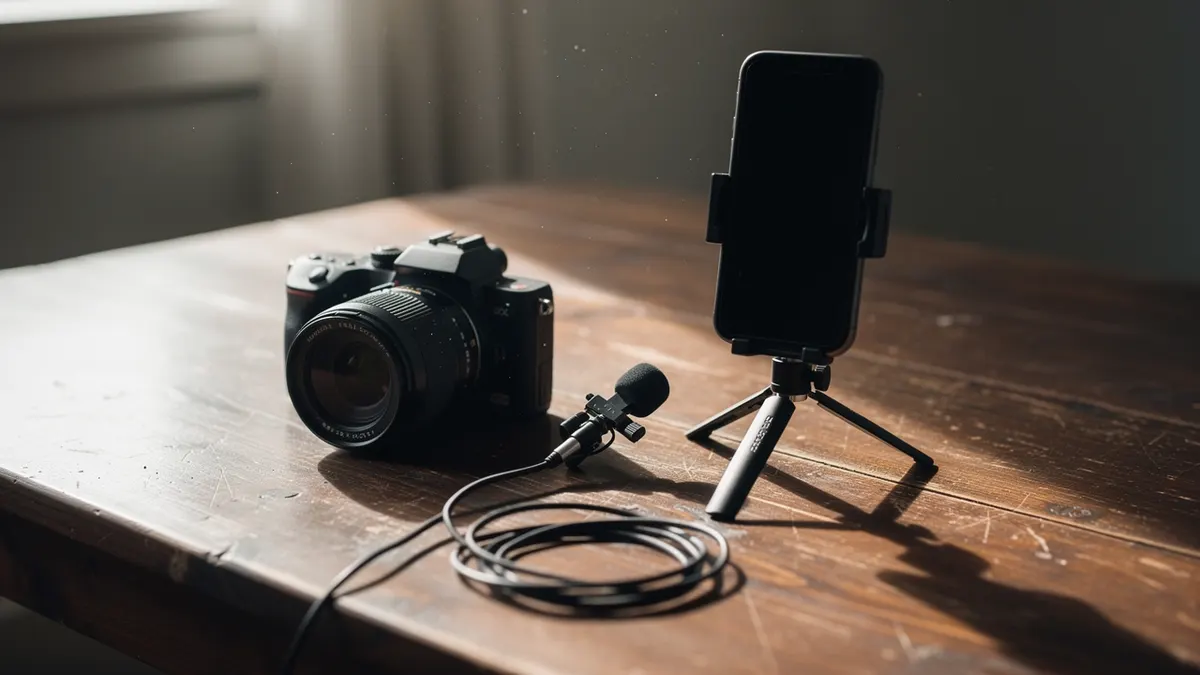
Neither works as it comes. The phone's internal microphone and the camera's are equally bad beyond a metre. The purchase that changes how quality is perceived is not the camera, it is a thirty-euro lavalier microphone. It is the most profitable advice in this comparison and the least followed. And if you shoot in a room with echo, a blanket over the back of a chair out of frame does more for the result than any change of camera.
The file you deliver, which is what the client sees
A brand does not receive your camera, it receives a file. And there the difference narrows far more than the price of the gear suggests.
Almost every job asks for 9:16 vertical, between 1080 and 4K, with clean audio and no watermark. A current phone delivers that by default. A camera delivers a horizontal file, in a flat colour profile if you shot that way, which has to be cropped, graded and re-exported before it is usable. The client does not see that extra work and you pay for it.
There is one exception worth knowing: when the client asks for raw material to edit in house, the camera has a real advantage, because a file with greater colour depth survives someone else's grading better. That job exists, but it is a minority in UGC and it is paid as brand video, not as UGC.
What each option costs
| Item | Phone | Camera |
|---|---|---|
| Starting gear | you already have it | 600 € to 1 400 € |
| Lavalier microphone | 30 € to 90 € | 30 € to 90 € |
| Stabilisation | built in | tripod or gimbal, 60 € to 200 € |
| Editing time per piece | 30 to 60 minutes | 60 to 120 minutes |
| Learning time | hours | weeks |
| Redoing a take on the spot | immediate | needs checking on screen |
The surprising row is editing time. A camera file is heavier, is not optimised for vertical and usually needs colour correction. If you charge 120 € a video, two hours of editing instead of one halves your hourly rate.
When the phone is enough, and it almost always is
When you shoot by day, vertically, with the product less than a metre away. When the job is an unboxing, a demonstration, a testimonial or a routine. When the client buys the video for social or for mobile advertising, which is where ninety-five per cent of UGC ends up.
And above all when you are starting. A camera does not raise your rates: rates rise when you can write a hook, not when you buy a sensor.
When the camera starts paying for itself
When you invoice steadily and part of your work comes from brands who review material on a large screen. When you work in categories where detail rules: jewellery, textured cosmetics, close-up food. When you are obliged to shoot at night. And when you want to offer something other than classic UGC, such as brand video or website content, where the visual bar is different.
A simple calculation to decide: divide the price of the gear by what you charge per video. If the result is over ten jobs, and you do not have ten jobs committed, the answer is to wait.
It is worth doing with numbers. A creator charging 110 € a video and delivering six pieces a month invoices 660 €. A 900 € body plus a 300 € lens and an 80 € tripod come to 1 280 €, almost two full months of gross billing, before tax and social contributions. For that purchase to make sense, it has to produce an increase in rate or volume that pays it back in under a year, which is about 110 € more a month.
Does that happen? Sometimes, and not because of the image. It happens when the camera lets you accept a kind of job you used to turn down: content for the client's website, studio product video, interviews. If those jobs are not in your book and you are not actively chasing them, the camera does not pay for itself, it sits in a cupboard.
The opposite mistake exists too. A creator with fifteen monthly jobs still shooting at night on a phone loses takes, repeats sessions and delivers material the client accepts grudgingly. There the gear is no longer a whim, it is the cause of the friction.
And there is a third route almost nobody raises: renting. In Madrid, Barcelona and Valencia, shops rent a body and lens for between 40 € and 70 € a weekend. For a creator who gets two or three demanding jobs a quarter, renting costs under 300 € a year against 1 280 € to buy, and it removes the risk of buying the wrong gear before knowing what is needed.
The second-hand market is the other reasonable way out. A body two generations old shoots exactly the same vertical video as this year's model, at half the price, and the difference shows in functions UGC does not use.