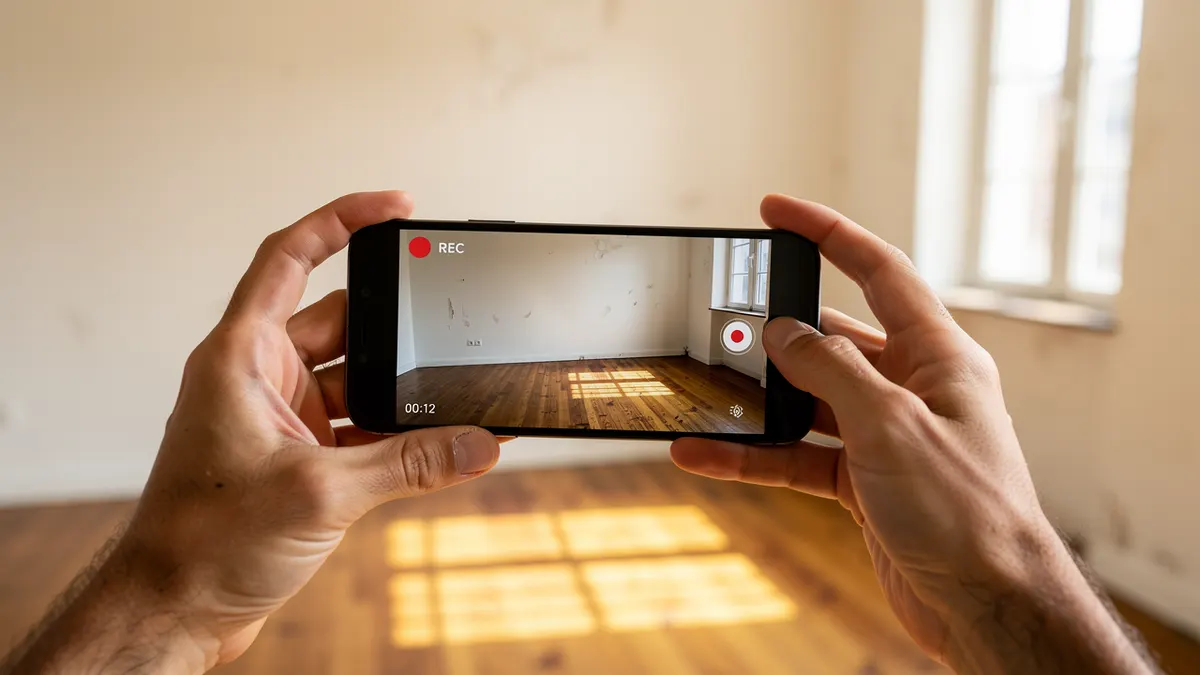
A property video dies the day the property sells, and everybody knows it while shooting. Invoice it accordingly, or sell what survives instead.
Two orders under one word
The property, which is perishable
A flat's video has a lifespan known in advance: a few weeks, sometimes a few days. It will be taken down without notice, and nobody will tell you. It is a production, not an investment, and it has to be invoiced as such, at shooting and editing, with no spreading over time.
The agency, which is not
Everything about the agency, its method, its area and its people stays useful for years. These are two distinct orders, with two prices, two rights durations and two ways of shooting, even though they are almost always bundled under the single word video.
What does not belong to you
Seven points to settle before shooting, several of which are surprising.
The property itself, access to which depends on the owner and not on the agent.
The common areas, which come under the building.
The people present, including neighbours passing by.
Furniture belonging to an occupant, who has not necessarily given agreement.
Visible artworks and decorative objects, whose image may be protected.
Commercial signage in the neighbourhood, to be filmed with care.
And music, whose rights for commercial use are checked before editing.
The sentences you must not write
Seven formulations to leave to the agency, whose exact framework is checked with the competent authority and with a lawyer.
Any statement about the floor area, the construction or the condition of the property.
Any mention of yield, investment or future value.
Any promise about administrative timescales or obtaining financing.
Any description of the neighbourhood liable to exclude a category of people.
Any comparison with another property on the market.
The mandatory professional details, which belong to the agency.
And the price, which changes and dates the video faster than anything else.
What survives the sale
Six sets of footage to shoot systematically.
The neighbourhood, dealt with above, filmed on foot and at eye level.
The agent's introduction, in thirty seconds and one take.
The gestures of the trade: opening, measuring, explaining, handing over keys.
The shops and services around, without signage being too visible.
Seasonal exteriors, to be redone once a year.
And testimonials from former clients, with written agreement, which serve the whole agency.
How to invoice a perishable video
Six pricing rules specific to this category.
Invoicing the production in full at the shoot, without tying payment to the sale.
Separating the property video and the agency library on the quote.
Setting a short rights duration for the property, a long one for the agency.
Explicitly providing for the property selling before release, which happens often.
Charging extra for a second visit, which agencies regularly request.
And offering a monthly subscription rather than one-off orders, which matches agencies' real rhythm.
Turning it into a relationship
The agent moves house and takes you along
In this profession, people move more than brands do. A satisfied agent changing agency takes their suppliers with them, including their videographer, because they already know the rhythm, the price and the quality. That is why the agent's personal library, their introduction, their gestures, their face, is worth more than an order for twenty properties: it belongs to somebody who will take you elsewhere.
The shoot that produces both orders
Six organisational settings for leaving with everything.
Planning twenty minutes more than the announced time, reserved for the neighbourhood and the agent.
Shooting the property first, while access is open.
Filming the agent outdoors, never in the property's living room.
Recording their introduction twice, one short and one long version.
Noting precisely what was shot, so it can be sold again later.
And delivering the library separately, in a folder distinct from the property's.
What is filmed in a property
| Sequence | What it proves | The rule |
|---|---|---|
| The entrance and moving from room to room | Volume and flow | A continuous shot |
| Each room in full | The real proportions | No distorting lens |
| The exterior and the access | The surroundings | No identifiable neighbour |
What is arranged before the appointment
The owner's written consent, no occupants during the shoot, and the removal of personal items. An inhabited property is filmed with the residents' explicit agreement.
What is never stated without a document
A floor area, a survey, a service charge or an energy rating. Each is read on an official document, to be confirmed with the professional holding the mandate.
What changes for a rental
Five differences from a sale.
The lifespan is even shorter, sometimes a few days.
The current occupant is often present, which changes the permissions needed.
A furnished place films differently from an empty one, the question being immediate use.
Charges and conditions are never stated in the video, they belong to the listing.
And seasonality is strong, which allows a subscription aligned with the turnover periods.
One last marker: in Portugal, a creator who only films properties starts again from scratch every month. One who leaves every shoot with twenty minutes of agency and neighbourhood footage builds a catalogue that can be sold again, and ends up invoicing the same day twice.