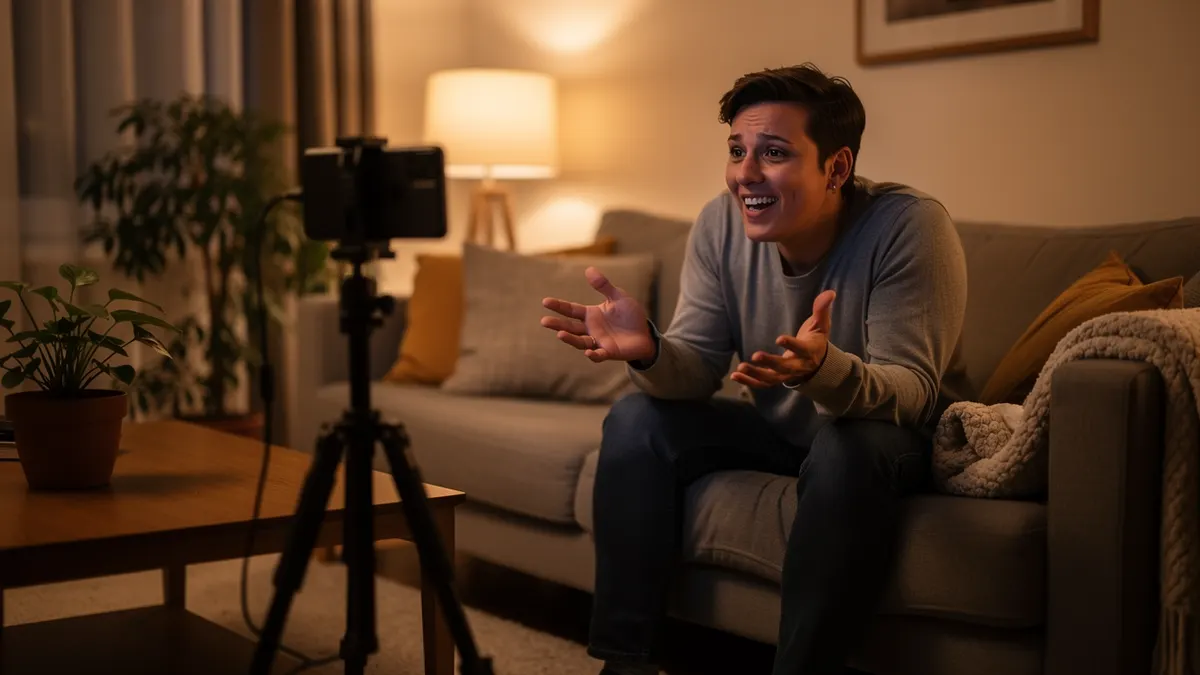
A brand asks whether you can deliver in English. You say yes, because you speak English. Two weeks later the video comes back with a revision request nobody can explain, and everyone is polite about it.
The problem was not your English. It was that the language was treated as a personal attribute rather than as part of what was being bought, so nobody agreed on what it actually had to sound like.
Four requests that look the same
They arrive worded almost identically and they want different things.
A Portuguese brand selling abroad
They want their product understood in a market that is not this one. The accent matters less than the clarity, and a Portuguese accent in English is often an asset: it says the product comes from somewhere. Ask which country the campaign runs in, because English for the Netherlands and English for the United States are not the same brief.
A foreign brand producing here
They want the footage from Portugal and the voice from home. Often the right answer is that you film and someone else speaks, and saying so early makes you look competent rather than limited. You can still be paid for the shoot, the direction and the rights.
A Spanish client
Iberian brands cross the border constantly and will ask for Spanish because it is cheaper than hiring twice. Be honest about the level. A Portuguese speaker doing approximate Spanish is instantly recognisable to a Spanish audience, and it damages the brand more than an obvious Portuguese voice with subtitles.
Brazilian Portuguese, asked of a Portuguese creator
This one gets accepted far too easily. It is a different variety with different vocabulary and rhythm, and a Brazilian audience hears the difference in the first sentence. Unless the brand explicitly wants a European voice speaking to a Brazilian market, this is not a language question, it is casting.
| The request | What it really wants | Check before saying yes |
|---|---|---|
| Can you do it in English | An understandable voice for a foreign market | Which country, and who signs off on the wording |
| We need Spanish | A second market without a second shoot | Whether the audience is Spanish or Latin American |
| Do it for Brazil | A Brazilian voice, usually | Whether they know you are European |
| Both languages please | Two files, not one bilingual file | That the second version is quoted, not assumed |
The last row is where money is lost. A second language is a second deliverable with its own edit, its own captions and its own approval round, and it is priced as one.
Shoot the second version, never dub it
If two languages are agreed, do both on the day, in the same clothes, in the same light, back to back. Ten extra minutes at the shoot costs nothing.
Recording a voice afterwards over the same picture never works. The mouth does not match, the rhythm of the gestures belongs to the first language, and viewers register that something is wrong without being able to say what. The only case where a separate voice is fine is when nobody is speaking on camera in the first place.
Judging your own level honestly
There is one test and it takes thirty seconds. Away from any script, improvise half a minute about the product in that language, record it, and listen back.
If it holds, you can perform in that language and you can quote for it. If it stalls, you can read in that language, which is a different and much smaller thing. Reading works for a voice over product shots and fails the moment the camera is on your face, because a performance needs the words to be somewhere other than in front of your eyes.
Say which of the two you are offering. Brands almost never ask, and they are relieved when someone tells them.
When to say no
There is one situation where declining is the professional answer: when the language fights the script.
If the copy is idiomatic, funny, or built on wordplay, it needs someone who owns the language. Delivering it approximately produces a file the brand cannot run and you cannot invoice with a straight face. Offer the alternative instead: you film it, you deliver clean footage and captions, and they bring the voice.
That answer loses one job and wins the next three, because a brand that has been told the truth once will ask you again.