A brand opens your best video, watches the beginning, then scrolls to see how many others there are. The second half of that sentence is the whole problem.
What a first portfolio has to prove
Nobody buys taste, they buy repeatability
A buyer is not judging your creativity, they are assessing a risk: paying, waiting, and receiving something unusable. Anything that reduces that risk has value, and nothing else does. That is why regularity beats brilliance by a wide margin, and why a decent video delivered four times is worth more than a remarkable one delivered once.
Four ordinary videos beat one brilliant one
Four is enough, and the number is not arbitrary. Below that, no method is visible. Above it, nobody watches. Those four videos have to share the same technical level, the same care and the same pacing, and differ only in the product and the objection handled. It is the resemblance between them that constitutes the proof, not their variety.
Here, speculative work is prospecting, not practice
Choose the brand the way you choose a prospect
Filming for practice leads nowhere if the product matches no real buyer. So choose brands you could approach tomorrow: present in Portugal or selling online in your language, with a visible advertising budget, and a product you genuinely use. The video then becomes an application that already shows the finished work, rather than an exercise.
What to shoot this week
Seven steps, in order, with what you already have at home.
Choosing four products you own and genuinely use.
Assigning each a different objection: price, duration, complexity, result.
Writing a first and a last sentence for each, nothing more.
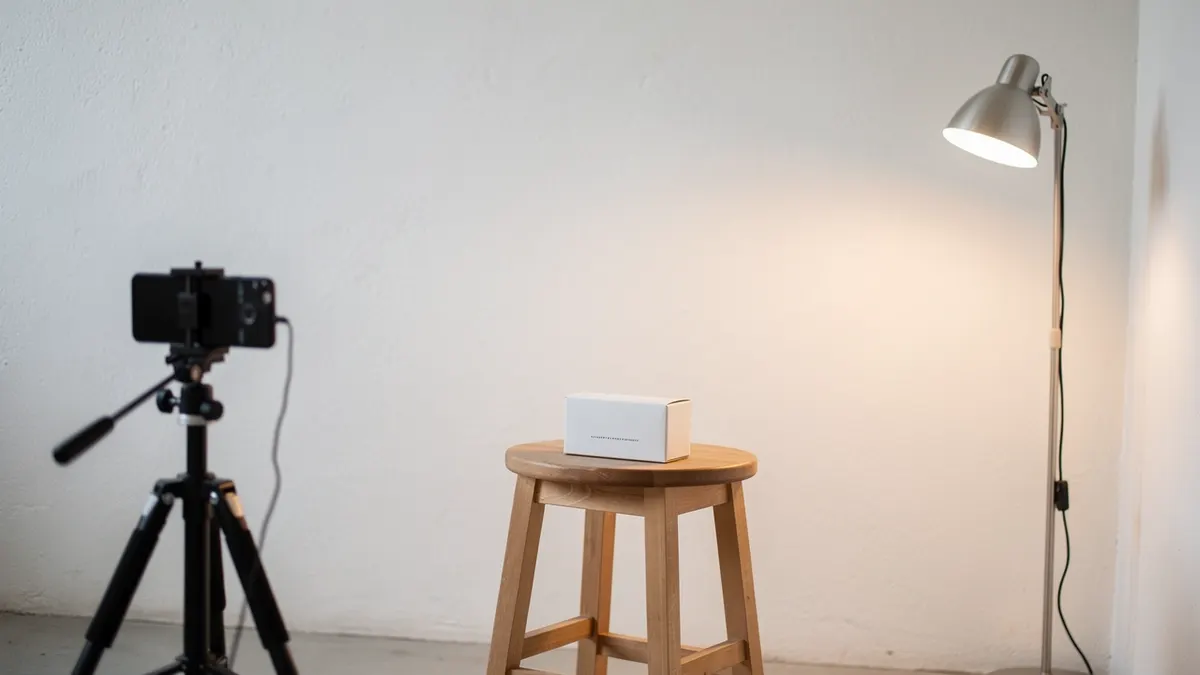
Filming all four on the same day, in the same setting, with the same light.
Editing in the same format and the same length, which makes the series legible.
Naming the files the same way, a detail buyers notice.
And publishing or sending all four together, never one at a time.
The four videos, one per objection
Six markers for choosing the objections.
Taking the objection you had yourself before buying the product.
Avoiding abstract objections, quality or trust, which cannot be filmed.
Choosing objections the product page does not already handle.
Not handling two objections in the same video.
Keeping one frankly negative objection out of the four, which immediately sets the portfolio apart.
And stating each objection out loud in the first five seconds.
How to present them
Six presentation rules that count as much as the videos.
Making all four visible on a single page, with no password and no download.
Putting first the one that most resembles you, not the most impressive.
Writing one line per video: product, objection handled, duration.
Stating that these are demonstration videos, without making an excuse of it.
Choosing a format that opens well on a phone, since that is where it is watched.
And adding one sentence about your usual delivery time, information nobody gives and everybody looks for.
What disqualifies a portfolio in ten seconds
Six flaws that make people close the page.
Bad sound from the first second, rejection reason number one.
Four videos of visibly different levels.
A vertical video next to a horizontal one, which signals improvisation.
A brand logo used in a way that suggests a collaboration that never happened.
A claim about a regulated product, wording to be checked with a lawyer before the shoot.
And a link that does not open first time, which is enough to end the conversation.
What you shoot when you have no orders
| The exercise | What it proves | What it costs |
|---|---|---|
| A product you already own | Framing and lighting | Nothing |
| A usage demonstration | The clarity of the explanation | Nothing |
| An objection answer | The ability to argue | Nothing |
What separates an exercise from a real sample
Nothing, if the quality is there. A brand never asks whether the video was commissioned; it looks at whether it could run it. That is the only criterion.
What is not done
Using a brand's logo or implying a collaboration that does not exist. The video is presented as a sample of craft, never as a client reference.
What changes in Portugal
Five features of the local market.
The domestic market is small, so some clients will be abroad and will judge remotely, on this file alone.
An English version of one of the four videos considerably widens the number of possible buyers.
Cultural proximity with Brazil opens a neighbouring market, provided you do not erase your accent.
Local brands decide quickly and are willing to test, which makes direct prospecting effective.
And competition is more about reliability than price, which favours consistency.
One last marker: your first portfolio does not have to be impressive, it has to be credible. Four videos filmed on the same day, with the same settings and the same rigour, say exactly what the buyer wants to know: that you will be able to do the same thing next week, with their product.