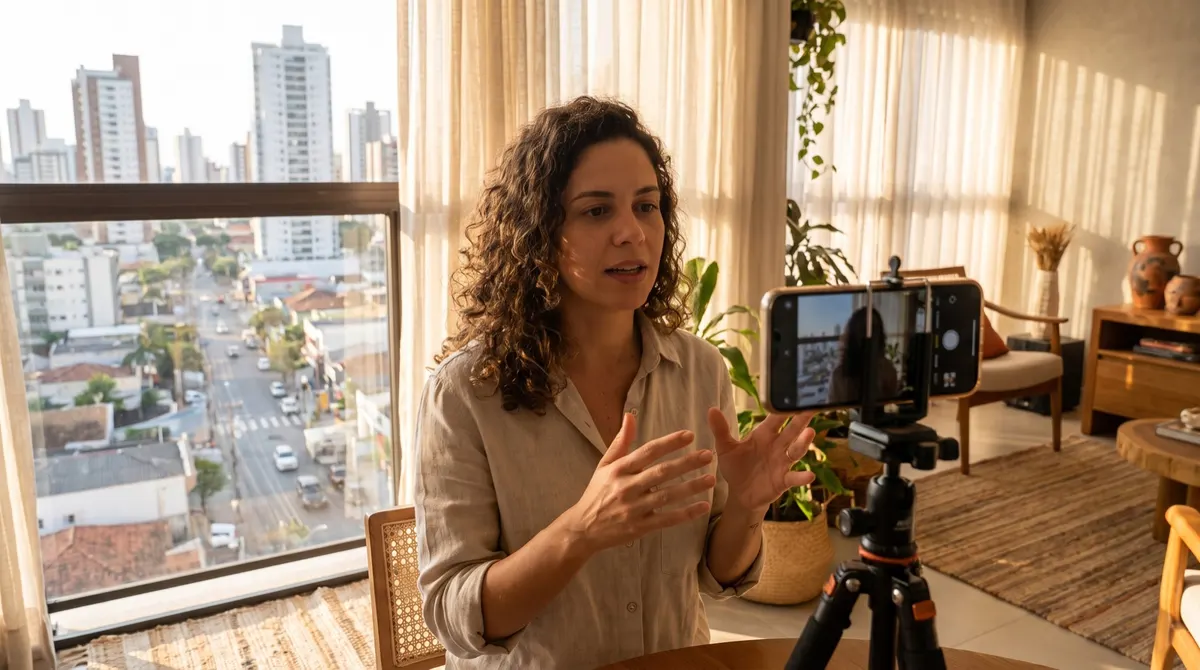
Continuous prospecting for UGC creators in Brazil: finding brands, warm and cold contact, and following up without wearing people out.
Building a target list worth having
Seven sources, from fastest to most lasting.
Marketplace sellers whose listings have no video at all.
Brands already running advertising, and therefore holding a budget.
Small brands in visible growth, which publish often and lack content.
Local distributors of an imported brand, which produce their own content.
Shops that are opening, the period when the need is greatest.
Brands whose products you genuinely use, the most credible application there is.
And companies already working with a creator you know, and therefore buying this format.
Warming the ground before pitching
Seven moves that strongly increase the reply rate.
Actually buying the product where possible, which changes the whole message.
Leaving a detailed, honest review, publicly visible.
Answering a question asked by another customer on the listing.
Commenting usefully on a post, without ever offering your services in a comment.
Identifying the person who handles content, rather than writing to the general address.
Waiting a few days between the gesture and the message, so it does not look calculated.
And arriving with a precise observation about their existing content, not with a compliment.
Writing cold messages that get replies
Seven writing rules.
A first sentence about their product, never about you.
A message of six lines at most, readable on a phone without scrolling.
A concrete, priced proposal, rather than an offer of collaboration.
A single open link, with no password and no download.
An objection identified in their category, which proves you looked.
A real availability date.
And a single closing question, answerable with yes or no.
The application video
Six production rules for this particular format.
Twenty seconds, never sixty.
A product you already own, dealt with above.
One single objection, stated in the first three seconds.
No mention of price in the video, which stays in the message.
The product name pronounced correctly, a detail that is noticed immediately.
And a version reusable for other brands in the same category, simply by changing the product.
Following up without becoming annoying
Six chasing rules.
Chasing once, seven days later, in the same thread.
Adding new information, a video, a result, an availability.
Never reproaching the absence of a reply, even jokingly.
Explicitly offering to be passed on to the right person.
Stopping after the second attempt and noting the date.
And getting back in touch six months later, with new work, which often works better than the first time.
The brands not worth approaching
Seven signals that cost more time than they return.
Those posting adverts asking for content in exchange for product only.
Those whose product page already carries videos taken from creators, with no credit.
Those replying by asking for a free example before any discussion of price.
Those whose customer reviews report delivery problems, since video will change nothing there.
Those changing name or page every six months.
Those demanding exclusivity from the first message.
And those in a heavily regulated category with nobody in charge of approval, which guarantees a blockage at delivery.
Turning a reply into a paid assignment
Seven steps after a first positive message.
Replying within the hour if possible, since speed counts enormously here.
Asking only three questions: objective, date, format.
Offering a batch of three videos rather than one.
Sending a simple quote, with production and rights separated.
Setting a delivery date tied to receipt of the product.
Confirming in writing what was agreed in messaging, without exception.
And raising the question of renewal in that first exchange, which turns a client into recurring income.
What loses an assignment already won
Six mistakes made after the positive reply, and therefore the most expensive.
Replying three days later, when the brand had written to three creators.
Sending a complicated quote, with options nobody asked for.
Stating a price different from the one in the first message.
Asking ten questions before confirming availability.
Leaving the agreement in messaging without ever writing it down in black and white.
And delivering one day after the date, which is remembered far longer than the quality of the video.
What a message that gets a reply contains
| Line | What it says | Length |
|---|---|---|
| The opening | What you noticed about them | One sentence |
| The proposal | What you can produce | Two sentences |
| The proof | A link to the closest sample | One line |
| The next step | A simple question to answer | One sentence |
What gets a message deleted unread
A ten-line block, a link to an entire folder, and a sign-off longer than the proposal. Three flaws with no relation to the quality of the work.
What is measured honestly
The reply rate over thirty messages, not five. Below one reply in ten, it is the message that needs changing, not the recipient list.
The weekly rhythm that holds
Six habits that make prospecting sustainable.
Adding ten targets a week, never a hundred at once.
Sending five messages per working day, late in the morning.
Producing one application video a week, reusable ten times.
Keeping a simple table with the date of the last contact and the language of the reply.
Devoting thirty minutes a day to this activity, not one day a month.
And treating a low reply rate as normal, since consistency produces the result, not intensity.
One last marker: in Brazil, prospecting rewards neither talent nor persuasion, it rewards regularity and speed of reply. A creator sending five messages a day and answering within the hour gets more work than a better creator who writes three times a month.
Sources
- Portal do Empreendedor (MEI), Brazilian government
- Receita Federal, Brazilian tax authority
- Simples Nacional, official portal
Checked on 26 August 2026. Thresholds and rates change: where this guide and the official source disagree, the official source is right.