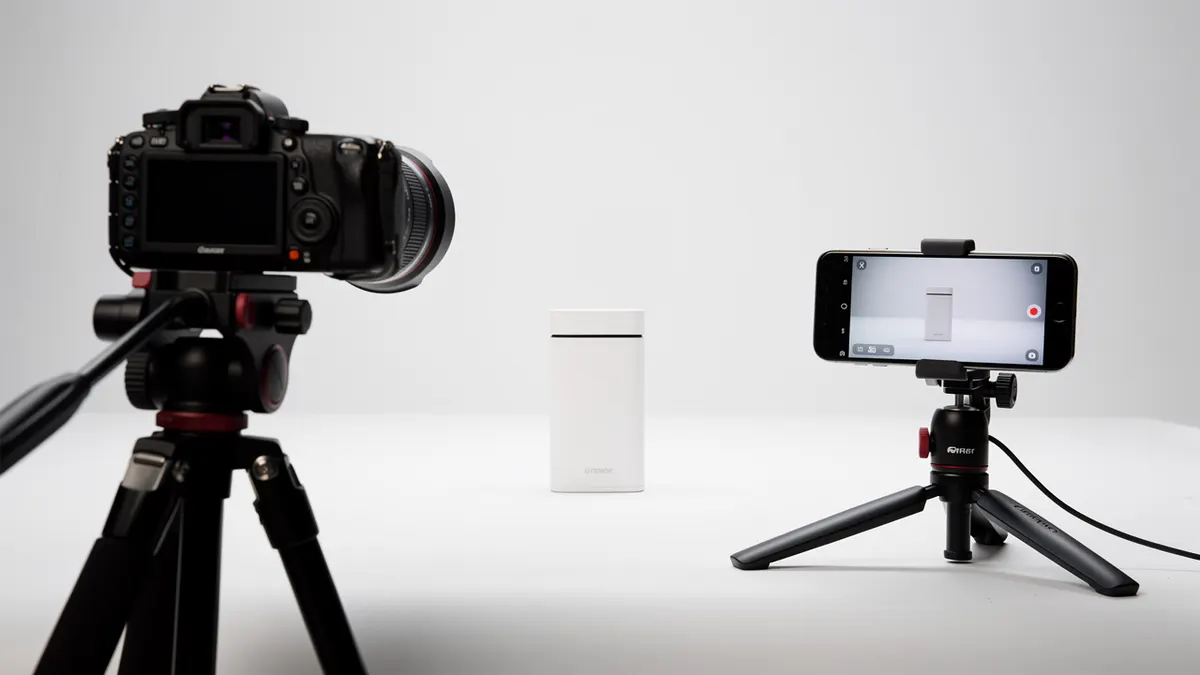

A bought photo costs a few dozen pesos and arrives in ten seconds. The problem is not the price: it is what it says, and what it forbids you to say.
The same image serves your competitors
That is the structural flaw, and it shows at the scale of a city.
Libraries classify their visuals by keyword. Three brands in the same sector search the same words, find the same first pages, and buy the same images.
The result can be observed by scrolling a feed: the same kitchen, the same terrace, the same couple laughing at a computer.
An image three competitors use builds nothing: it makes the three interchangeable.
The recognition problem
That is the point specific to the Mexican market, and it goes deeper than aesthetics.
International libraries tag their images by country, but the tag does not guarantee the eye. A large share of the visuals sold under that name show either a postcard or an interior that could be anywhere.
Yet your buyer immediately recognises a kitchen that is not hers: the packaging formats, the make of the fridge, the electric socket, the light, the way the cup is held.
She does not put it into words. She scrolls on.
What a stock library is really for
It has a use, and it is real: the set.
A background, a texture, a cutaway, a concept illustration, a slide backdrop. Everything that does not have to be recognised as true.
What it cannot carry: the argument. The moment the product works, the hand using it, the reaction, the before and after, the voice explaining.
The rule holds in one line: stock dresses the scene, creator content demonstrates.
Where to use both together
It is the most economical combination, and it is underused.
A creator video carries the demonstration and the voice. Bought cutaways fill the gaps: a city shot, a texture, a transition.
On a product page, the bought photo can serve as a banner; the usage videos must be real.
In a sales presentation, the illustration is bought, the proof is filmed.
Two separate budgets, two functions, no competition between them.
What each source really costs
| Item | Stock library | Commissioned video |
|---|---|---|
| Direct cost | A subscription or a purchase | A quote per video |
| Hidden cost | Time spent finding a shot that fits | The production lead time |
| Risk | Seeing it at a competitor's | None |
What a catalogue image can never replace
The product itself, the packaging, its size in the hand, and a person explaining why they chose it. No library holds those shots.
What combines intelligently
Mood shots come from the catalogue, product shots are filmed. Same format, same colour temperature, and the join does not show.
The test before buying an image
Three questions, fifteen seconds.
Could this image have been taken in the city where my customer lives? If you hesitate, it does not fit.
Am I asking this image to prove something? If so, it has to be filmed.
Can a competitor buy the same one within the hour? The answer is almost always yes, which settles its place: the set, not the message.
Add a fourth reflex, purely bookkeeping. Note the licence reference, its duration and the media covered in a file. An image used three years after its licence expired costs far more than a shoot.