Agency, marketplace or freelancer? Here is an honest comparison of cost, speed, control and payment security.
The four ways to get videos
Six characteristics, two per main option.
The agency: a single contact, a margin that covers coordination.
The agency: an already-tested pool, a longer start-up time.
The marketplace: direct choice of creators, a price with no middle layer.
The marketplace: a payment mechanism, coordination on your side.
The generalist freelancer: the lowest price, the highest variability.
And in-house sourcing: total control, the highest time cost.
What each option costs
Seven items to compare, never the video price alone.
The price of the video itself.
Any margin or commission.
The usage rights, often invoiced separately.
Internal coordination time, in hours.
The cost of unusable videos.
The cost of replacing a creator who fails to deliver.
And the cost of the delay to the campaign.
Which option is fastest
Six lead-time markers, from the shortest to the longest.
A marketplace with creators already available.
A freelancer already known and tested.
An agency on a recurring order.
An agency on a first job, with scoping.
In-house sourcing from scratch.
And any option at all if the product ships late.
How quality control compares
Six real differences.
The agency filters before you, but on its own criteria.
The marketplace lets you choose on portfolio.
The generalist freelancer filters nothing.
In-house depends entirely on your time.
The brief remains your responsibility in all four cases.
And the number of revisions included changes everything, whatever the channel.
And payment protection
Seven points to check before ordering.
Who holds the funds between order and delivery.
What happens if the creator does not deliver.
The refund timeframe, written down in full.
The procedure in case of disagreement on quality.
The possibility of replacing without paying twice.
The written record of exchanges.
And the exact moment payment goes out to the creator.
The comparison, line by line
Seven criteria, to decide without spending a week on it.
The price per delivered video.
The speed of getting started.
Control over choosing the creator.
Payment security.
The monthly volume it can absorb.
Ownership of the raw files.
And the exit cost, the day you switch.
The questions to ask before choosing
Seven questions, to be answered in writing.
Who writes the brief, and over how many pages.
How many different creators will be proposed.
How many revisions are included.
What happens if a creator does not deliver.
How usage rights are invoiced.
Who holds the raw files.
And what the notice period is.
The questions to ask a freelancer
Seven questions, before any payment.
The delivery time, counted from receipt of the product.
The number of versions included.
The delivery format, and the subtitles.
What the rights include, and what they do not.
The payment terms, deposit included.
Availability for a second version.
And two examples of videos for the same kind of product.
What marks out a good portfolio
Six signs readable in two minutes.
Whole videos, not only clips.
Consistent quality across several months.
Clean sound, indoors included.
Products comparable to yours.
Sharp vertical formats, not recrops.
And at least one video where the person says what is wrong.
Which option for your brand
Six situations, one answer each.
First campaign, tight budget: marketplace.
Steady monthly volume, small team: agency.
Regulated category: agency, for the review.
Urgent need on a simple product: marketplace.
Internal team of three: direct or marketplace.
And a very specialised market: in-house sourcing, topped up by a marketplace.
What a marketplace changes in practice
Six mechanisms that replace coordination.
The brief travels with the order, the creator reads it before accepting.
Payment is taken at ordering, without being released straight away.
Exchanges stay in one place, dated.
Delivery happens in a private space.
Payment goes out when the brand approves.
And replacement happens without reopening a negotiation.
What the comparison almost always forgets
Six costs invisible on a quote.
The time spent writing the brief.
The time spent reviewing versions.
The cost of a video that does not match the product received.
The cost of a licence that is too short, discovered six months later.
The cost of a creator who has to be re-explained every time.
And the cost of not knowing what worked.
How to test two channels at once
Six steps, over one month.
Write one brief, identical for both.
Order three videos on each side.
Run all six on the same budget.
Compare the cost per video actually run.
Count your hours, channel by channel.
And decide on those two figures, not on a general impression.
Can you switch later
Yes, and it is simpler than people think, on one condition: keep the raw files and the contact details of the creators who worked well. As long as those two things belong to you, changing channel costs one brief to resend. If they belong to the supplier, the change costs an entire library.
What each route takes on
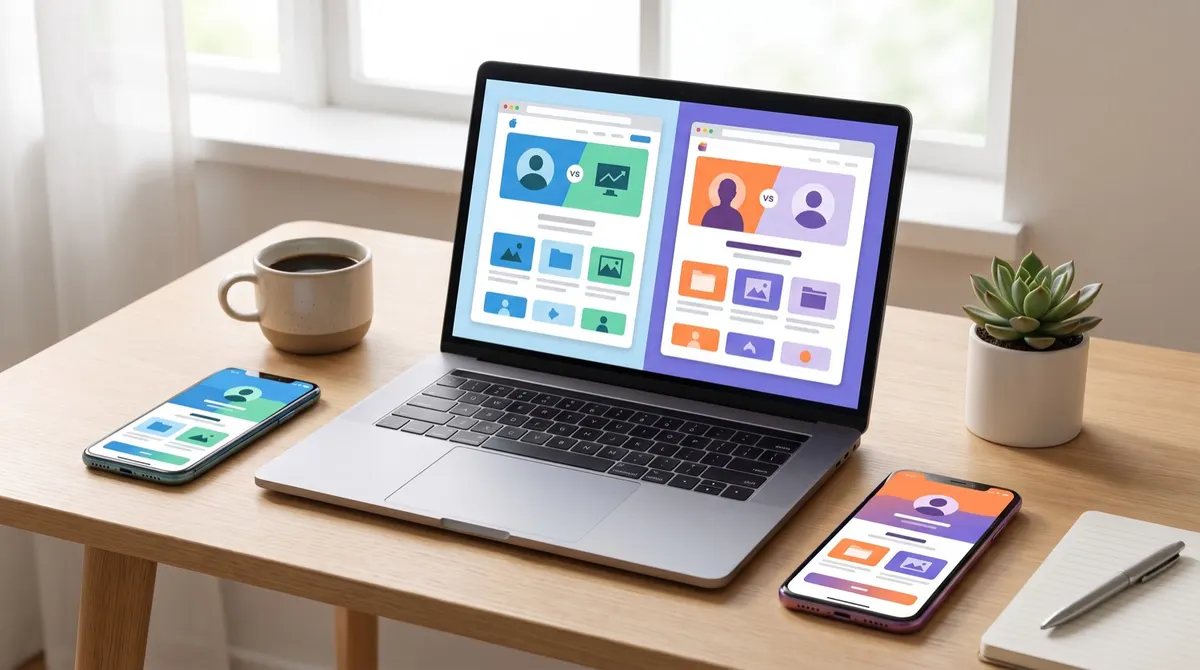
| Task | An agency | A marketplace |
|---|---|---|
| Finding creators | It proposes a list | You filter yourself |
| Tracking production | A single contact | One thread per creator |
| Framing payment | Invoiced by the agency | The platform's process |
| Choosing the faces | A proposal | A direct choice |
What it costs on both sides
An agency takes a margin per video, a marketplace a commission known in advance. The real question is not which costs less, but what the coordination time saved is worth.
What decides according to volume
Below five videos a quarter, the platform is enough. Beyond thirty a month with tight deadlines, coordination becomes a job and the agency is justified.
What the platform charges
On UGC MATCH, joining is free and there is no subscription: the platform retains 10% of the price on the creator side, who therefore keeps 90%, and charges the brand a 6% service fee, with a minimum of 1.50 EUR. The brand pays at ordering, the funds are not released straight away, and payment goes out on approval.
One last marker: do not compare prices, compare what happens on the day a video fails to arrive. That is the day the difference between the options becomes visible.