A purchase made once a decade, researched obsessively, and settled on points no spec sheet ever mentions.
Access is the first question
The most frequent cause of cancellation, and it is purely physical.
Before choosing an appliance, the buyer wonders whether it will fit through: the front door, the lift, the turn of the stairs, the threshold, the width of the corridor.
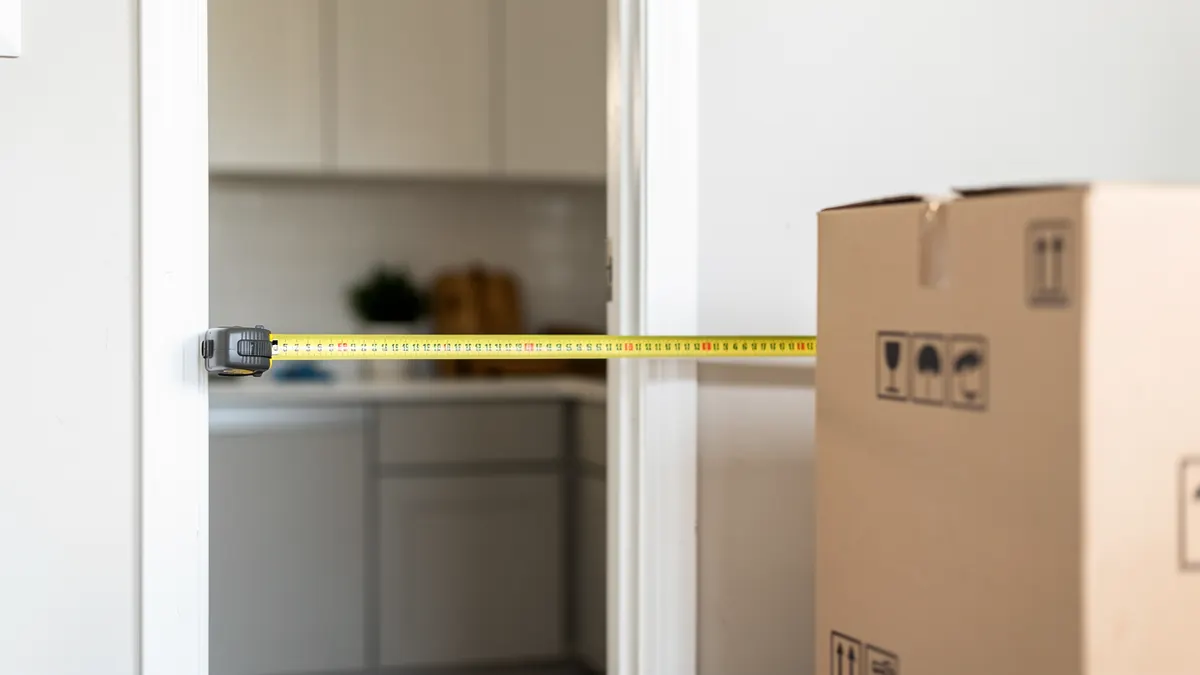
So film the whole route, tape measure in hand, with the figures said out loud. Two shots are enough: the doorway measured, and the appliance seen from the front with its width on screen.
Built-in fitting needs precise figures
That is where video really replaces a datasheet.
Show the available space, the clearance needed at the back for connections, the door opening once installed, and what happens when a neighbouring drawer opens at the same time.
Two mistakes never to make: filming an appliance in a studio kitchen, larger than average, and cutting the sequence before the door opens fully.
Installation is a worry, not a detail
Three questions come back, and nobody answers them on video.
Who connects it, and whether a qualified person is needed for water, gas or electricity.
What is included in the delivery: carrying upstairs, removing the old appliance, starting it up.
And the real time between the truck arriving and first use.
Show those three points and you remove the main objection.
Winter changes two things
That is the local particularity, and it goes unnoticed.
An appliance delivered in deep cold is not plugged in straight away: it must come back to temperature, and a compressor started too early can suffer. Say so, with the waiting time given by the manufacturer.
And the season's humidity changes perception: a dryer that seems slow in summer looks indispensable in February, when nothing dries in the open air.
Here the claims are performance claims
That is the risk zone, and it is regulated.
Consumption, efficiency class, announced savings, capacity, noise level: these are values measured in standardised conditions, which are not recalculated in a living room.
Three rules. Read the label on screen rather than quoting a figure from memory. Never convert a consumption figure into a saving on the bill. And check the mentions applicable to appliances and their labelling with the competent authorities before publication.
What the buyer wants to see before ordering
| Doubt | The shot that answers it | Length |
|---|---|---|
| The size in the kitchen | The appliance in place, next to the worktop | 6 s |
| The noise | A take with no music, at real level | 8 s |
| The upkeep | Dismantling and cleaning | 15 s |
What is filmed over time
The same appliance after a month of use. Marks, seals and worn controls say more than any unboxing shot.
What is not claimed without a document
A consumption figure, a noise level, a capacity or a programme duration. Those numbers come from the technical sheet, to be confirmed with the manufacturer.
The creator to choose
Two criteria, and audience is not one of them.
Somebody living in a home comparable to the target customers': same floor area, same kind of kitchen, same constraints.
And somebody willing to film over time, because the strongest asset in this category is the video shot six months after installation, when the appliance has been used every day and the novelty has worn off.