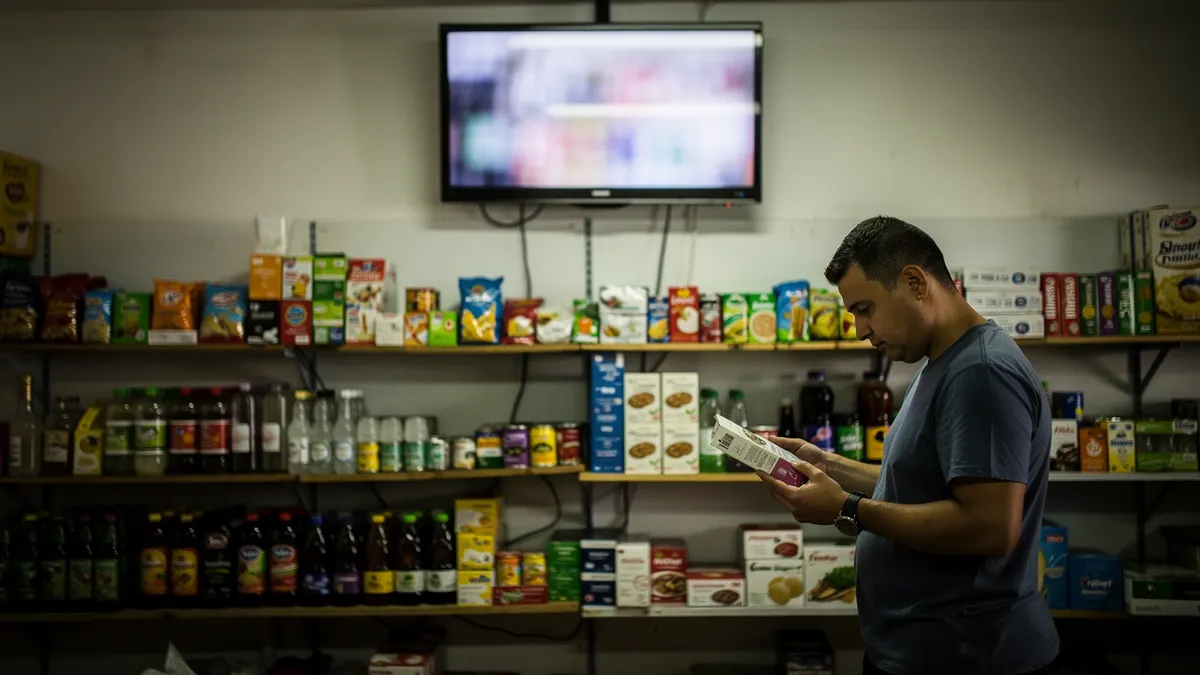
In store, the video keeps working after the click. Provided it contains nothing that ages in a week.
The shelf code extends the label
That is the most profitable and least exploited use.
A code printed on the label or on a shelf holder leads to a short video: the demonstration, the real scale, what is in the box, the assembly.
It answers exactly what the person is wondering, standing in front of the product with no assistant available. And it requires no equipment investment: the shelf already exists.
Three categories gain immediately: products that need assembling, those whose use is not obvious, and those existing in several variants that are hard to compare on the packaging.
What the video must contain in that case
Four elements, and none of them dates.
The product out of the box, placed next to its packaging, for scale.
The main gesture, filmed in full, with no cut.
The list of what is included, shown flat.
And the real duration of an operation: assembly, preparation, charging, drying.
Add a very short version, ten to fifteen seconds, for people watching while standing in an aisle, and a long version for those genuinely hesitating.
In-store screens
They obey physical rules, not creative ones.
The person walks past, does not stop, looks from a distance and without sound. What works: a close-up recognisable in one second, a loop with no apparent beginning or end, and one word legible at three metres.
What fails: long text, a wide shot, a spoken hook, a logo at the end, and the price, for the reason described in the box.
The useful length is short, ten to fifteen seconds repeated. A thirty-second video in store is never seen in full.
What to plan in the brief
Five points, all written before the shoot.
The formats and file sizes accepted by the shop or by the distributor.
A version with no burnt-in text, so a disclosure or a language can be added later.
A fixed ten-second product shot, no hands and no movement: that is the one always asked for again and impossible to manufacture afterwards.
Rights explicitly covering distribution at the point of sale and by resellers, which are not included by default in an advertising licence.
And the authorisations of the people filmed, valid for that medium.
That last point blocks more broadcasts than all the others combined. The obligations applicable to disclosures, claims and people's image depend on your situation and are checked with a lawyer, before the files are submitted.
Your resellers have nothing
That is the blind spot of most brands.
The shops selling your products have neither content, nor time, nor the skill to produce any. So they post the manufacturer's photographs, or nothing.
Give them a simple folder: two short videos with no dominant logo, a version with no text, the fixed product shot, and one page saying what to publish and where. The cost is nil since the shoot already exists, and the effect is immediate, because those shops talk to customers your advertising does not reach.
What the video changes for a physical shop
| Goal | What you film | Where it serves |
|---|---|---|
| Bring people in | The window and the street | Local networks |
| Reassure before coming | The interior, visible opening hours | Business listing |
| Sell on the spot | The product tried at the counter | In-store screen |
What is prepared with the team
A slot with no customers, someone happy to appear, the area to film in and the product to show. Thirty well-prepared minutes beat two improvised hours.
What ages fast and is reshot
A displayed price, a promotion, a seasonal decoration. Filming those shots separately lets you swap ten seconds instead of the whole video.
What can be measured
Two figures, and they are available without any tool.
The number of scans of the shelf code, by item and by shop. It tells you which product raises a question, and where.
And the change in sales of that item in the equipped shops, compared with the others. That is the only measure isolating the effect of the setup, and it needs nothing but a spreadsheet.
Sources
Checked on 4 September 2026. Thresholds and rates change: where this guide and the official source disagree, the official source is right.