What a Mexican buyer must see before adding to basket, and why the diversity of skin tones decides the video's effectiveness.
Naming the starting skin tone
That is the rule making the video useful to somebody other than the person filmed.
With no named starting point, a result cannot be transposed: the audience does not know whether it is looking at its own situation.
Three elements to state at the start, in one sentence.
The starting shade and its exact reference in the range used.
The undertone, where the brand documents it.
And the state of the skin that day: dry, oily, after exercise, at the end of the day.
One video is never enough
That is the point campaigns from elsewhere underestimate.
The country brings together a very wide variety of skin tones, and a single demonstration speaks to only a fraction of the audience.
Three casting rules. At least four different skin tones per campaign, not two. Profiles living in different regions, because the climate changes the result. And people who genuinely use this type of product, not neutral faces.
One budget consequence: four simple videos at four people's homes are worth more than one polished video at a single one.
The application shot is the whole video
Three technical requirements, settled on the shoot.
A fixed shot, with no cut during application: a cut in the middle destroys the proof.
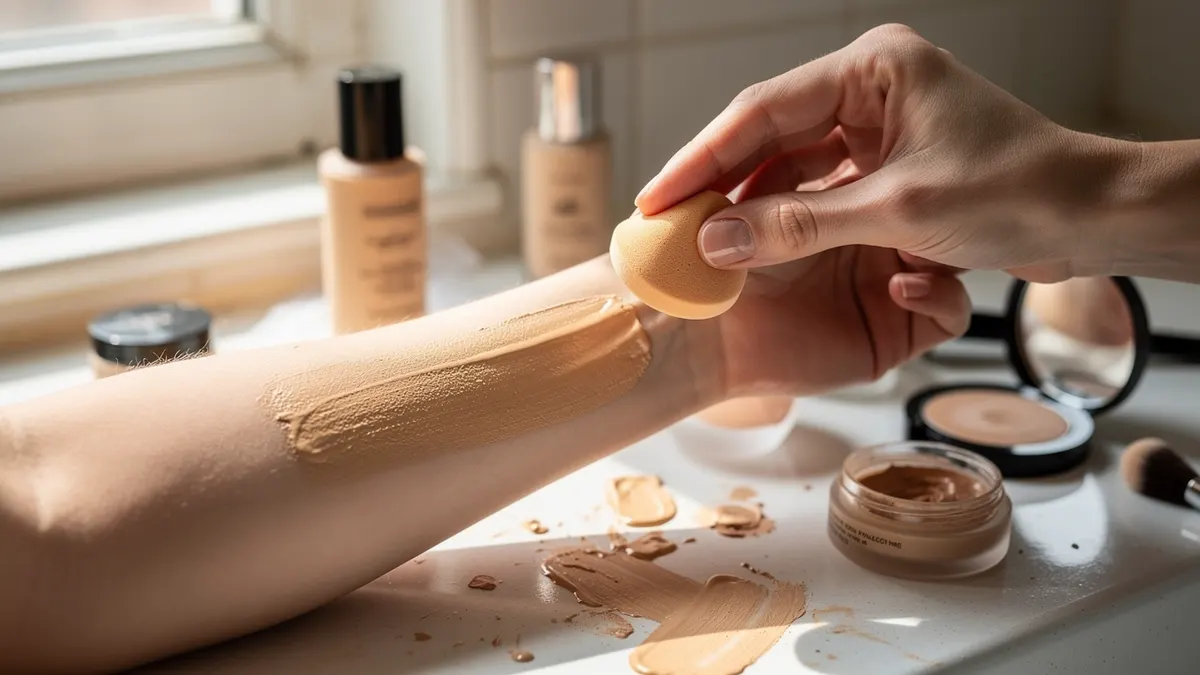
Real quantity visible: what is taken, on the finger or the sponge, before being applied.
And the same distance to the face from start to finish, so the colour stays comparable.
Two absolute prohibitions: no filter, no skin retouching. A filtered video in this category proves nothing and is spotted immediately.
Heat changes the result
That is the local variable nobody films.
Heat, humidity, travel, a long day: a texture holding three hours in an air-conditioned room may not hold outside.
Four shots worth a whole campaign. The result after two hours outside. The result after a journey. What happens when you touch up during the day. And the look at the end of the day, with no flattering light.
Before and after has limits
Three rules, and they protect everybody.
The two images are made in the same place, at the same hour, with the same light and the same framing.
No change of hairstyle, clothing or posture between the two.
And the elapsed time is stated, precisely.
A fourth rule, more important than the other three: claims about an effect on the skin fall under precise rules, and are checked with a lawyer before the shoot. What can be shown is not what can be said.
What the light decides
| Source | Skin rendering | When to use it |
|---|---|---|
| Side window | Visible texture, soft shadows | Applying a skincare product |
| Front ring light | Smoothed skin, catchlight in the eye | Make-up |
| Ceiling light alone | Marked under-eye shadows | To avoid |
What is shown in close-up
The texture leaving the bottle, the spread on the back of the hand, the absorption after thirty seconds. Those are the three shots buyers really look for.
What is not said on camera
A therapeutic effect, a duration of results, a comparison with a treatment. The permitted vocabulary is framed, to be confirmed with a lawyer.
What to forbid in the brief
Four points, to be written in black and white.
No filter or smoothing, including the ones applied by default by the device.
No promise of a medical result, nor of correcting a dermatological problem.
No named comparison with a competing brand without prior approval.
And no improvisation about ingredients: what is said comes from the product sheet, word for word.
One last practical point: keep, for each video, the shade reference, the date, the hour and the light source. Those four pieces of information turn a video library into a comparison tool, and that is exactly what the category never has.