How coffee brands, cafes and roasters in Brazil use UGC, the formats that work and how to get started.
Why coffee is a category made for UGC in Brazil
Seven reasons rooted in local habits.
Coffee is drunk several times a day, which gives natural content with no staging.
It is offered: proposing a cup is a social gesture, dealt with above.
The choice is made by habit, which makes a peer's recommendation more effective than an advert.
The country produces coffee, so the audience knows the vocabulary, the origin and the roast.
Preparation methods coexist, cloth filter, stovetop pot, capsule machine, each with its own audience.
The price per cup is an argument understood immediately.
And smell cannot be filmed, which forces you to show something else: the gestures, the crema, the colour, the routine.
The coffee content formats that convert
The preparation ritual
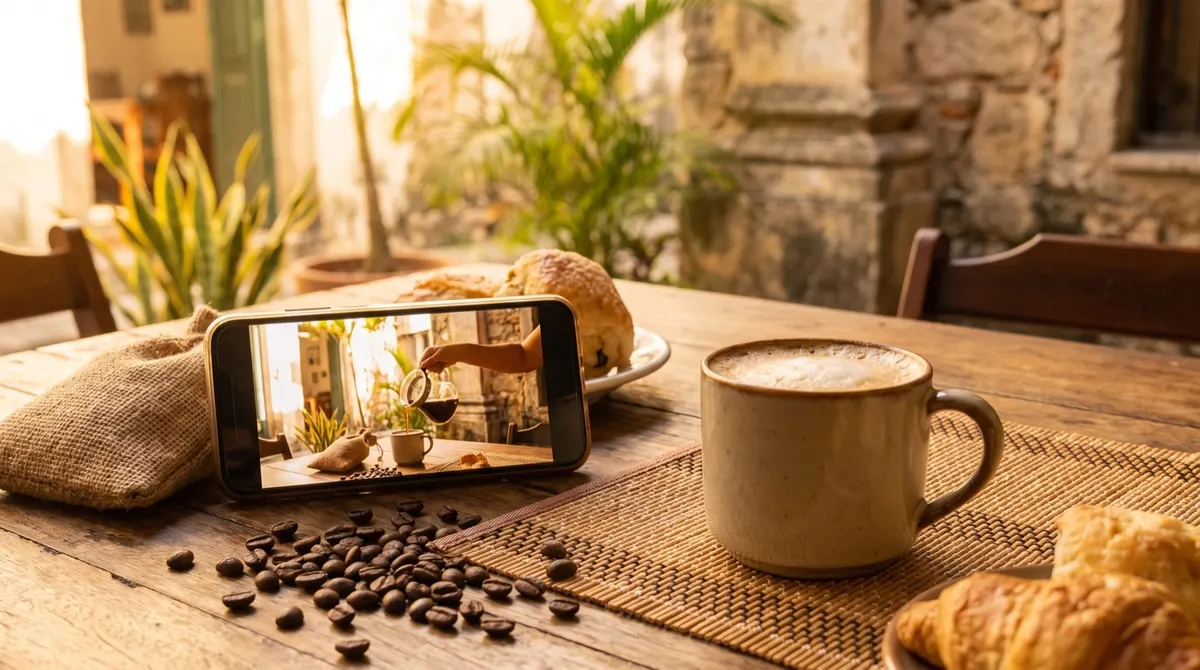
One single take, from bean to pour, with no cut. It is the most watched format, because it is calming and shows the real duration of the operation. Film at worktop height and let the gesture finish.
The taste reaction
It is only worth something if it is honest. A precise taste, acidity, bitterness, a fruity note, says more than an enthusiastic adjective. Actually drink before speaking, the two seconds of silence being the credible part of the shot.
The morning routine
Coffee is never alone: there is waking up, the kitchen, the first task of the day. This format sells the product through context, and it is the one brands reuse the longest.
The atmosphere of the cafe
For a cafe, the thing filmed is not the drink, it is the place: the sound of the room, the light, the seat you settle into. A well-shot atmosphere video fills tables on a Saturday.
The convenience angle for capsules
Here the question is neither taste nor origin, it is time. Show the real duration between the gesture and the cup, and what becomes of the used capsule, a question the audience asks systematically.
How creators actually film it
Seven settings that make the difference.
Filming near a window, since steam is only visible in backlight.
Using a light-coloured cup to show the colour, a dark cup showing nothing.
Pouring slowly, since a fast pour becomes illegible on screen.
Filming the crema close up in the first ten seconds, before it settles.
Putting the phone down rather than holding it, since preparation shots need stability.
Recording the gestures without music, then adding music in the edit.
And keeping the real kitchen, since marks on the worktop make the video credible.
Price per cup, the argument nobody films
Six concrete pieces of information that trigger the purchase.
The number of cups obtained from the bag, counted and stated.
The quantity used per cup, shown with a spoon, not described.
How long the bag lasts in a real household.
The price per cup compared with a coffee bought outside.
How the product behaves after opening, a week later.
And how to store it, a frequent question a video answers better than text.
Where the content is distributed
Six placements, with what they require.
The roaster's product page, first use and the most durable.
Paid advertising, which consumes variants rather than a single video.
Marketplaces, where video reduces questions about grind and size.
A cafe's own networks, where the aim is local footfall.
Screens in the room, a frequent use often forgotten in the contract.
And launch campaigns for a new origin, where several kitchens beat one studio.
What you cannot claim about coffee
Five precautions, to be validated with a lawyer and with the competent authority before the shoot.
Any health, energy or weight-loss claim falls under a regulatory framework and is checked.
Mentions of origin, certification and classification are quoted as they are, never rephrased.
A daily consumption recommendation is not the creator's business.
Comparisons with a competing brand commit the brand and have to be validated in writing.
And any statement about caffeine content has to come from the product's technical sheet.
What is filmed on a coffee
| Shot | What it triggers | The technical detail |
|---|---|---|
| The grounds falling | The suggested aroma | A dark background, raking light |
| The extraction | The gesture and the real time | No cut during the flow |
| The first sip | The suggested taste | A close-up at cup height |
What is prepared before switching the camera on
Two cups, a cloth, and hot water ready. The good take often comes on the third attempt, and the worktop must still be clean by then.
What is verified before talking about the product
An origin, a variety, a roast or a production method. Each is read on the bag and confirmed with the roaster, because a wrongly stated origin commits the brand.
Getting started in coffee UGC
Seven steps for building a portfolio in this niche.
Filming three different preparations with the coffee you already have at home.
Handling one objection per video: too bitter, too long, too expensive, too complicated.
Taking care of the pouring sound, which is the category's signature.
Building a constant setting, the same table and the same light, to create a series.
Approaching local roasters before big brands, since their decision cycle is shorter.
Offering a batch of three videos per origin rather than an isolated one.
And keeping the rushes, often bought by the brand when it changes its packaging.
One last marker: in Brazil a coffee video does not sell a taste, which does not cross the screen. It sells a place in a day: the moment, the gesture, the person you pour for. That is why the second cup counts more than the first.