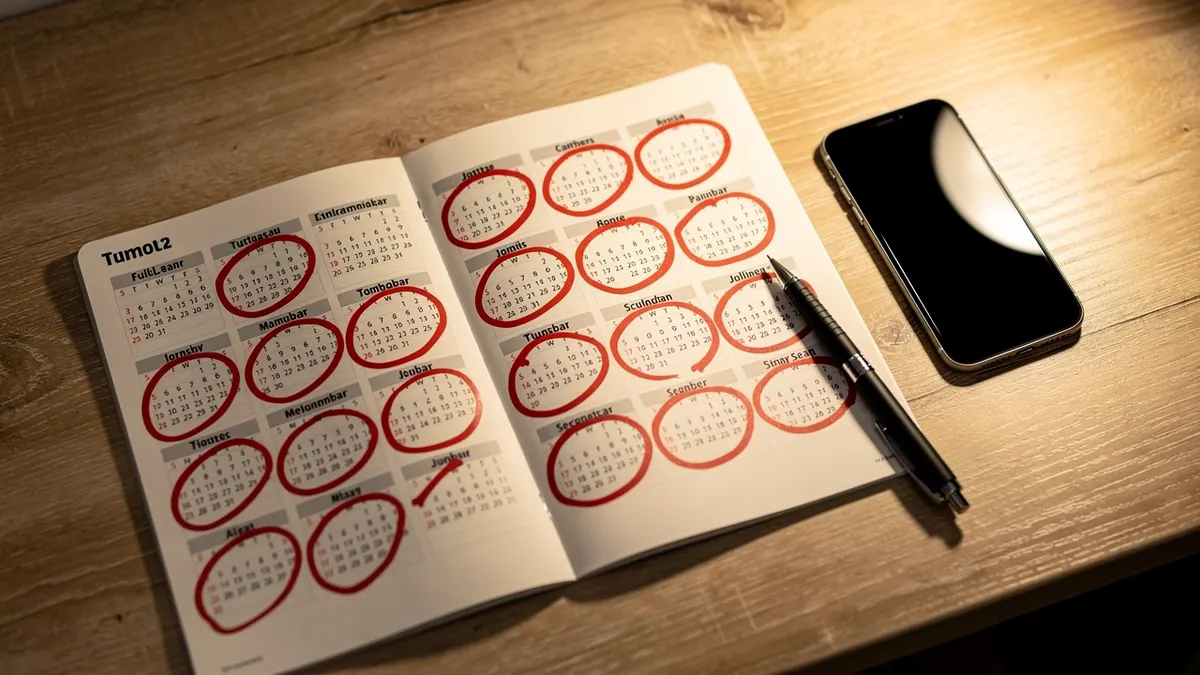
The commercial peaks that count, when to commission the creatives, and how to plan a year of content in one afternoon.
The six-week rule
Three reasons why six weeks is the right minimum lead time.
The brief, the choice of creator and the sending of the product already take two weeks, before any shoot.
Shooting and editing take two more, with a margin for one revision.
And the last two serve for approvals, language versions and setting up the advertising.
One consequence: a campaign decided three weeks before the peak will not be ready, it will be botched. Better to aim at the next peak.
The Spanish commercial year
Six moments carrying most of the volume.
January, a period of sales and restart, to be prepared in November.
Spring, with the local festivities and regional events, whose dates vary from one community to another.
Summer, very uneven by sector, strong for tourism and weak for the rest.
The September return, short and regional.
November, the month of the big promotions, to be prepared from September.
And December, split between the gifts of the start of the month and those of the January festivities, a local specificity many foreign brands forget.
The Spanish August
Four facts to build into the calendar rather than endure.
Decisions are not taken: the people who approve are away.
Creators are available, but products arrive badly and deliveries slow down.
The audience's attention moves outdoors, to holidays and travel.
And September campaigns therefore have to be approved before the end of July, without exception.
One production consequence: August is the best month to shoot undated content, the kind that will serve all the following year.
Content that does not expire
Five types of video to produce as a priority, because they can be re-published.
Use demonstrations, with no mention of price or promotion.
Answers to frequent questions, which stay valid for years.
Comparisons between two formats of the same product.
Service videos: delivery, returns, maintenance.
And generic cutaways, which are always missing at the edit.
One proportion rule that works: half the annual budget on undated content, the other half spread over the six moments listed above. That split avoids the classic trap, a whole year of production consumed by two weeks of promotions.
What is planned over a quarter
| Block | What you prepare | Load |
|---|---|---|
| The retail dates | Videos with no price, no date | Two shooting days |
| The evergreen catalogue | Product demonstrations | One day a month |
| The answers to questions | One video per recurring objection | Half a day |
What can slip without damage
An evergreen video can wait a week. A date-bound video cannot: it is shot ahead or not at all.
What is reviewed every month
What was published, what worked, and what is still in reserve. A calendar nobody reviews becomes a list of good intentions in six weeks.
What to note at the end of each period
Four pieces of information to record while the memory is fresh.
The real date of last approval, which will become your marker the following year.
What was missing in content, almost always the out-of-stock video and the one answering questions received.
The real time between order and delivery from the creators.
And the creatives that lasted longer than the others, the only indicator worth following from one year to the next.
One last marker: a content calendar is not there to fill boxes, it is there to make sure nobody decides in a rush. The question to ask in January is not what will be published in November, it is by which date November's script has to be signed.