A large share of the country's jewellery is quietly made here, alongside olive oil and dense tourism. Three categories, a tiny creator market.
Three markets in a small city
Six client categories.
Jewellery workshops and manufacturers.
Distributors and exporters.
Oil producers and processors.
Accommodation and tourism operators.
Restaurants and food shops.
And shops in the historic centre.
What jewellery orders
Six frequent formats.
A filmed product sheet per reference.
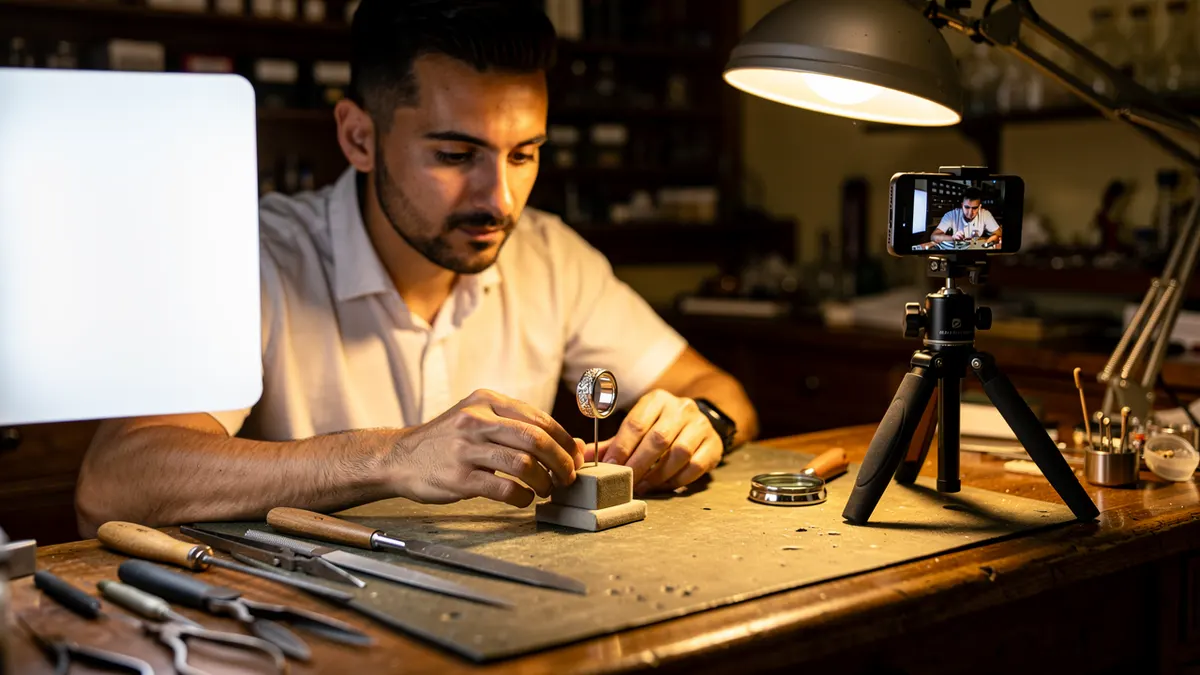
A making-of or workshop video.
Content for an online shop.
A video for a trade fair.
A collection presentation.
And communication toward a foreign buyer.
Filming jewellery, the local speciality
Seven technical points.
A wide, diffuse source, never a spot.
A neutral background that does not tint the metal.
Control of what appears in the reflection.
A tripod and focus set before the take.
Cleaning the piece between takes.
A sense of scale on a hand or a known object.
And a colour faithful to the real material.
What a workshop expects from a provider
Six requirements.
Not handling pieces without permission.
Respecting the confidentiality of unreleased models.
Working without interrupting production.
Delivering images usable in store and online.
Supplying several framing formats.
And having it approved before release.
Oil and food
Six regular clients.
Mills and cooperatives.
Oil and preserve brands.
Regional distributors.
Grocers and markets.
Restaurants.
And exporters.
Heat is a production constraint
Six precautions.
Shoot early in the morning or late in the day.
Keep the gear in the shade between takes.
Bring extra batteries.
Bring water for the whole crew.
Have an air-conditioned fallback space.
And protect the lens from dust.
How to build a price here
Six lines to show.
Preparation and setting up the rig.
The half-day or day of shooting.
The number of references filmed.
The number of revisions included.
The rights line, with duration and territory.
And the option of a subtitled version for export.
How to film a historic site
Six rules that apply here.
Settle the access conditions in writing beforehand.
Shoot at the hours when it is empty.
No tripod without explicit permission.
No person in frame without consent.
No added light on fragile surfaces.
And approval before any commercial use.
What an Andalusian heritage city orders
| The buyer | Their typical order | Their window |
|---|---|---|
| A courtyard guesthouse | The place and the coolness | Spring |
| A leather or silver craftsperson | The gesture and the material | All year |
| A restaurant in the centre | The plate and the terrace | Off-service |
What summer heat changes
From June to September, exteriors are unusable between noon and seven in the evening. Shoots are set early in the morning, and a client unaware of that needs to learn it before fixing a date.
What a courtyard demands in settings
A very wide gap between shade and sky. Exposing for faces and accepting a bright sky gives a usable image, whereas exposing for the sky gives black silhouettes.
What the platform brings
On UGC MATCH, joining is free and there is no subscription: you declare your languages, you are visible by category and country, and the order keeps a record of the brief and the delivery. The brand pays at ordering, the funds are not released straight away, and payment goes out on approval. The platform retains 10% of the price on the creator side, who therefore keeps 90%, and charges the brand a 6% service fee, with a minimum of 1.50 EUR.
One last marker: in this city, the rare skill fits in one sentence. Knowing how to control a reflection is worth more than a recent camera body.
Sources
- Agencia Tributaria, Spanish tax authority
- Spanish Social Security, self-employed registration (RETA)
Checked on 26 August 2026. Thresholds and rates change: where this guide and the official source disagree, the official source is right.