A skincare brand from Bogotá has just opened a US entity, a warehouse in Doral and an Instagram account in English. Its founders speak Spanish to each other and to their first American hires. Their customers in Miami speak both, switch mid-sentence, and can tell in three seconds whether a video was made by someone who lives that way or by someone who learned Spanish in a classroom. That brand's first creator brief is the Miami job, and it is not a translation job.
Miami is where Latin American companies enter the United States and where American companies reach Latin America, and the creator economy here is built on that traffic. The product a creator sells in this city is not "content in two languages". It is credibility in a market that is bilingual by default and suspicious of anyone who pretends to be.
The client is often not from here, and not from the US either
Miami's brand clients come in three kinds, and they do not want the same thing.
| Client | What it is buying | What it does not know yet | Language it needs |
|---|---|---|---|
| Latin American company launching in the US | An American read of its brand without losing its origin | The US disclosure rule, the regulated words, the local tone | English first, Spanish second |
| American brand targeting Hispanic consumers | Credibility with an audience that has seen every clumsy attempt | Which Spanish, and which references land in Miami | Spanish first, sometimes the mix |
| Local direct-to-consumer brand | Volume, speed, a face that fits the feed | Nothing the creator needs to teach it | Whatever its audience speaks |
For the first two, the creator is a cultural interpreter as much as a filmmaker. The founder from Bogotá needs someone to tell her that the joke does not land in English, that the packaging claim needs a different word in Miami Spanish than in Colombian Spanish, and that the American buyer will read "natural" as a promise the brand may be asked to back up. That advice is worth more than the video, and it is what earns repeat work.
Bilingual is not two versions of the same script
Brands often arrive with a script in one language and ask for "the same in the other". Miami videos rarely work that way. The Spanish version is not a translation of the English one; it has a different opening, a different reference and often a different call to action, because the two audiences are not in the same relationship with the brand. A creator who offers to write the second version rather than translate it is offering what no translation vendor can, and should price it as a second video, not as a subtitle track.
Code-switching is a format, and it has to be ordered
The same applies to code-switching. Content that moves between English and Spanish inside one sentence is how much of the city talks, and it can be the most effective format for a local audience, but it is unusable for a national campaign in either language. The brief should say which of the three it wants, English, Spanish or the mix, and a creator should ask when it does not.
Two federal rules, one Florida fact
Whatever the language, the disclosure rule is federal, applies to the Spanish caption as much as to the English one, and expects the Spanish caption to carry a Spanish disclosure. The Federal Trade Commission's guidance requires a clear disclosure of a material connection with the brand, payment, gifted product or business relationship, placed with the endorsement and hard to miss, in plain terms. The guidance adds a line that matters more here than anywhere: the disclosure should be in the same language as the endorsement itself. A Spanish post needs its disclosure in Spanish, not an English "sponsored" pasted onto it, and a creator who says so to a brand new to the US market is doing part of its compliance for it.
New arrivals tend to treat the rule as an American formality their audience ignores; the regulator does not, and the post is aimed at US consumers. The tax paperwork is federal too. A US business paying an independent creator reports it to the IRS on Form 1099-NEC once payments reach the threshold, $2,000 under the 2026 instructions. A brand paying from abroad through its new Florida entity will ask for a W-9 like any other US company. And Florida itself is one of the states the Texas Comptroller lists as levying no personal income tax, which is one reason creators in Miami keep more of the same gross than creators in New York or Los Angeles, and one reason day rates here can be competitive without being low.
Hospitality, cruise lines and the content that is filmed on site
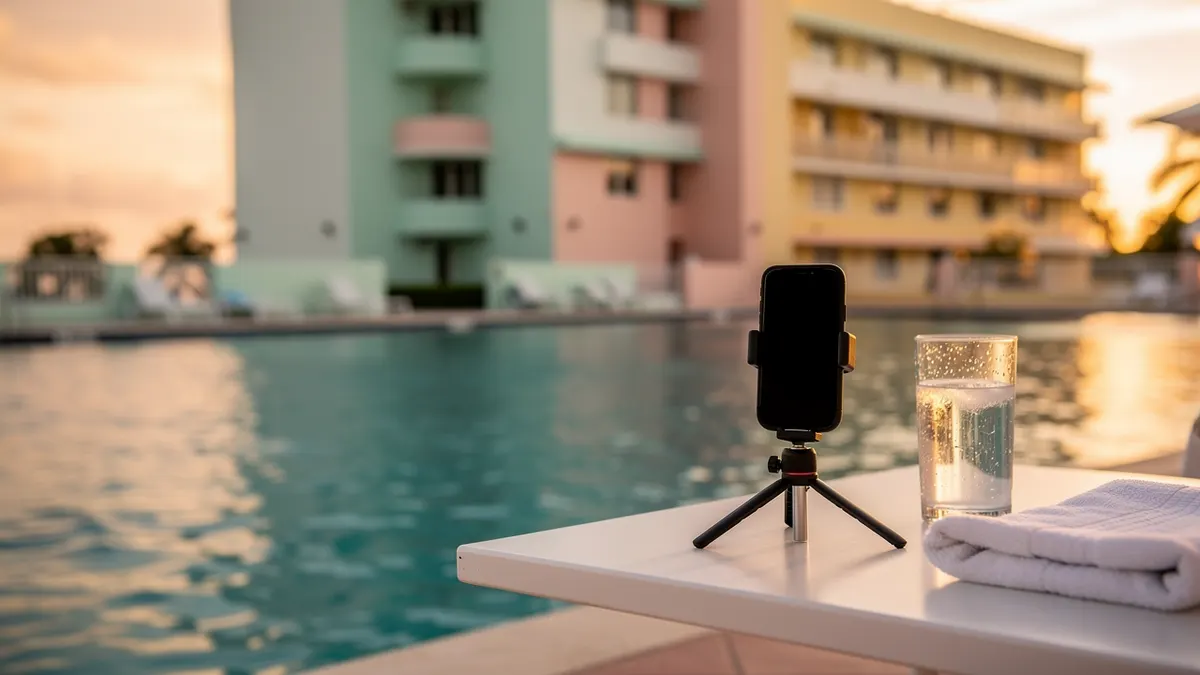
The other engine of Miami's creator market is that the city is a product. Hotels, restaurants, cruise operators, event venues and the real estate around them buy first-person content filmed on location, from creators who can be there on the day, in the light the city is known for. This is the work that cannot be shipped in a box: the room, the pool, the terminal, the night out.
That work has its own conditions. A hotel shoot is scheduled around occupancy, not around the creator; a cruise embarkation has security rules that decide where a phone can be raised; a restaurant wants the dish filmed at service, with no time for a second take. The creator who thrives can film fast in a live environment and leave, which is closer to news gathering than to studio work. The mechanics of filming inside a working venue are the ones to master before pitching hospitality clients here.
Hurricane season is a scheduling clause
From June to November, the calendar in South Florida has a variable no other American market plans around in the same way. Serious brands write it into their content plans: location shoots are front-loaded into the dry months, and summer briefs come with flexibility on dates. A creator should do the same: a location shoot booked in September carries a rescheduling clause, and the deposit is not refunded because the sky changed. It is an operational point, not a dramatic one, and clients respect the creator who raises it first.
Sources
- Federal Trade Commission, Disclosures 101 for Social Media Influencers
- IRS, Instructions for Forms 1099-MISC and 1099-NEC (12/2026)
- Texas Comptroller of Public Accounts, Fiscal Notes, February 2016: Starting a New Business (the five states without personal income tax, Florida among them)
Checked on 19 September 2026. This guide is not legal or tax advice. Where this guide and the official source disagree, the official source prevails.