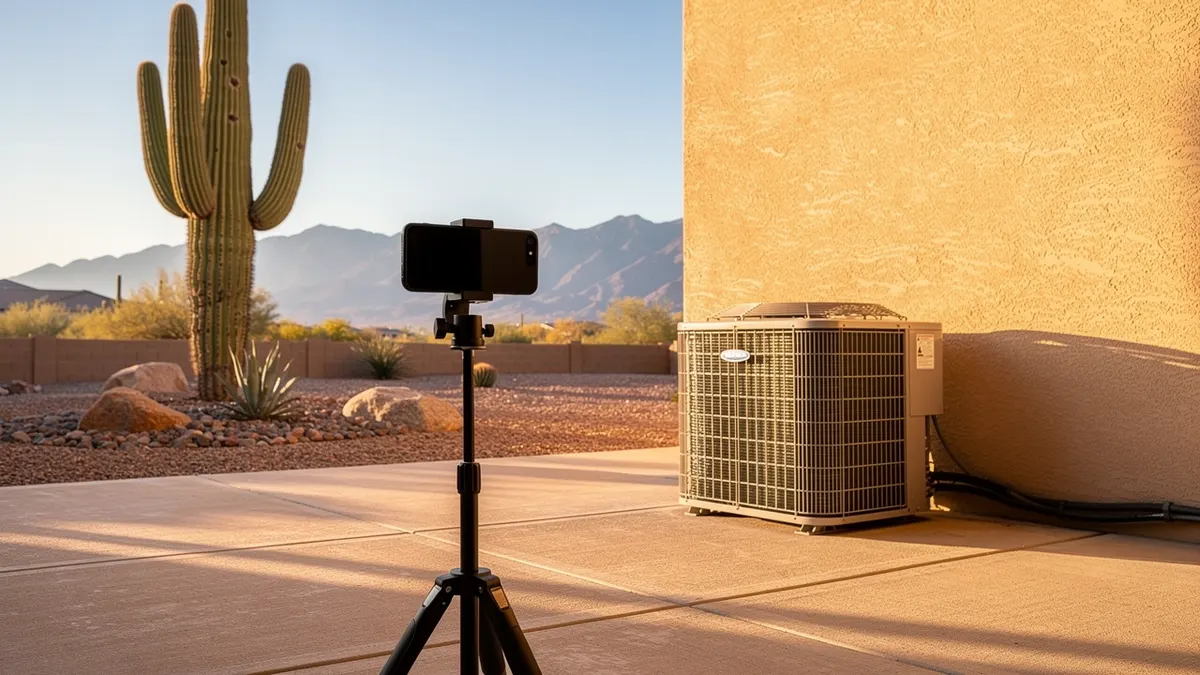
The owner of an air-conditioning company in the East Valley wants a video by Friday because the first week of real heat is coming and that is when the phone rings. She has never hired a creator, she has a marketing agency that runs her search ads, and what she wants is a person who looks like her customer explaining, on camera, why the annual tune-up is worth booking before June. The agency found the creator on a marketplace. The brief is two paragraphs. The product is a service, the customer is a homeowner, and the video will run in the same ad account as the coupons.
That is a Phoenix job, and it is the shape of much of the creator work in this metro. The local economy that hires creators here is built on services to households, on the franchises that deliver those services, on healthcare and on real estate, in a region where many people arrived recently, are retired or come for the winter. A creator who has only made product videos is learning a second craft.
The service brief: no unboxing, a person and a problem
The buyer is a business owner or a franchisor
Two buyers dominate. The first is the owner of a local business, a dentist, a plumber, a pool company, a med spa, a moving company, who has a budget, an agency and no time. The second is the marketing department of a franchise system, which orders content for dozens of local units that all have to look like the brand and each have to look local. The first buyer wants speed and a video that sounds like a neighbor, whereas the second wants consistency and brand compliance across a program, and behaves like the corporate buyers the Dallas guide describes, with a vendor process and an approval chain. A creator who can serve both, the neighbor's tone inside the franchisor's rules, can serve most of the local briefs.
What a service video has to do
There is no product to hold. The video has to make a service visible: the problem the customer has, the moment they decide, what the visit is like, what changes afterward. The creator is playing the customer, and the credibility comes from being plausibly that customer, a homeowner, a parent, a retiree, rather than a presenter. Claims are the trap: a med spa or a dental practice answers to rules of its own, and "results" in a video are a matter for the business and those rules, not for the creator's enthusiasm. Say what happened; do not promise what will.
| Service category | What the video shows | What the buyer checks first |
|---|---|---|
| Home services (HVAC, plumbing, pool, pest) | The problem at home, the call, the visit, the relief | That it looks like a real house in the metro, in the right season |
| Health and med spa | The decision, the visit, the experience | Claims and before-and-after language, cleared by the business |
| Real estate and moving | The move, the neighborhood, the first week | That the neighborhood is real and named correctly |
| Franchise units | The same story, localized per unit | Brand compliance across the whole program |
Heat, light and the two seasons
Phoenix has a season in which outdoor filming is done before nine in the morning and a season in which the whole country seems to be visiting. Summer shoots happen early, indoors or in the shade, with the product or the service where the heat is the point: nobody films an air-conditioning ad in February, and nobody films a pool company in the shade. Winter is the reverse: mild, bright, and full of seasonal residents and visitors, which is when hospitality, golf, real estate and healthcare for retirees send their briefs. A creator's availability calendar here is the inverse of a Northern one, busiest when the rest of the country is cold.
The light is the desert's: hard, bright and unforgiving at midday, soft and long at the ends of the day. Creators who work here film early and late, and the ones who film at noon deliver footage the buyer will not use.
The metro is wide, and the customer lives in a suburb
The Phoenix metro spreads across a valley of separate cities, and a brief that says "Phoenix" may mean Scottsdale, Mesa, Chandler, Gilbert or Glendale, each with its own customer and, for a franchise, its own unit. On-site work means driving, and the drive belongs in the quote, as it does in every spread-out market in this cocoon. It also means that the "real house in the metro" the buyer wants is the creator's own suburb more often than not, and a creator whose home looks like the customer's home has a set that no studio can replace.
Pricing a service video
Service videos are priced like product videos, production plus usage plus extras, with two adjustments. The usage is often local and long: a plumber's video runs in the same local ad account for a year, so the license term should say a year and be priced as one, rather than as a 30-day social post. And the volume comes from franchises, where a program of localized videos across units is the job, priced per deliverable with a program rate, which is the volume logic the Dallas guide describes; the rates guide for the United States gives the four parts of the quote itself. What usually stops a creator from getting the franchise program is not the price; it is that the portfolio has no service video in it. A franchisor cannot picture a program from unboxings. One spec service video, marked as a concept, filmed in the creator's own kitchen with a real problem and a real visit, is what a franchisor can picture across forty units.
Checked on 20 September 2026. This guide is not legal or tax advice.